Hunterbrook Media’s investment affiliate, Hunterbrook Capital, does not have any positions related to this article at the time of publication. Positions may change at any time. Full disclosures below.
A Brazilian appeals court judge has ruled that a legal dispute between traditional farming communities in the Amazon and international firms over carbon credit sales must be heard in federal court. The decision sets a potential legal precedent that could offer greater protection for often vulnerable communities — and greater stability for companies looking to invest.
The ruling arose from a lawsuit filed by two forest-community associations, Mapuá and Terra Grande-Pracuúba Extractive Reserve Associations, against several well-known companies, including Air France (EPA:AF), Banco Santander (BME:SAN), Deloitte, and Barilla do Brasil.
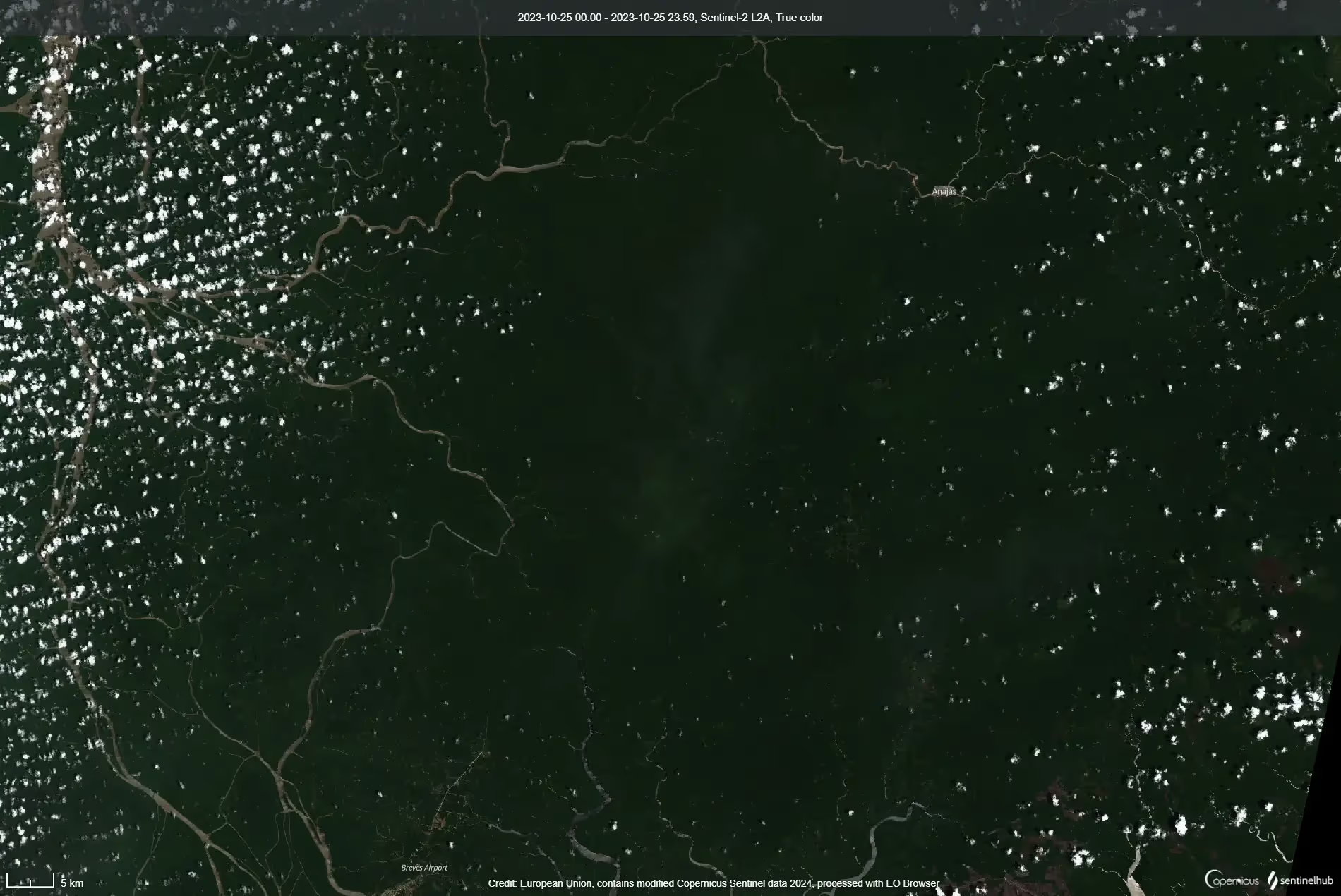
The communities allege that third-party firms, acting on behalf of the defendant companies, improperly exploited their forests to generate carbon credits and boost green credentials.
The carbon credit projects by Bio Assets, Ecomapua Conservação Ltda and Sustainable Carbon were certified by Verra, the world’s largest certifier of voluntary carbon offsets, based in Washington, DC. A recent investigation by The Guardian, Die Zeit, and SourceMaterial found that more than 90% of Verra’s rainforest offset credits are “likely to be ‘phantom credits’ and do not represent genuine carbon reductions.”
In the case of the Mapuá and Terra Grande-Pracuúba Extractive Reserve Associations, community leaders allege that the carbon credits were appropriated by third parties and sold to companies that did not conduct necessary due diligence.
In his ruling, Judge Ricardo Villas Bôas Cueva, who sits on Brazil’s highest appellate court, did not definitively determine the merit of the claims. But he did decide that such decisions are, in his view, the jurisdiction of the federal court system, as opposed to the state court system.
Adriano Camargo Gomes, one of the lawyers representing the communities, told Hunterbrook Media that the judge’s decision, while not legally binding, would set a legal precedent for similar future cases.
“Because it’s a higher court, it tends to be followed,” he said.
Federal courts in Brazil are generally seen as more independent and less subject to pressure from local interest groups compared to state courts. So the decision may allow Brazil to establish national precedents regarding a carbon credits market estimated to be worth billions in the coming years — rather than relying on a patchwork of local decisions.
Brazil is home to around two-thirds of the Amazon Rainforest and proponents of carbon credit markets have hailed the burgeoning sector as a way to protect and monetize South America’s forests. A 2022 report by McKinsey noted that Brazil had “about 15% of the potential to abate or sequester carbon from the atmosphere using natural climate solutions.”
The industry, however, has already faced scrutiny, with traditional communities accusing companies of harassment and engaging in land grabbing to produce fraudulent credits.
Rodrigo Fialho Borges, a professor at Brazil’s Getulio Vargas Foundation Law School and partner at PGLaw, told Hunterbrook Media that, in his view, given the Brazilian Amazon’s chaotic land registry system and well known history of violence, the companies buying the carbon credits had not exercised sufficient forethought.
“The companies want to buy credits to, among other reasons, improve their image, to say that they are carbon neutral,” said Borges, who co-authored a legal report used in the case. “You have to do due diligence.”
The appellate judge’s decision may help standardize the process through which failures of due diligence are adjudicated — as Brazil, South America’s largest country, looks to accelerate its position as a hub of green investment.
In December, Brazilian lawmakers voted a bill in the lower house to regulate carbon credit sales that is currently with the Senate.
The bill would establish a “cap-and-trade” system, in which projects that would reduce or remove carbon dioxide from the atmosphere would sell tradable permits to companies that produce emissions.
Last week, Helder Barbalho, governor of the Amazonian state of Pará where the legal dispute took place and where the COP30 climate conference is due to be held in the state’s capital Belém, was in New York at a Brazil-USA investment summit talking up opportunities in his state’s carbon credits market and other green investment possibilities.
Hunterbrook Media contacted Verra, Air France, Santander, Deloitte and Barilla to ask if they believed they had conducted appropriate due diligence regarding the carbon credit projects in Pará state.
A member of Verra’s communications team told Hunterbrook that they “would be looking into this query” but as of publishing had offered no further response.
Santander Brasil’s press relations area told Hunterbrook that they had not been officially informed of the complaint and therefore would not comment.
Barilla’s media relations team said that “Barilla was neither formally served nor notified of the arguments and discussions involved in the lawsuit. Therefore, we have no further comments at this time.”
“For carbon compensation projects we exclusively refer to the VCS program, which represents one of the world’s most widely used and recognized offsetting programs and includes projects that must follow a strict assessment process. To the best of our knowledge, all procedures related to the purchase of carbon credits were regular.”
The other companies did not reply.
Sam Cowie is a British journalist, producer and consultant based in São Paulo, Brazil, the country where he has lived on and off since 2011. His long-reads, investigations and documentaries have been published by Bloomberg, The Financial Times, The Associated Press, The Guardian, Al Jazeera and by Brazilian outlets Folha de S.Paulo, Repórter Brasil and Valor Econômico. He is the recipient of several grants and fellowships including most recently from the Earth Journalism Fund and the Pulitzer Rainforest Foundation.
Sam Koppelman is a New York Times best-selling author who has written books with former United States Attorney General Eric Holder and former United States Acting Solicitor General Neal Katyal. He helped build Fenway Strategies into one of the preeminent strategic communications firms in the country—with side quests speechwriting for Michael Bloomberg, running the surrogate remarks operation on the Biden-Harris campaign, and co-founding Mayday, which is now one of the leading information providers on how to access reproductive health care in states with bans. Sam has published in the New York Times, Washington Post, Boston Globe, Time Magazine, and other outlets — and occasionally volunteers on a fire speech for a good cause. He has a BA in Government from Harvard, where he was named a John Harvard Scholar and wrote op-eds like “Shut Down Harvard Football,” which he tells us were great for his social life.