Hunterbrook Media’s investment affiliate, Hunterbrook Capital, does not have any positions related to this article at the time of publication. Positions may change at any time.
One day they were there. Then, they weren’t.
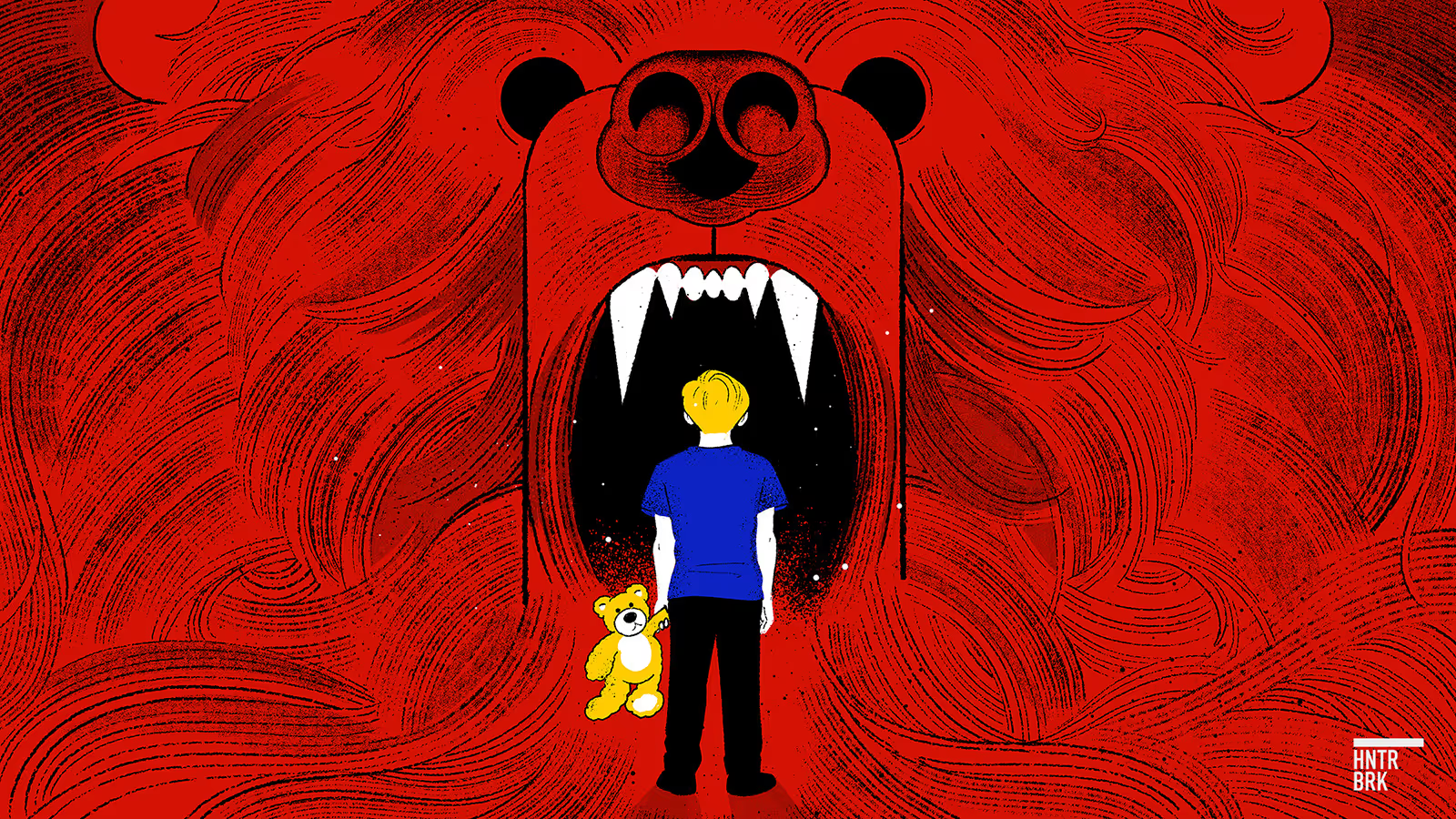
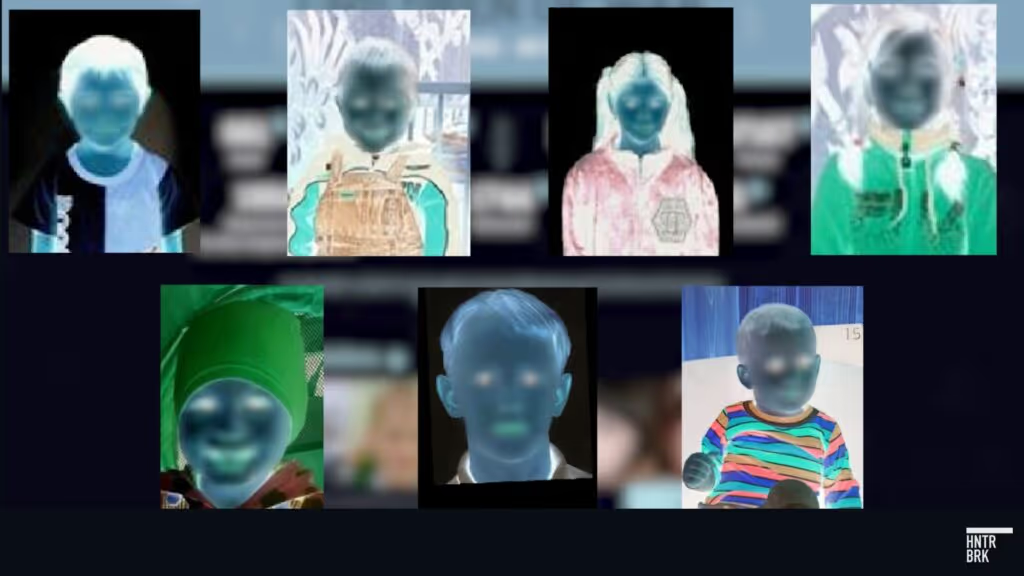
Ukrainian kids, advertised as Russian orphans on an adoption website. Hunterbrook identified the children and provided the information to Ukrainian prosecutors. Then, the Kremlin erased the entire site.
In total, Hunterbrook Media identified 12 Ukrainian children between the ages of six and 15 listed for adoption on two Russian websites, presented as Russian orphans. Hunterbrook cross-referenced 35,164 profiles on adoption sites against Ukraine’s official missing children database.
AI image recognition software and open-source intelligence tools verified the likely legitimacy of the matches. So did the Ukrainian National Police, the country’s primary civilian law-enforcement agency.
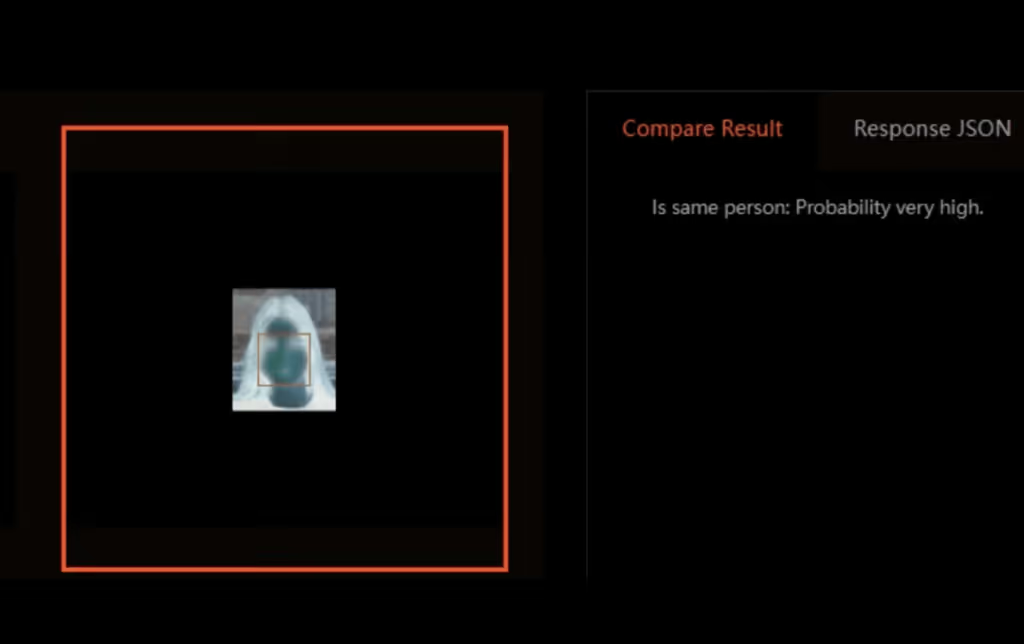
In response to these findings, the Ukrainian National Police wrote to Hunterbrook in August to say it was investigating the cases of the missing children alongside the Security Service of Ukraine.
Four of the children have now been found, the letter said, and their cases closed.
Then, the Russian data vanished from both of the adoption websites.
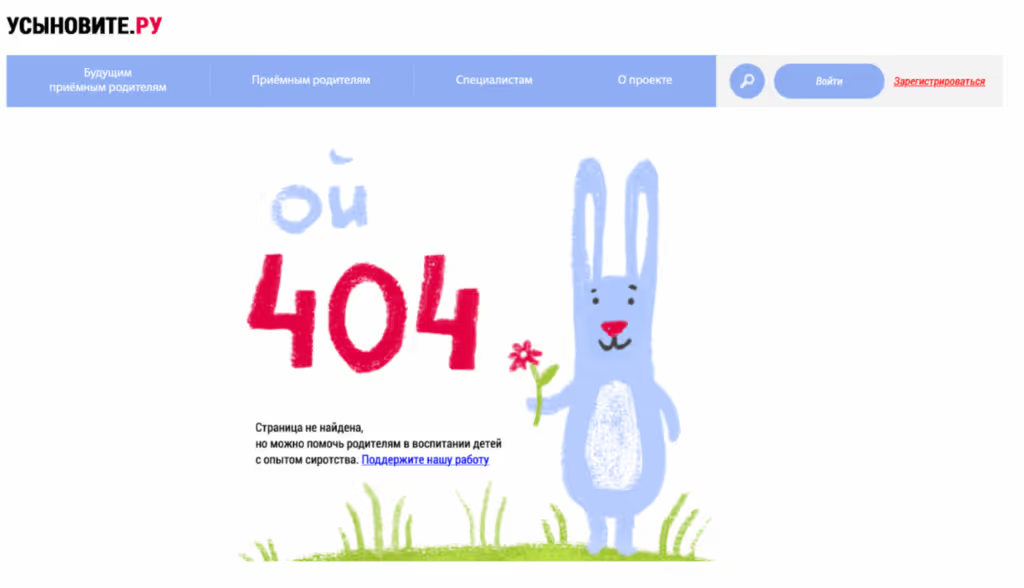
Ukraine’s Prosecutor General’s Office, which received Hunterbrook’s findings, is building a genocide case in which child abduction is a central pillar. The deliberate erasure of records tied to those transfers could help establish genocidal intent.
“The only logical inference from deleting such data is that the goal is to prevent them from ever being returned to Ukraine and have them raised as Russians,” Martin Flaherty, professor of international human rights law at Fordham University, told Hunterbrook. “If the purpose was humanitarian, e.g., to remove them from a warzone, there would be no reason to hide or delete data identifying who they are.”
The U.N. International Court of Justice made a ruling conveying a similar sentiment in 2015 — declaring that forcibly transferring children “can also entail the intent to destroy the group physically” as it affects “the group’s capacity to renew itself.”
The deletion of the profile pages appears to be part of a systematic pattern.
Save Ukraine, a nonprofit leading efforts to return stolen children, reports that Russian data on Ukrainian minors routinely disappears after being exposed.
“Once a Ukrainian child enters the Russian adoption system, their name, date of birth, and documents are changed,” Natalia Savchenko, head of communications at Save Ukraine, told Hunterbrook. “After that, tracing, finding, and rescuing them becomes almost impossible.”
The scale of the crisis is immense. Russia admitted in 2022 to deporting 744,000 children from Ukraine to Russia. Ukraine’s Children of War database has identified 19,546 of them by name. Only 1,762 have been returned as of November 1.
Since the invasion, Russia has forcibly transferred tens of thousands of Ukrainian children to “education” and military sites across Russia. There are hundreds of these sites, where children face re-education campaigns denying Ukraine’s existence as a separate nation. The International Criminal Court issued arrest warrants in 2023 for President Vladimir Putin and Maria Lvova-Belova, the so-called “Children’s Rights Commissioner,” on charges of war crimes for the forcible transfer of Ukrainian children.
Russia has adapted its laws to absorb these children.
In May 2022, Putin signed a decree allowing Russian families to apply for citizenship on behalf of Ukrainian orphans without Ukraine’s permission. Following the annexation of four Ukrainian regions that October, children in those territories were deemed Russian citizens by default. By 2024, children refusing Russian citizenship faced deportation. The U.N. condemned these moves as violations of the “fundamental principles of child protection.”
For Ukraine, recovering these children may be a matter of national survival.
Ukraine has one of the world’s lowest birth rates. The population has declined by nearly 25% since the invasion began. The U.N. projects Ukraine’s population could shrink to 15.3 million by 2100. That’d be half the population of Texas.
The longer children remain in Russia, the deeper their forced assimilation becomes. One 11-year-old returned to Kyiv calling Ukrainians “Nazis,” repeating his Russian foster family’s language. Thousands are reportedly being prepared for military service against their homeland.
The U.S. has promised to act. First Lady Melania Trump sent Putin a letter in August urging the return of Ukrainian children. President Trump reportedly promised President Zelenskyy to work closely with both parties to help make sure children were returned home. Then Trump’s administration cut funding to Yale’s Humanitarian Research Lab, a leading organization tracking the abducted children to over 100 sites in Russia.
Still, Ukraine is working to bring children home, with all the evidence it can find.
If you have any of your own, please send it to ideas@hntrbrk.com.
Nazar Solomakha is a reporter and lawyer focused on corporate accountability, sanctions, and export controls. He has contributed to sanctions designation efforts and prepared legal submissions before national and international courts concerning individuals and companies implicated in fueling Russia’s war against Ukraine. Nazar has passed the New York Bar and is a member of the National Union of Journalists of Ukraine. He holds an LLM from Columbia University, a Master 2 in American business law from Paris 1 Panthéon Sorbonne University, and an LLB from the National University of Kyiv Mohyla Academy.
Blake Spendley joined Hunterbrook from the Center for Naval Analyses (CNA), where he led investigations as a Research Specialist for the Marine Corps and US Navy. He built and owns the leading open-source intelligence (OSINT) account on X/Twitter, called @OSINTTechnical (over 1 million followers), which also distributes Hunterbrook Media reporting. His OSINT research has been published in Bloomberg, the Wall Street Journal, and The Economist, among other top business outlets. He has a B.A. in Political Science from USC.
Sam Koppelman is a New York Times best-selling author who has written books with former United States Attorney General Eric Holder and former United States Acting Solicitor General Neal Katyal. He helped build Fenway Strategies into one of the preeminent strategic communications firms in the country—with side quests speechwriting for Michael Bloomberg, running the surrogate remarks operation on the Biden-Harris campaign, and co-founding Mayday, which is now one of the leading information providers on how to access reproductive health care in states with bans. Sam has published in the New York Times, Washington Post, Boston Globe, Time Magazine, and other outlets — and occasionally volunteers on a fire speech for a good cause. He has a BA in Government from Harvard, where he was named a John Harvard Scholar and wrote op-eds like “Shut Down Harvard Football,” which he tells us were great for his social life.