Hunterbrook Media’s investment affiliate, Hunterbrook Capital, does not have any positions related to this article at the time of publication. Positions may change at any time. Full disclosures below.
- A new DJI update enables everyday operators to fly their drones over and into airports, military bases, sensitive infrastructure, wildfires, and national no-fly zones in the United States.
- Hundreds of sensitive-site operators may be forced to deploy counter-drone solutions. The update comes just days after a DJI drone crashed into a firefighting waterbomber over California.
- DJI promises to place “control back in the hands of the drone operators, in line with regulatory principles of the operator bearing final responsibility” — and tells Hunterbrook that it has given “authorities the tools they need to enforce existing rules.”
- DJI, by one estimate, controls 90% of the global consumer drone market. The company currently faces the risk of a total ban in the U.S.
DJI, the world’s leading drone manufacturer, announced today that it will remove “Restricted Zones” from its Fly and Pilot flight apps in the U.S.
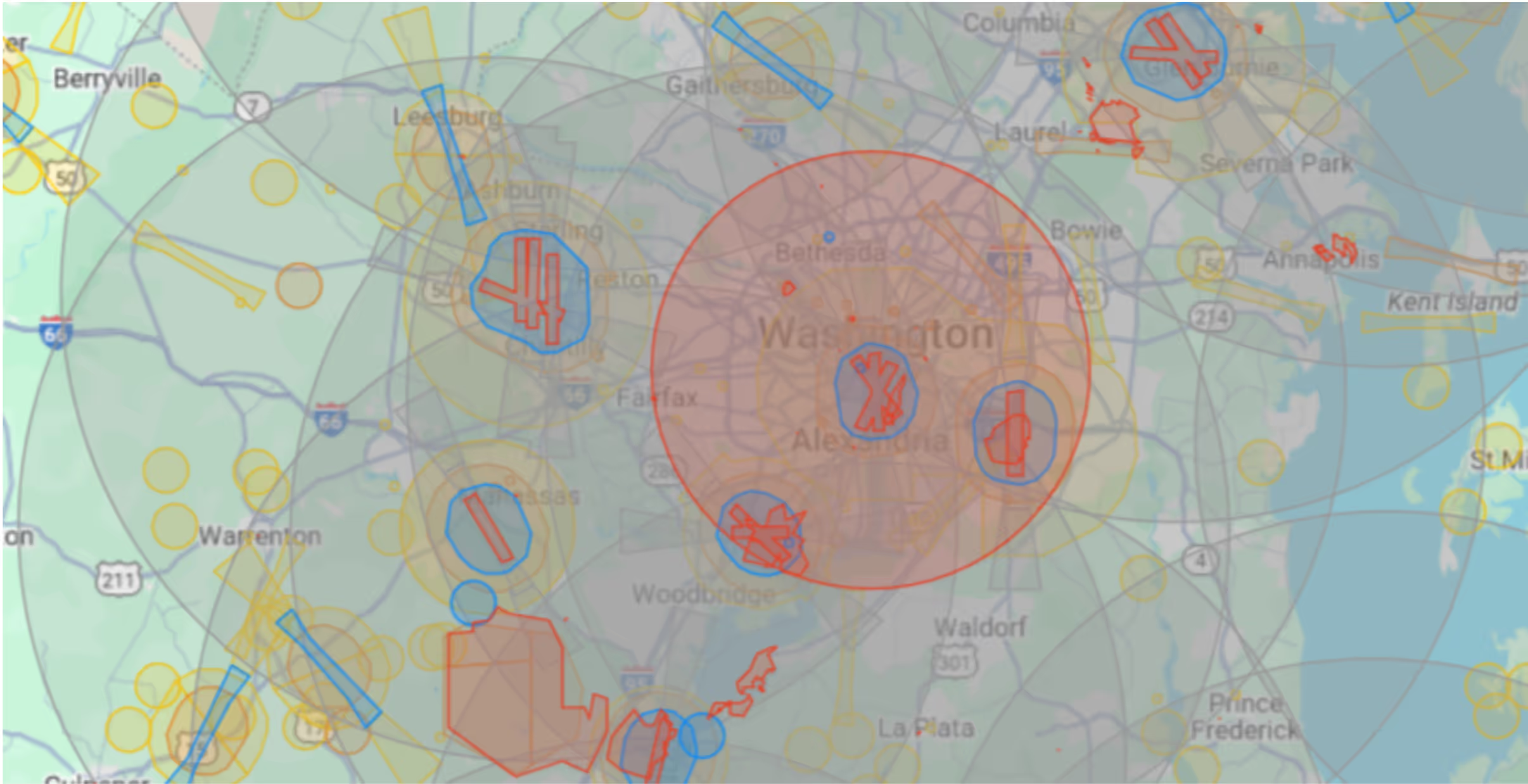
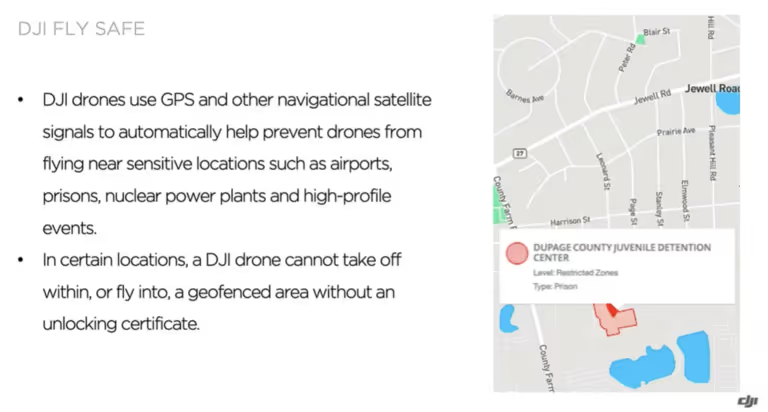
DJI’s Restricted Zones reflect restricted airspace where drone use is heavily limited or entirely prohibited due to safety, security, or legal concerns. These zones are defined within DJI’s geofencing system and typically include locations such as airports and military bases, and sensitive infrastructure like nuclear power plants, prisons, and government facilities. The zones may reflect a mix of state and federal law.
The FAA’s temporary flight restrictions were also enforced in certain areas during events, emergencies, or VIP movements. Government authorities may implement national or local no-fly zones for public safety or security. In these zones, DJI drones were unable to take off. If a drone flew into the border of a zone, according to DJI, “it will automatically decelerate and hover in place.” If a drone somehow managed to enter the zone, “it will automatically land … during the landing, the person operating the unmanned aerial vehicle (UAV) will only be able to move the UAV in horizontal directions and unable to ascend or descend.” In some cases, users can apply for authorization through DJI’s system to override restrictions, depending on local regulations and specific use cases.
After today’s DJI update, all that users will receive is an “in-app alert” notifying them that they are “flying near FAA-designated controlled airspace.”
DJI said the update would “place control back in the hands of the drone operators,” claiming it is “in line with regulatory principles of the operator bearing final responsibility.” DJI added that the new system has been active in the U.K. and several EU countries since January 2024.
Notably, any person can walk into a Best Buy and walk out with a DJI Mavic 3 Pro, the same model heavily used in Ukraine as a reconnaissance and bomber drone.
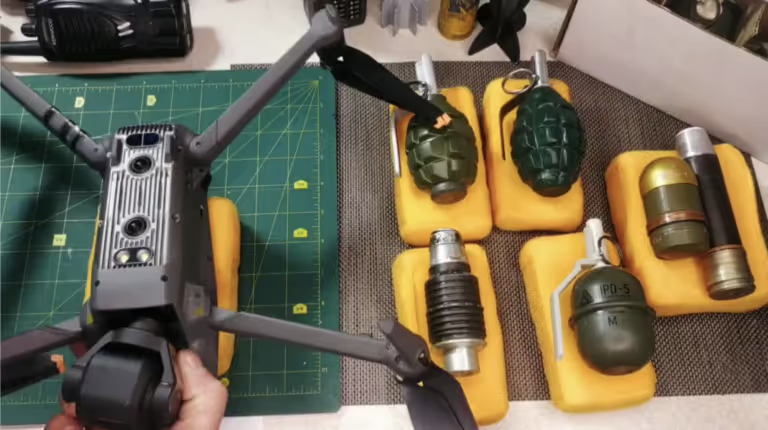
DJI previously touted its Fly Safe system as a capability that protected sensitive and high-profile sites.
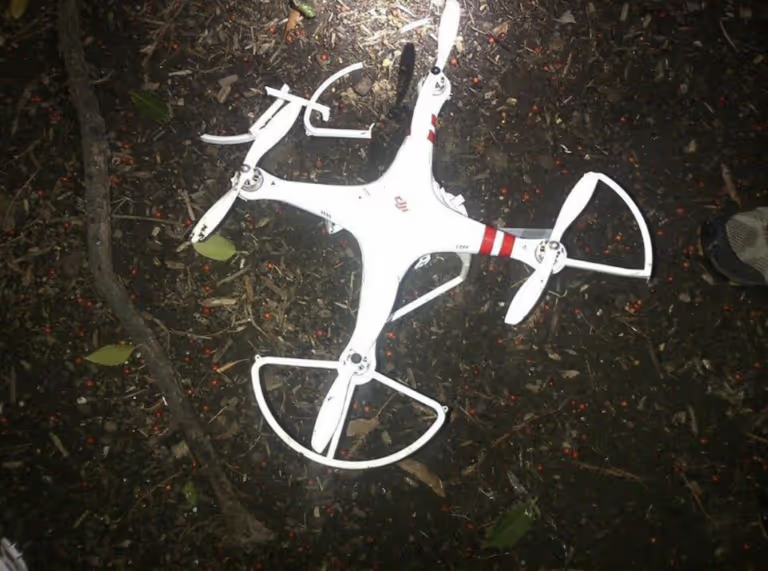
In 2015, DJI used its Fly Safe system to ban Washington, D.C.-area flights following a string of high-profile incidents, including one in which a DJI Phantom quadcopter crashed into the White House grounds.
The danger of a non-geofenced DJI drone was highlighted Thursday, January 9, when a Canadian firefighting aircraft suffered serious damage after colliding with a DJI Mini illegally flying over the Palisades Fire in Los Angeles.
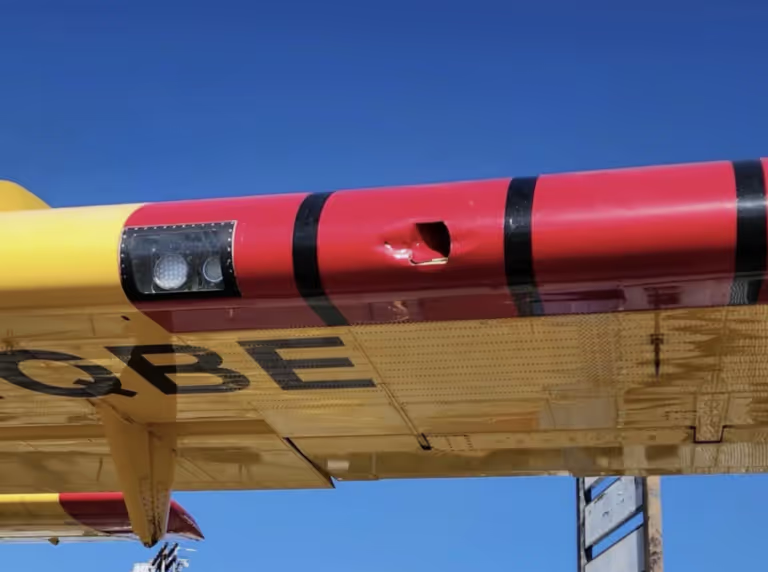
Though an FAA-issued Temporary Flight Restriction had been enacted in the area, the drone was able to operate illegally. According to DroneXL, “While DJI drones, including the Mini series, come equipped with built-in geofencing capabilities designed to restrict flight in TFR zones and near emergency operations, the effectiveness of these systems depends heavily on real-time connectivity. For geofencing to properly enforce newly implemented TFR zones, the drone must have active internet connectivity during pre-flight to receive updated restriction data.
”Today, a multitude of operators, such as airports and other sensitive sites, face a new DJI-driven drone threat. Companies like Ondas Holdings (NASDAQ: $ONDS) offer counter-UAV solutions. The company markets its Ondas Iron Drone as a prepackaged, automated intercepting system that “eliminates small drones without using GPS or RF jamming.”
Other companies, including QinetiQ (QQ.L), offer jamming solutions that effectively produce an anti-drone bubble around a sensitive site.
DJI has faced strict U.S. government regulation in recent years. In 2019, Congress “banned the Pentagon from buying or using drones and components manufactured in China.” In 2021, the Department of Defense added DJI to the list of “Entities Identified as Chinese Military Companies Operating in the United States.” Multiple states, including Arkansas, Florida, Mississippi, and Tennessee, have banned DJI drones from government use. In 2024, DJI accused U.S. Customs and Border Protection of blocking imports, reportedly under the Uyghur Forced Labor Prevention Act, a law that prohibits products made with forced labor from China. This has not publicly been confirmed.
The most significant U.S. action against DJI in 2024 came from Congress. Last September, following arguments that DJI was a threat to national security, the U.S. House of Representatives passed the Countering CCP Drones Act with bipartisan support. If signed into law, the bill would add DJI to the Federal Communications Commission’s Covered List, effectively banning new DJI drones. The act holds bipartisan support in the Senate. DJI strongly rebuked the bill, denouncing it for “baseless allegations and xenophobic fear” in a December statement.
Now, under the threat of an effective ban on new drone sales in the U.S., DJI has removed a key security feature found in all of its existing drones.
In a statement, DJI told Hunterbrook that it “voluntarily put geofencing in place in 2013 when mass produced small drones were a new entrant to the airspace and regulators needed time to consider rules to enable these products to be used safely. Since then, the FAA has imposed Remote ID requirements that means that drones flown in the U.S. broadcast the equivalent of a license plate for drones. This requirement went into effect in early 2024 and gives authorities the tools they need to enforce existing rules.” Additionally, the company added: “DJI has proactively reached out to the relevant authorities to offer assistance with operations or investigations during this challenging time.”
The FAA told Hunterbrook: “The FAA’s role is to ensure drones operate safely within the National Airspace System. Drone operators must comply with FAA regulations including obtaining proper airspace authorization, when required.” The agency added, “The FAA does not require geofencing from drone manufacturers.”
The FAA said it has been “testing drone detection and counter-drone technology at airports over the last few years to determine how well different technologies mitigate potential risks posed by drones.” An FAA-chartered committee on UAS detection and mitigation systems released its report in early 2024, one that the FAA said it is reviewing.
Blake Spendley joined Hunterbrook from the Center for Naval Analyses (CNA), where he led investigations as a Research Specialist for the Marine Corps and US Navy. He built and owns the leading open-source intelligence (OSINT) account on X/Twitter, called @OSINTTechnical (over 1 million followers), which also distributes Hunterbrook Media reporting. His OSINT research has been published in Bloomberg, the Wall Street Journal, and The Economist, among other top business outlets. He has a B.A. in Political Science from USC.
Sam Koppelman is a New York Times best-selling author who has written books with former United States Attorney General Eric Holder and former United States Acting Solicitor General Neal Katyal. He helped build Fenway Strategies into one of the preeminent strategic communications firms in the country—with side quests speechwriting for Michael Bloomberg, running the surrogate remarks operation on the Biden-Harris campaign, and co-founding Mayday, which is now one of the leading information providers on how to access reproductive health care in states with bans. Sam has published in the New York Times, Washington Post, Boston Globe, Time Magazine, and other outlets — and occasionally volunteers on a fire speech for a good cause. He has a BA in Government from Harvard, where he was named a John Harvard Scholar and wrote op-eds like “Shut Down Harvard Football,” which he tells us were great for his social life.