Hunterbrook Media’s investment affiliate, Hunterbrook Capital, does not have any positions related to this article at the time of publication. Positions may change at any time. Full disclosures below.
On Friday, the Namibian Competition Commission approved Sinomine Resource Group Co. Ltd.’s (SHE: 002738) proposed acquisition of the controversial copper mine owned by Dundee Precious Metals Inc. (TSX: $DPM) in Tsumeb, Namibia. But the terms of the deal have changed in recent weeks.
On August 1, Dundee disclosed a significant reduction in the purchase price of the smelter.
The initial agreement, announced in March 2024, valued Dundee’s 98% stake in its smelter at $49 million. The company now expects to receive just $20 million.
Dundee divulged the reduction in sale price along with an update regarding the termination of the smelter’s tolling agreement with metals trading firm IXM S.A. (The contract pays IXM, formerly Louis Dreyfus Commodities Metals Suisse S.A., to process the metals sold from Dundee’s smelter.)
“Two factors have resulted in amendments to the original agreement,” Dundee told Hunterbrook Media in response to questions about the change in sale price from the company’s initial announcement. “IXM’s decision to end its tolling agreement with the smelter, and significant changes in market conditions between now and the period when the agreement was originally negotiated.” Prices for copper have fallen from recent highs.
IXM declined to comment as to why it terminated its agreement with Dundee. Sinomine did not return Hunterbrook Media’s repeated requests for comment.
The approval process for the sale had been drawn out, with the Namibian Competition Commission reviewing the transaction for almost six months — nearing the maximum window allowed by Namibian law. According to the competition watchdog, the slow progress was due, in part, to a lack of engagement from the parties involved.
“Challenges are mostly due to getting critical information from stakeholders,” the Namibian Competition Commission told Hunterbrook Media via email.
“This information is usually required from the concerned parties. Should they take an extended time to provide such information, it provides a challenge to the Commission to make its determination within the prescribed timeframe,” the Namibian Competition Commission explained.
Engelbrecht A. Nawatiseb, a former mayor of Tsumeb and cabinet official of Namibia, is a part of the Tsumeb Business Consortium, which wrote to the Competition Commission as an interested party in the transaction. He told Hunterbrook Media in an interview he expected the Commission to approve the sale, but with conditions such as the requirement that Sinomine “continue to monitor the arsenic levels in the town and control it and report to the relevant authorities.”
In a press release, Dundee said, “The sale is on track to close as planned in the third quarter of 2024, subject to completing the documentation regarding the revised purchase price and proposed tolling arrangement.”
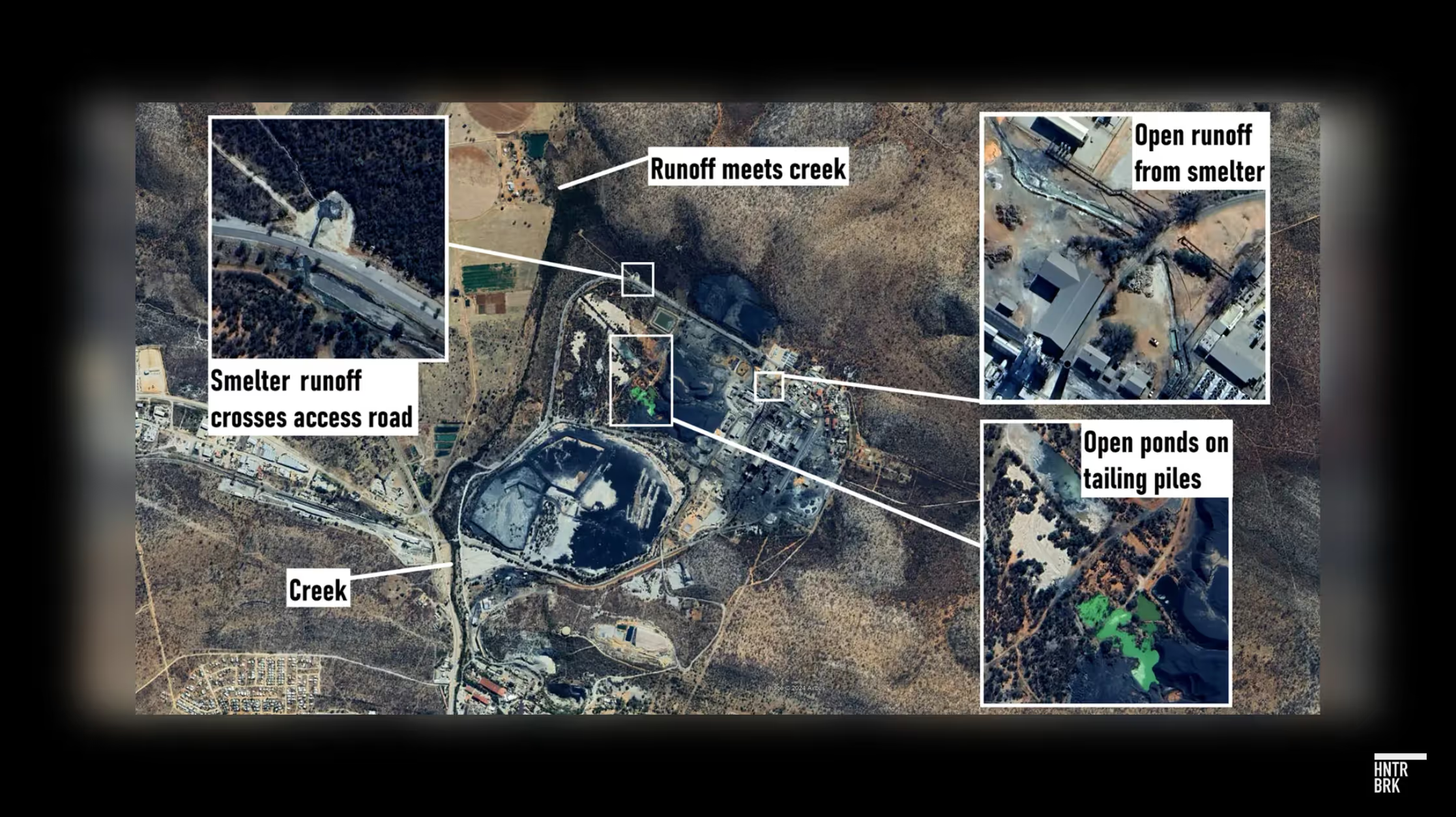
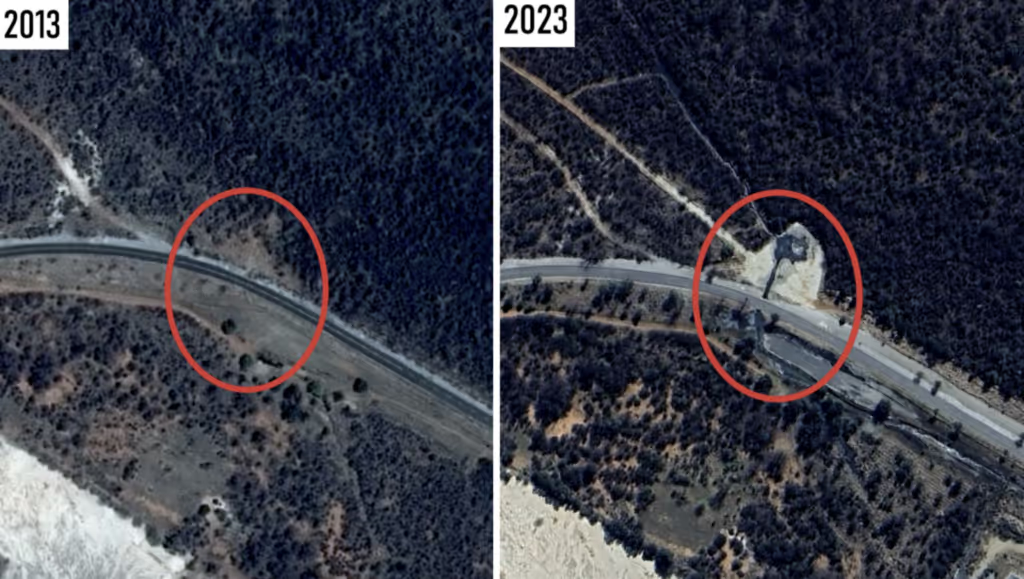
Locals and environmentalists have long raised concerns about the smelter’s operations and its significant impact on the surrounding community. An investigation published in May by Hunterbrook Media detailed the environmental and health damage caused by the facility, including dangerous working conditions that have led to employee hospitalizations.
Dundee did not address Hunterbrook Media’s questions surrounding whether there were any outstanding regulatory, environmental, or community issues that have influenced the renegotiation of the sale terms.
Nawatiseb said that Dundee has refused to invest further in the smelter because it is “mismanaged,” adding: “It does not make profit.”
“The one thing I can reassure you about is that no one in Tsumeb drinks water from the tap. No one,” Nawatiseb said. He added, “People don’t trust the water quality of this town.” In a follow-up interview after the announced approval from the Namibian Competition Commission, he said, “How do you leave a town and its people exposed to such dangerous toxic waste, and you let these guys off the hook?”
He also said the oxygen plant and “one or two other production plants” at the smelter have been down since last week, which has led to a halt in production. Dundee and Sinomine did not respond to questions surrounding any changes to output.
Operations at the Tsumeb smelter have a history associated with environmental and public health concerns. An assessment of the facility’s impact on Tsumeb was released in 2019. That report, commissioned by Dundee to justify an expansion at the smelter, found that there had been “continuous improvement” due to the company’s efforts to modernize the smelter.
But it also stated that Tsumeb community members faced “systemic overexposure” to arsenic and “significantly more prevalent” exposure to another pollutant, sulfur dioxide, than residents of a similar town without a smelter.
Nyasha Nyaungwa is an African media industry veteran with over 20 years of experience. Nyasha has gained first-hand knowledge of local, regional and international finance through his work as a Reuters correspondent, sub-editor of the Namibia Economist and news editor of the Windhoek Observer, among other publications. His interests span mining, energy, financial markets, politics and the environment with a strong focus on the Southern African region.
Daniel Sherwood contributed reporting. Sherwood joined Hunterbrook from The Capitol Forum, a premium subscription financial publication, where he was an Editor & Senior Correspondent, writing and managing market-moving investigative reports and building the Upstream database. Prior to The Capitol Forum, Daniel has experience conducting undercover investigations into fossil fuel companies and other research. He also served as an Honors Law Clerk in the Criminal Enforcement Division of the EPA. He has a JD from Michigan State University. Daniel is based in Michigan.