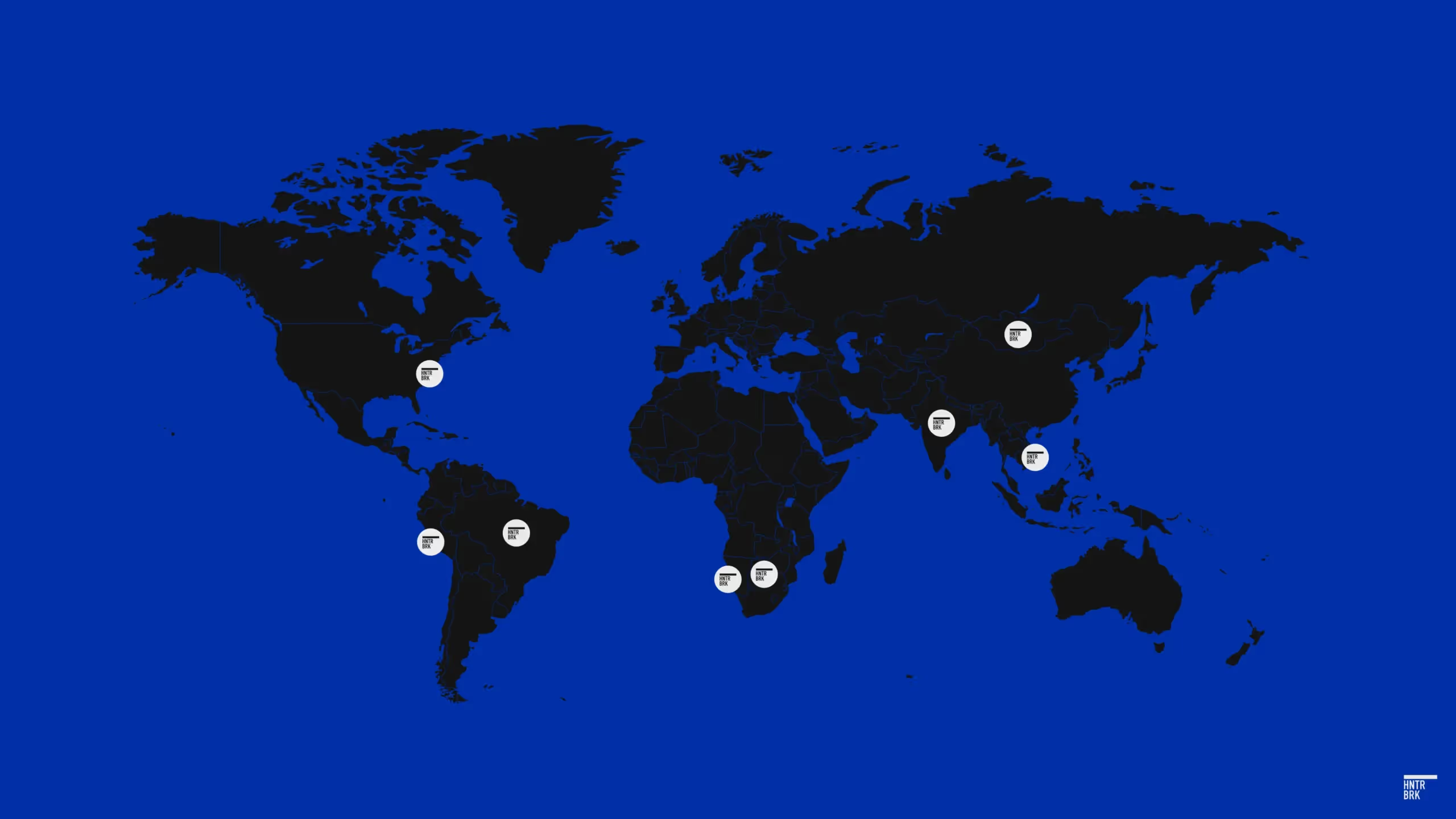
Who We Are: Hunterbrook Media publishes investigative and global reporting — with no ads or paywalls. Our mission is visibility in under-covered regions and accountability in under-scrutinized sectors.
Our Position: As of publication, Hunterbrook Media’s investment affiliate Hunterbrook Capital does not have any positions related to this article.
Mongolia
Mongolia to List Copper on Exchange to Attract More Buyers Amid Higher Domestic Production and Copper Prices
The Mongolian Stock Exchange in Ulaanbaatar is adding copper concentrate trading in 2024, amid rising prices due to global limited supply and growing demand. Copper futures have also been spiking.
Mongolia’s exports of copper concentrate have been rising, although contributions to global supply had remained small relative to Mongolia’s reserves. Its copper reserves, at 56.5 million metric tons, exceed those of the U.S. or Mexico. Only two mines are currently operating: one near the city of Erdenet and the other at Oyu Tolgoi in the Gobi Desert.
Copper concentrate is processed from copper ore. Global supply fell in 2023, due to disruptions at major mines and declining ore grades. Demand rose from the renewable energy sector, where copper is essential to electric vehicles, wind turbines, and power grids. Copper is also an important metal in everyday electronics from cell phones to televisions.
Over 90 percent of the 270 buyers currently registered in the MSE’s electronic trading system are from China, Mongolia’s southern neighbor and the largest purchaser of exports including coal, copper, and iron. Altai Khangai, consultant to the Minister of Finance and former chief executive of the MSE, says that listing copper on the exchange should attract new buyers to Mongolia’s market, potentially increasing the price of Mongolian copper and augmenting the ways it could be exported.
“Mongolia will position itself as a rising player in the global copper industry,” he told local media.
State-owned Erdenet Mining Corp., Mongolia’s second-largest copper exporter, intends initially to sell 5-10% of its copper concentrate through the MSE — 50,000 metric tons — with plans to increase to 20-50%.
The controversial Oyu Tolgoi mine, already Mongolia’s largest copper exporter, is further ramping up production of both copper and gold. The mine is operated by British-Australian multinational Rio Tinto (LSE: $RIO, ASX: $RIO). The mine is the subject of an ongoing disagreement over revenue distribution between Rio Tinto, which owns 66%, and the Mongolian government, which owns the other 34%. Solongoo Bayarsaikhan, the deputy minister of justice and home affairs, recently told local media that Mongolia plans to pursue international arbitration over the mine’s royalties, and taxes, with the hearing scheduled for September 2025.
A third copper mine may open in Kharmagtai, led by Xanadu Mines Ltd. (ASX: $XAM, TSX: $XAM). Xanadu is conducting pre-feasibility studies. Production is expected to start in late 2027. Last year, the project received a $35 million investment in a joint venture with China’s Zijin Mining Group Co. Ltd. (SHE: 601899, HKSE: 2899).
Brazil
Construction Begins on Rainforest Thermoelectric Plant Despite Indigenous Concerns
On March 25, Eneva SA (BVMF: $ENEV3), a Brazilian power generation company, announced the start of construction of its Azulão Thermoelectric Complex in the Amazon Rainforest municipality of Silves, Amazonas state. The firm expects to invest $1.16 billion, it said in a statement. The construction follows a February petition by the prosecutor’s office, Ministério Público Federal, calling for the immediate suspension of the project’s environmental license, due to environmental concerns by local Indigenous and riverine groups.
The prosecutor’s office alleges that the state body IPAAM, which issued the license, does not have the authority to do so, and that only Brazil’s environmental regulator, IBAMA, can issue any possible new environmental licenses.
Brazil is a signatory of International Labour Organization Convention 169, which stipulates that governments have the duty to consult Indigenous and other traditional peoples in advance regarding administrative or legislative measures that potentially affect their interests, such as infrastructure projects. According to the petition submitted by the federal prosecutors, at least two local traditional peoples’ groups in the region claim they received no consultation about the project.
Braskem Stock Hits 2024 High Despite Senate Probe
Shares of Brazilian petrochemical company Braskem S.A. (NYSE: $BAK, BVMF: $BRKM5) hit a 2024 high last week, despite being in the midst of an ongoing senate probe to investigate environmental damage related to the company’s rock salt mining.
According to Braskem, since 2019, 40,000 residents have been relocated from risk areas defined by Civil Defense in the northeastern Brazilian city of Maceió due to land subsidence.
Meanwhile, also this week, Brazil’s Senate launched a “hotsite” enabling the submission of online statements by affected residents to aid the inquiry, known by its acronym CPI, that started in early March.
“One of the main objectives of the CPI is to ensure fair compensation to those affected by the environmental damage that began in 2018 in Maceió, caused by the exploration of rock salt mineral by the petrochemical company Braskem,” said a statement on the Brazilian Senate’s website.
The Braskem disaster is one of at least three major mining disasters in Brazil over the last decade, along with the Mariana and Brumadinho mining disasters, both in Minas Gerais state, in 2015 and 2019, respectively, which have caused significant damage to the environment and local communities. Share prices of the firms involved have generally rebounded after sharp falls. In each of three major cases, law firms have pursued lawsuits abroad in countries where the mining firms held subsidiaries or assets. Alagoas state Sen. Rodrigo Cunha posted a video in Geneva this week where he attended the Inter-Parliamentary Union and delivered a speech asking for the world’s support in search of a “just reparation” for victims of what he described as “the socio-environmental crime committed by Braskem in Maceió.”
“All residents, owners and traders of around 14,500 properties have been supported by the Financial Compensation and Relocation Support Program, created by Braskem to promote people’s safety and ensure that they can be compensated in the shortest possible time,” the company said in a statement on its website.
Hidrovias do Brasil Stocks Soar After Acquisition Announcement
Hidrovias do Brasil (BVMF: $HBSA3), a logistics firm operating on Brazilian waterways, soared on March 25 following an announcement the day before by logistics and energy conglomerate Ultrapar (NYSE: $UGP, BVMF: $UGPA3) that it would increase its stake. The purchase comes amid increased demand for river transportation to export Brazil’s commodities, including agricultural, mineral, and oil.
Industry experts note that waterway transportation in Brazil can be cheaper and may have less of an environmental impact than highway transportation. As of 2023, Brazil transports roughly two-thirds of its cargo via highways, but the state is looking at waterway extension projects to encourage waterway transportation. Across Brazil, both state and private sector projects and investments in fluvial transportation, ports, and storage are increasing. For example, the detonation of the Pedral Lourenço rocks — a project of the government’s Novo Programa de Aceleração do Crescimento — aims to make the Tocantins River navigable for large cargo ships year-round. After delays due to environmental concerns, work is expected to start in 2024.
Peru
Energy company Repsol sued again
Repsol (BME: $REP) is facing more legal fallout from its 2022 oil spill from La Pampilla refinery north of Lima, which the UN called Peru’s “worst ecological disaster” in recent memory. Over 10,000 barrels of crude oil leaked from a tanker during unloading operations, creating a slick that has polluted dozens of miles of coastline, killing wildlife, contaminating fisheries on which thousands of people depend, and devastating beaches and marine reserves. A 2023 study revealed the broad nature of the spill, with dozens of kilometers of vulnerable coastline affected.
Last year, Peru’s consumer protection agency, INDECOPI, filed a $4.5 billion lawsuit. Now, a class action lawsuit on behalf of over 34,000 local residents has been filed at the Hague by the nonprofit Stichting Environmental and Fundamental Rights (represented by British law firm Pogust Goodhead). Despite Repsol’s claim that it has remediated the affected area and complied with Peruvian law, at a cost of $270 million, Peruvian media and NGOs continue to report more contamination.
Peruvian state responsible for contamination at former Doe Run smelter of Renco Group
The Inter-American Court of Human Rights has ruled that the Peruvian state is liable for the public health effects of contamination caused by a smelter in the town of La Oroya, high in the Andes.
The court ordered that 80 plaintiffs in the area must each receive substantial compensation for the “violation of the rights to a healthy environment, personal health and integrity, a dignified life and access to information.” It ordered the Peruvian state to provide medical care and monitor the air, water, and soil around La Oroya. The IACHR ruling is binding, yet Peru has often failed to comply with decisions from the court, as the IACHR lacks effective ways to sanction member states.
Once among the world’s most diversified metal smelters, La Oroya began operating in 1922 and remains one of the few able to process multiple metals, including copper, zinc, lead, gold, and selenium. Yet it has long caused serious pollution, with local residents, including children, repeatedly found to have dangerous levels of lead in their blood. Ambient sulfur dioxide, cadmium, and arsenic levels all exceed World Health Organization-permitted limits. The town was once named among the world’s 10 most contaminated areas.
Fishing industry pushing to operate in marine reserve
The National Fisheries Society, the principal organization representing Peru’s large-scale fishing industry, has filed a lawsuit demanding the right to operate within the Paracas National Reserve, a protected natural marine area three hours south of Lima. The Society claims that there was industrial fishing in Paracas before the reserve was founded in 1975, giving its members acquired rights. The national protected areas service, SERNANP, is fighting the lawsuit, which experts say would have severe negative impacts on the reserve, and calling into question the Society’s stated commitment to “sustainability” and the “protection of the environment.” Should the Society succeed, those concerns could extend to the industry’s international customers.
Sheraton hotel ordered demolished
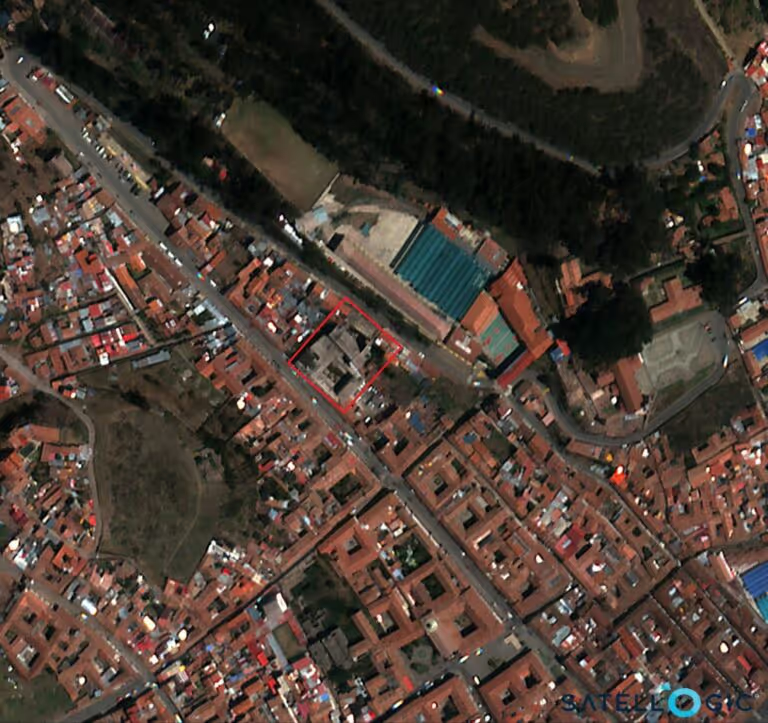
A major new Sheraton hotel under construction in the tourist hub of Cuzco must be demolished in the coming months for damaging archeological remains and violating zoning restrictions, a city court ruled. The Sheraton brand belongs to Marriott International Inc. (NASDAQ: $MAR), which did not respond to Hunterbrook’s request for comment.
The legal battle began in 2016, shortly after builders initiated work on the $40 million hotel a block from the main square of Cuzco, the former capital of the Inca empire and gateway to Machu Picchu, one of Latin America’s most visited tourism destinations. The cost of demolition, estimated at between $1 million and $2 million, will be borne by the Provincial Municipality of Cuzco, which had initially authorized the construction in violation of its own codes.
The unfinished hotel building site can be seen here in the heart of Cuzco on November 11, 2023, in satellite imagery obtained by Hunterbrook. A local agency has until the end of April to prepare a technical report for demolition.
India
Indian Farmers March for Support Ahead of General Elections
Ahead of India’s upcoming general elections, which start on April 9, thousands of farmers have resumedmarching on New Delhi since halting briefly in February to protest for loan waivers and an increase in the Minimum Support Price on crops. The MSP is an intervention by India’s government to insure farmers against a sudden or sharp drop in crop prices. Prime Minister Narendra Modi had promised to double farm incomes from what they were in 2015. That has yet to occur.
The march had been called off briefly after the death in February of a farmer when the police fired tear gas into a crowd of protesters. Over 600 million people in India depend on agriculture for a living, and farmers are an important voting bloc for Modi. He and his party are expected to win a third straight term, but alienating farmers could diminish his support. Farmers have historically influenced Indian politics: In 2021, after a nearly year-long protest, the ruling Bharatiya Janata Party repealed three laws that had overhauled Indian agriculture.
Founder of Former $22 Billion Education Company Byju’s Faces Corruption Allegations
On March 29, the online education company Byju’s held an “extraordinary general meeting” with shareholders amid conflict with the chief executive and founder, Byju Raveendran. Byju’s’ valuation has declined by over 99%, to $225 million in 2024 from $22 billion in 2022.
After the EGM called by the founder last week, major shareholders did not object on Friday to Byju’s’ plan to raise nearly $200 million in additional capital through the issuance of shares, but dissenting shareholders allegedly did not attend.
During the pandemic, Byju’s built a large customer base on the demand for online education. As schools and coaching classes resumed, Byju’s’ sector slowed. Then, on February 22, India’s anti-corruption watchdog prevented the CEO from leaving the country after India’s Enforcement Directorate said Think & Learn Pvt. Ltd., the Byju’s parent company, had engaged in currency exchange violations totaling up to $1.1 billion.
Byju’s shareholders voted to fire the founder/CEO and called for revamping the board. In a letter to employees on February 24, Raveendran wrote that he remained the CEO, and it was “business as usual” at Byju’s. He called the decision by Byju’s investors to oust him in February “invalid and ineffective” on account of a low turnout. On March 2, Raveendran told his employees that he won’t be able to pay their salaries. Videos of angry staff fighting with their bosses over promised compensation have gone viral on X.
Vietnam
Vietnamese Authorities Prosecute Real Estate Tycoon and Family as Government Aims to Bolster Investor Confidence
Vietnam’s Ministry of Public Security is seeking to put a major real estate businessman on trial among 50 others for alleged stock manipulation. The Vietnamese government is striving to have the Ho Chi Minh Stock Exchange upgraded to an emerging market by FTSE Russell.
The Ministry, which controls Vietnam’s police and investigatory agencies, in October 2023 completed a probe of Trinh Van Quyet, the founder and former chairman of Vietnamese conglomerate FLC Group. Quyet was one of the first major business people targeted in an anti-corruption campaign that began in 2014 but until recently had largely been focused on public-sector graft. He was detained in January 2022. A trial date hasn’t been set, and Quyet has denied the allegations.
Among the accused are 11 of Quyet’s relatives, including his sister, who allegedly set up more than 20 companies in the names of dozens of family members, then opened more than 500 stock accounts to trade FLC shares between them, according to government officials. HoSE officials were also accused of abetting Quyet’s scheme. From May 2017 to January 2022, six FLC-linked stock tickers rose by up to 1,700%. Officials claim this allowed Quyet to cash out an alleged $30 million. All six tickers have since been delisted.
Namibia
Uranium Prices Drive Foreign Exploration in Namibia
Australian and Canadian companies continue to advance their uranium plans in Namibia, the world’s second largest producer of the commodity, after a dramatic rise in uranium prices in 2023.
- Elevate Uranium Ltd. (ASX: $EL8, OTC: $ELVUF) added a fifth rig in Namibia as part of its 2024 drilling program. The company reports that over half of its uranium reserves are now in Namibia, with the rest in Australia.
- Paladin Energy Ltd. (ASX: $PDN, NSX: $PDN) is resuming production at its Namibian mine. On April 2, Paladin announced it achieved production and will provide further information on “key” updates by July.
- Bannerman Energy Ltd. (ASX: $BMN, OTCQX: $BNNLF) says it received an approved mining license for its flagship Etango Project in December 2023.
- Deep Yellow Ltd. (ASX: $DYL, OTC: $DYLLF) announced its expanded drilling efforts will take place from February to April, with updated results to be announced during July.
- Madison Metals Inc. (CSE: $GREN, OTCQB: $MMTLF) released early sampling results in February and March that the company hopes will help accelerate its development.
Yintai Competitive Bid for Osino in Search for Gold Following Exhumation of Ancestral Graves and Proposal to Dam Local River
Yintai Gold Co. Ltd. (SHE: 000975) outbid Dundee Precious Metals Inc. (TSX: $DPM) with its $272.5 million all-cash offer to buy Canadian miner Osino Resources Corp. (CSE: $OSI) and its Twin Hills Gold Project in central Namibia. The deal is expected to close in the first half of 2024, pending regulatory approval.
Osino forecast Twin Hills to have a 13-year life with an average gold production of more than 169,000 ounces per year and $1.5 billion in revenue. During Osino’s exploration, the company discovered four ancestral graves. In January, after negotiations with family members of the deceased broke down, Osino exhumed the bodies. Family members decried the lack of information or permission to witness the exhumation. Osino’s CEO stated that the company’s conduct was in line with Namibian law and told national outlet the Namibian Broadcasting Corp. that relatives would only be allowed to observe if police were present.
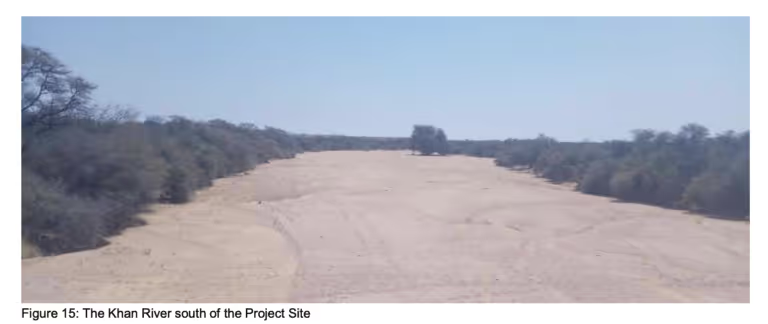
Osino is also proposing to dam the ephemeral Khan River to support its operations, diverting an important supply of water for downstream farmers and communities in a dry environment.
Munkhchimeg Davaasharav is a freelance journalist and media consultant from Ulaanbaatar, Mongolia. Her journalism, featured in prominent local news media and international outlets like Reuters and The Guardian, spans various topics, from mining to human rights issues. Muugii is pursuing an MA in Media and Gender at the University of Sussex as a Chevening scholar.
Nyasha Nyaungwa is an African media industry veteran with over 20 years of experience. Nyasha has gained first-hand knowledge of local, regional and international finance through his work as a Reuters correspondent, sub-editor of the Namibia Economist and news editor of the Windhoek Observer, among other publications. His interests span mining, energy, financial markets, politics and the environment with a strong focus on the Southern African region.
Simeon Tegel is a British freelance journalist based in Lima, Peru, from where he also regularly roams across Latin America. He specializes in environmental stories, democracy and human rights and is a regular contributor to the Washington Post, among other media. A foodie and outdoorsman, he would not be anywhere other than Peru.
Sam Cowie is a British journalist, producer and consultant based in São Paulo, Brazil, the country where he has lived on and off since 2011. His long-reads, investigations and documentaries have been published by Bloomberg, The Financial Times, The Associated Press, The Guardian, Al Jazeera and by Brazilian outlets Folha de S.Paulo, Repórter Brasil and Valor Econômico. He is the recipient of several grants and fellowships including most recently from the Earth Journalism Fund and the Pulitzer Rainforest Foundation.
Brian Benza is a Southern Africa-focused freelance business journalist and researcher with interest in economic and social development, mining, energy, environment and the political economy. He covers the region for international newswires and Africa-focused research firms.
Abhishek Kumar Abhishek is a freelance reporter for The Economist and writes about technology, business, and social affairs. He contributed to the reporting from India for the book “Give People Money: How a Universal Basic Income Would End Poverty, Revolutionize Work and Remake the World” by Annie Lowrey. He also reported for “Carmageddon: How Cars Make Life Worse and What To Do About It” by Daniel Knowles.
Michael Tatarski is a Southeast Asia-based journalist focused on economic and business issues, the environment, and infrastructure development. He has contributed to publications including The Washington Post, The Guardian, and the South China Morning Post.
Daniel Sherwood contributed reporting. Sherwood joined Hunterbrook from The Capitol Forum, a premium subscription financial publication, where he was an Editor & Senior Correspondent, writing and managing market-moving investigative reports and building the Upstream database. Prior to The Capitol Forum, Daniel has experience conducting undercover investigations into fossil fuel companies and other research. He also served as an Honors Law Clerk in the Criminal Enforcement Division of the EPA. He has a JD from Michigan State University. Daniel is based in Michigan.
Jenny Ahn joined Hunterbrook after serving many years as a senior analyst in the US government. She is a seasoned geopolitical expert with a particular focus on the Asia-Pacific and has diverse overseas experience. She has an M.A. in International Affairs from Yale and a B.S. in International Relations from Stanford. Jenny is based in Virginia.
Blake Spendley joined Hunterbrook from the Center for Naval Analyses (CNA), where he led investigations as a Research Specialist for the Marine Corps and US Navy. He built and owns the leading open-source intelligence (OSINT) account on X/Twitter, called @OSINTTechnical (over 1 million followers), which also distributes Hunterbrook Media reporting. His OSINT research has been published in Bloomberg, the Wall Street Journal, and The Economist, among other top business outlets. He has a B.A. in Political Science from USC.