Hunterbrook Media’s investment affiliate, Hunterbrook Capital, does not have any positions related to this article at the time of publication. Positions may change at any time. Full disclosures below.
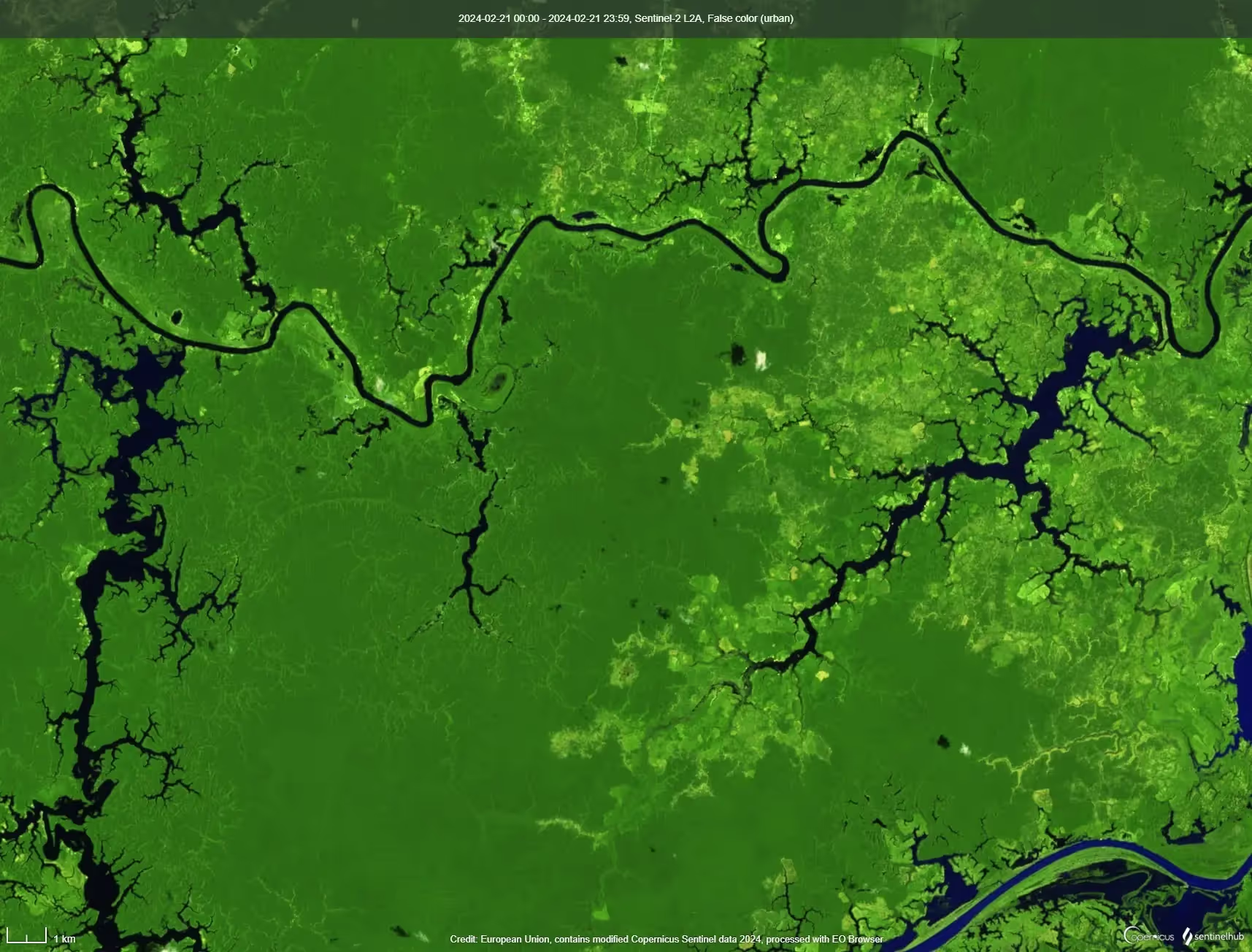
The Federal Prosecutors Office (MPF) in Brazil’s Amazonas state has filed a class action lawsuit to annul the concession of four oil and gas blocks in the Amazon River basin region, citing concerns over the rights of local Indigenous and riverine groups.
In a statement, the office said it had filed the lawsuit against the Brazilian government, the National Agency for Petroleum, and Natural Gas and Biofuels (ANP), the state body that offered the auction for the blocks in December, as well as Atem Participações S.A and energy provider Eneva S.A (BVMF: $ENEV3), which acquired the right to explore the blocks.
Exploration in the concession areas could potentially affect six Indigenous lands and at least eleven forest conservation units; local communities have not been adequately consulted about the possible impact on their lands, according to the office’s statement.
“We emphasise that approval for the inclusion of blocks in the bidding rounds does not mean tacit approval for environmental licensing by the responsible bodies, a step that is carried out after the contracts are signed,” ANP told Hunterbrook Media in an emailed statement when contacted about the lawsuit.
“All activities that the concessionaires carry out in the areas will require a detailed environmental licensing process, which will be conducted by the competent environmental agency,” the statement read.
Atem and Eneva have not to this point responded to Hunterbrook Media’s request for comment.
The move to annul the oil and gas blocks is the latest in a series of recent ongoing actions by the Amazonas branch of the Federal Prosecutors Office (MPF) to halt or pause extraction projects in the region, citing concerns for the rights of local Indigenous and other traditional communities.
Of the nine Brazilian states where Amazon Rainforest biome is present, Amazonas state maintains the highest volume of preserved forest and it has the largest number of Indigenous people in Brazil, some of whom live in voluntary isolation.
Brazil is a signatory of Convention No. 169 of the International Labor Organization, Article 6 of which determines that governments have the duty to consult Indigenous and other traditional peoples regarding administrative or legislative measures that potentially affect their interests.
Sam Cowie is a British journalist, producer and consultant based in São Paulo, Brazil, the country where he has lived on and off since 2011. His long-reads, investigations and documentaries have been published by Bloomberg, The Financial Times, The Associated Press, The Guardian, Al Jazeera and by Brazilian outlets Folha de S.Paulo, Repórter Brasil and Valor Econômico. He is the recipient of several grants and fellowships including most recently from the Earth Journalism Fund and the Pulitzer Rainforest Foundation.
Sam Koppelman is a New York Times best-selling author who has written books with former United States Attorney General Eric Holder and former United States Acting Solicitor General Neal Katyal. He helped build Fenway Strategies into one of the preeminent strategic communications firms in the country—with side quests speechwriting for Michael Bloomberg, running the surrogate remarks operation on the Biden-Harris campaign, and co-founding Mayday, which is now one of the leading information providers on how to access reproductive health care in states with bans. Sam has published in the New York Times, Washington Post, Boston Globe, Time Magazine, and other outlets — and occasionally volunteers on a fire speech for a good cause. He has a BA in Government from Harvard, where he was named a John Harvard Scholar and wrote op-eds like “Shut Down Harvard Football,” which he tells us were great for his social life.