
Based on Hunterbrook Media’s reporting, Hunterbrook Capital is long $HIMS at the time of publication. Positions may change at any time. See full disclosures below.
The FDA’s oversight of compounded GLP-1 drugs has complicated Hims & Hers Health Inc. ‘s (NYSE: $HIMS) foray into weight-loss drugs, but the telehealth giant may soon have a key ally in the Trump administration. STAT News reported on Sunday that President-elect Donald Trump has nominated Dr. Marty Makary, an executive of a startup called Sesame, which also sells compounded GLP-1 weight loss drugs online, to lead the Food and Drug Administration.
Hims — initially known for hair loss and sexual health products — has drawn scrutiny this year from medical experts for its rapid expansion into the weight-loss drug market. At the core of the controversy are GLP-1 drugs produced through a process called compounding, which means that the products are not FDA approved.
Compounded GLP-1 drugs are cheaper alternatives to the high-cost, FDA-approved, branded medications like Novo Nordisk’s Wegovy (semaglutide) and Eli Lilly’s Mounjaro (tirzepatide). Hims sells its version of these products under an FDA exemption that allows knockoff drugs to fill gaps during supply shortages, like the shortage of GLP-1 drugs amid extremely high demand.
The FDA’s erratic designation of those shortages has created a volatile regulatory environment. In October, the FDA removed tirzepatide from its shortage list, effectively barring compounding pharmacies from producing it. This catalyzed a lawsuit from the Outsourcing Facilities Association, representing compounding pharmacies, which argued that the decision was “reckless and arbitrary.” Just days later, the FDA reversed itself, reinstating tirzepatide’s shortage status and highlighting the uncertainty surrounding these regulatory decisions.1
“The FDA is in a flat spin,” said Dr. Rajesh Aggarwal, an obesity doctor and founding CEO of twenty30 health — describing the two-week period during which the FDA flip-flopped on this as “comical.”
“This is not how American officials should treat the American public.”
Aggarwal said he welcomes fellow GI surgeon Makary, whom he described as “evidence based and scientific in thought.” He said he believes Makary will be able to bring Lilly, Novo, and the compounders around the table to demand and drive clarity on the projected demand, medication supply, and pricing of GLP-1 meds.
Some of Makary’s past statements, particularly his advocacy of “natural immunity” during COVID-19, have received significant scrutiny.
For Hims, the uncertainty around the GLP-1 shortage has compounded other risks. Earlier this year, Hunterbrook Media exposed weaknesses in the company’s prescribing process for compounded GLP-1 drugs. The investigation revealed that patients could obtain prescriptions after brief online questionnaires, without speaking to a doctor. (Makary’s company, Sesame, appears to provide patients with a video consultation.) Hunterbrook also highlighted safety concerns with the supplier for Hims, BPI Labs, whose parent company has faced regulatory scrutiny and allegations of fraud.
Following Hunterbrook’s investigation, Hims updated its SEC risk disclosures, gave customers the opportunity to request certificates of analysis verifying that the compounded GLP-1 drugs have the appropriate ingredients, and — according to Wired — appears to have strengthened its prescribing requirements.2
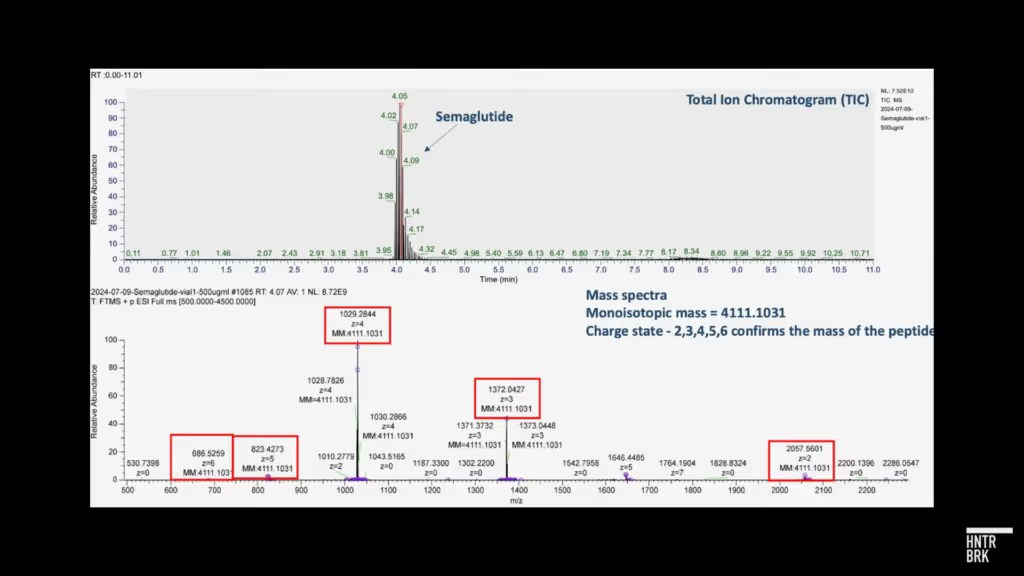
After its initial article, Hunterbrook analyzed samples acquired from Hims through an independent third-party laboratory that is FDA registered and inspected, GLP/cGMP compliant, and DEA licensed. The lab used common analytical chemistry techniques including peptide mapping via liquid chromatography-mass spectrometry (LC-MS) that confirmed that, unlike products sold by certain counterfeit GLP-1 providers, the tested samples were, in fact, semaglutide.3
In response to a request for comment on Hunterbrook’s lab results, Hims shared that it had obtained “third-party testing” of its own, which also “confirmed the presence of the semaglutide base at the concentration reflected in the COA that we share with customers,” referring to the Certificates of Analysis that Hims made available to customers following Hunterbrook’s investigation.

The nomination of Makary may provide an opportunity for Hims to stabilize its business. Makary has experience with telehealth at Sesame and, as STAT News reported, previously sat on the board of a company called Harrow that prescribed “both compounded and brand-name eye drugs.”
The surgeon may not only be sympathetic to Hims on compounded semaglutide. In a 2020 Fox News op-ed, Makary made a full-throated case for “embracing telehealth,” arguing it expands “access to medical care and improves our nation’s health security.”
“It is time we revamp archaic and cumbersome patient services,” he wrote.
It’s a case of unlikely bedfellows: The Trump Administration providing a potential boost to a company whose CEO Andrew Dudum has spoken out in favor of Palestinian rights and donated more than $100,000 in the 2024 election cycle to progressive groups like the Justice Democrats and candidates like former Representatives Cory Bush and Jamaal Bowman, according to the FEC’s database. Dudum also supported the presidential campaign of Vice President Kamala Harris.
Makary’s confirmation would not erase all risks for Hims, of course. Big Pharma is aggressively litigating against compounding, and patient safety concerns remain.
It is also worth noting that Makary’s commentary on GLP-1 drugs has not been entirely positive.
“GLP-1 drugs could cost Medicare a fortune, diverting funds from other medical services,” he recently tweeted. And in his book, “Blind Spots,” he notes that while GLP-1 drugs “appear to be effective not only for losing weight but also in reducing the health problems associated with obesity such as heart disease, liver disease, and renal failure,” we “don’t yet know” the long-term consequences, citing “loss of muscle mass” as a risk.
“While it appears that we are seeing exciting benefits from these medications, we have to be open to the fact that future research could tell us that people on them long-term ultimately live longer, or shorter lives,” he writes.
Regardless, Makary may not be the decider on the FDA’s approach to GLP-1 compounding. As USC Professor Genevieve Kanter told STAT, FDA employees are required to recuse themselves from decisions related to former employers, which may impact Makary’s ability to weigh in on questions surrounding GLP-1 shortages.
In addition, as head of the FDA, Makary would be reporting to the Secretary of the Department of Health and Human Services — set to be Robert F. Kennedy Jr., if confirmed.
Kennedy has expressed skepticism about GLP-1 drugs as a panacea — and criticized their cost.
But hey, GLP-1s may grow on RFK: after all, mass-prescribing semaglutide through the mail may just be the best way to end the era of Big Seed Oil once and for all.
Sam Koppelman is a New York Times best-selling author who has written books with former United States Attorney General Eric Holder and former United States Acting Solicitor General Neal Katyal. He helped build Fenway Strategies into one of the preeminent strategic communications firms in the country—with side quests speechwriting for Michael Bloomberg, running the surrogate remarks operation on the Biden-Harris campaign, and co-founding Mayday, which is now one of the leading information providers on how to access reproductive health care in states with bans. Sam has published in the New York Times, Washington Post, Boston Globe, Time Magazine, and other outlets — and occasionally volunteers on a fire speech for a good cause. He has a BA in Government from Harvard, where he was named a John Harvard Scholar and wrote op-eds like “Shut Down Harvard Football,” which he tells us were great for his social life.
Jim Impoco is the award-winning former editor-in-chief of Newsweek who returned the publication to print in 2014. Before that, he was executive editor at Thomson Reuters Digital, Sunday Business Editor at The New York Times, and Assistant Managing Editor at Fortune. Jim, who started his journalism career as a Tokyo-based reporter for The Associated Press and U.S. News & World Report, has a Master’s in Chinese and Japanese History from the University of California at Berkeley.