Hunterbrook Media’s investment affiliate, Hunterbrook Capital, does not have any positions related to this article at the time of publication. Positions may change at any time. Full disclosures below.
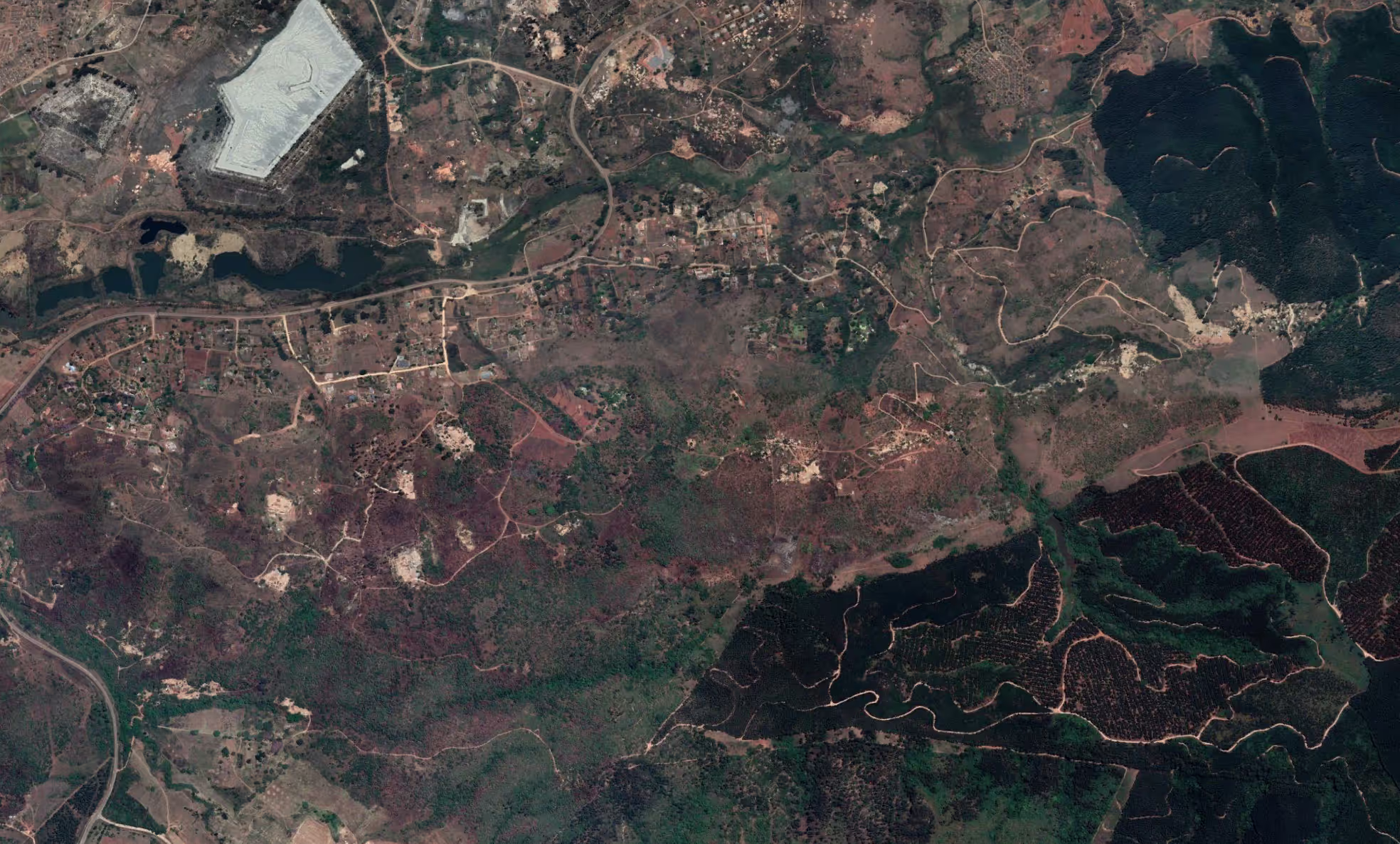
The “killer” Redwing gold mine in eastern Zimbabwe is one of several being taken over by the SPAC named Hennessy Capital Investment Corp. VI. (NASDAQ: $HCVI).
The SPAC is forming a new company called Namib Minerals to take over mines that had historically been operated by Metallon Corp., once one of Zimbabwe’s biggest mining companies. Hennessy Capital announced that the business combination deal will value Namib at $500 million plus whatever is raised during the merger.
The new venture will operate three mines, including two — Mazowe and Redwing — that have been flagged as risky assets due to the unregulated artisan miner squatting in the area. Dangerous practices at Redwing have allegedly led to the deaths of over a hundred people since 2020. And earlier this year, 15 miners were reportedly trapped for days before being rescued.
Namib Minerals did not respond to Hunterbrook’s request for comment. Hennessy Capital could not be reached.
Metallon had once produced as much as 50% of Zimbabwe’s gold output. But Metallon and its owner, South African mining magnate Mzi Khumalo, halted operations at Redwing and Mazowe in 2019, citing mounting debts and limited access to foreign capital, according to Bloomberg News.
The next year, several Metallon mines, including Mazowe, were placed under corporate rescue by Zimbabwe’s High Court as workers unions had successfully sued the firm, citing its inability to pay down its debts. Metallon reportedly owed as much as $200 million.
Artisanal and small-scale gold mining is one of the biggest economic activities for impoverished individuals in Zimbabwe due to the high unemployment rate. These miners rarely operate independently, according to Farai Maguwu, the director of the Centre for Natural Resource Governance. Instead, they are often hired to do the digging for powerful local politicians and other elites who are licensed to sell the precious metal. The gold is then sold to a subsidiary of the country’s central bank, the only legal buyer of gold in Zimbabwe.
At Mazowe, according to a 2020 report by the International Crisis Group, these politically controlled small-scale miners took over areas abandoned by Metallon. Redwing reportedly faces a similar situation. “Ever since Metallon left, politically connected companies which have no expertise in mining came in and brought in artisanal miners, who practise dangerous mining methods and have terribly damaged the environment, to dig for them,” Maguwu told Hunterbrook. “We did some investigations and we found that just like at Redwing, a similar situation prevails at Mazowe.”
Maguwu accused local politicians of facilitating the takeover by informal miners.
Unregistered artisanal miners tend to have a much poorer safety record compared to large-scale mining companies. According to the U.S. Department of Labor, an estimated thousands of children work in these unregulated gold mines, where they are exposed to mercury and other dangerous chemicals.
“I think it would be very difficult for the new investors to wrestle back the mines from these people,” Maguwu said of the miners. “The government is also benefiting because they need the foreign exchange” from the gold sales, he added.
Last year, gold was reportedly Zimbabwe’s largest revenue generator.
Brian Benza is a Southern Africa-focused freelance business journalist and researcher with interest in economic and social development, mining, energy, environment and the political economy. He covers the region for international newswires and Africa-focused research firms.
Tekendra Parmar is an editor and writer based in New York. He has written for Business Insider, The Nation, Time, and Fortune, among other publications. His work has been longlisted for a One World Media Award and a finalist for the Online Journalism Award.