
Hunterbrook Media’s investment affiliate, Hunterbrook Capital, does not have any positions related to this article at the time of publication. Positions may change at any time. Full disclosures below.
DATA CENTERS, UNMASKED
Tech giants are racing to build data centers to power the AI boom. Local communities are voicing concerns about emissions, water depletion, and noise.
But it’s an uneven fight: In many cases, residents don’t even know which tech company is behind the looming data center projects. Google, Amazon, Meta, and other hyperscalers hide behind opaque front companies that shield the giants from reputational damage and investor scrutiny, and avoid tipping off competitors.
Our new series aims to bring more transparency to the data center permitting process, through open-source intelligence and public records requests. We’ll uncover the true identities of mysterious data center developers, as well as their suppliers and investors, so communities know who they are dealing with.
An online petition against a proposed data center in Piqua, Ohio, dubbed “Project Klondike” has already gathered more than 2,500 signatures.
“We are not against progress nor are we opposed to development per se, but this decision cannot come at the cost of our water, tranquility, and financial stability,” part of the petition reads.
One of the comments underneath put it more bluntly: “Speaking for everyone- WE DONT WANT THIS.”
Residents are not just worried about the data center’s potential environmental harms, they also point out a lack of transparency in the development’s approval process, according to a post in a local Facebook group: The Piqua City Commission fast-tracked the project in November via an emergency resolution and greenlit a tax abatement, while citizens still didn’t know which company is behind the data center.
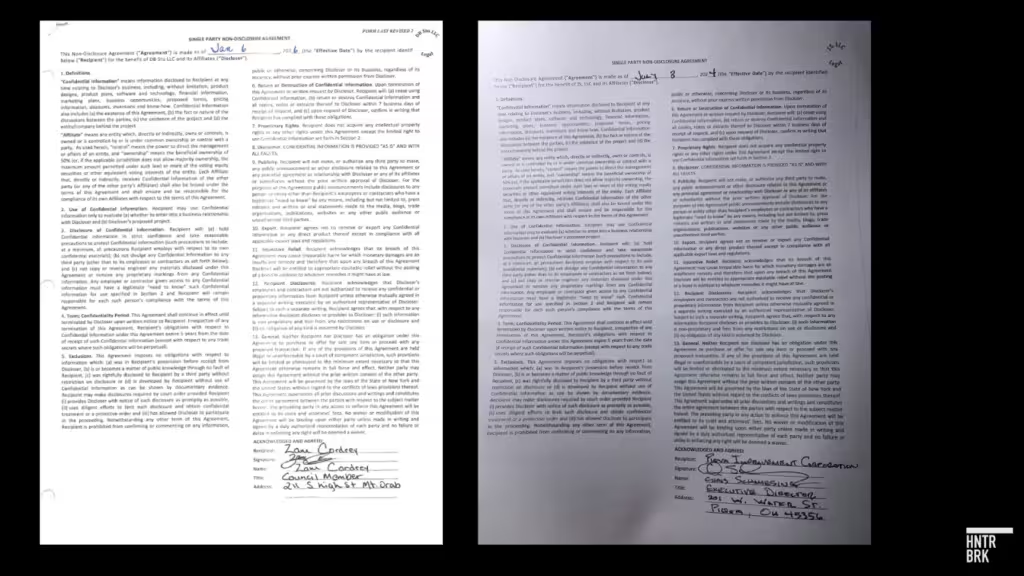
Piqua officials confirmed during the commission meeting that the city had signed a nondisclosure agreement with data center developer J5 LLC, prohibiting city officials from divulging the company’s owner. A copy of the NDA appears to have been posted on Facebook. The Piqua City Manager’s Office did not provide comment by the time of publication.
Notwithstanding the secrecy surrounding the project, a single line buried in J5’s corporate filings indicates that Meta is the actual developer behind the project. An annual corporate filing submitted by J5 LLC’s Nevada branch lists “1601 Willow Road” in Menlo Park, California, as the entity’s address: a building at Meta’s HQ compound in Silicon Valley.
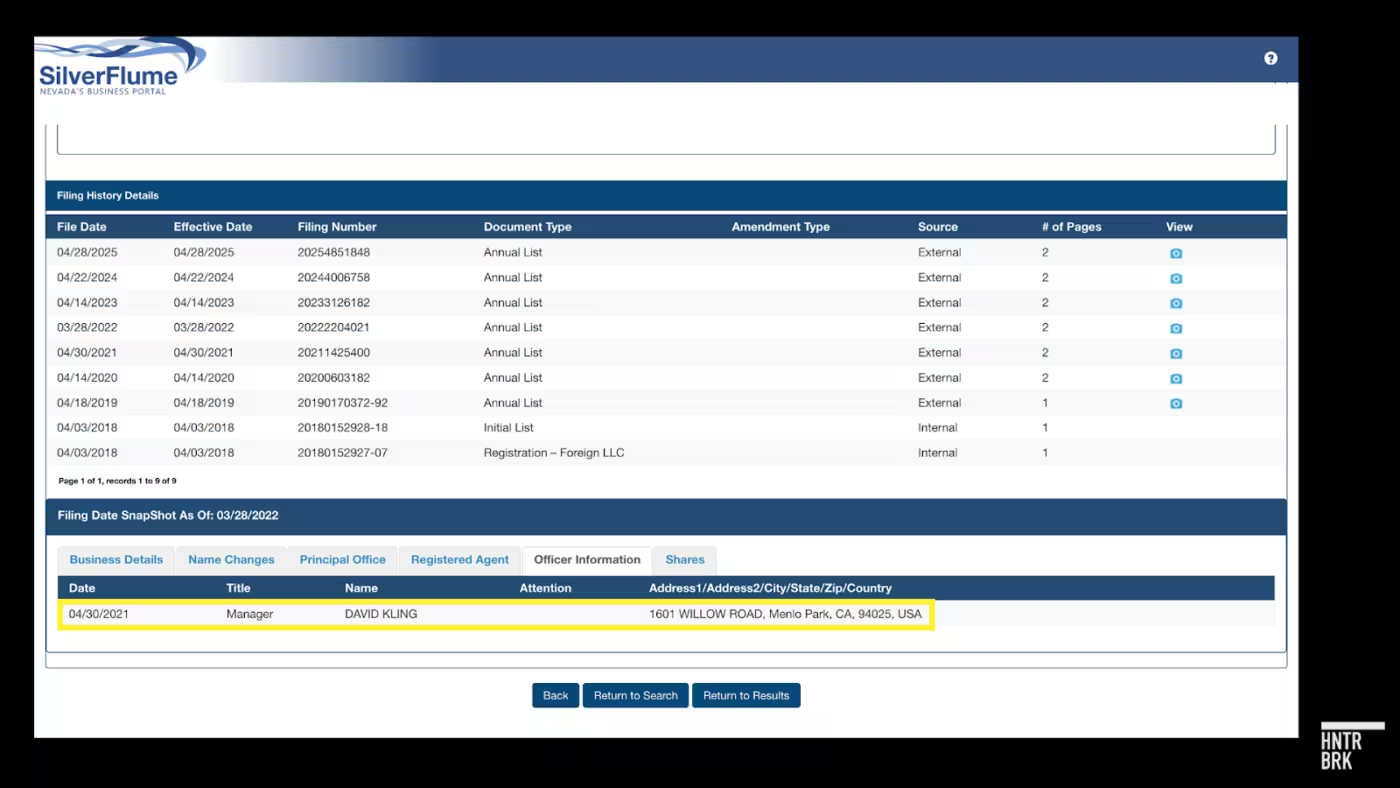
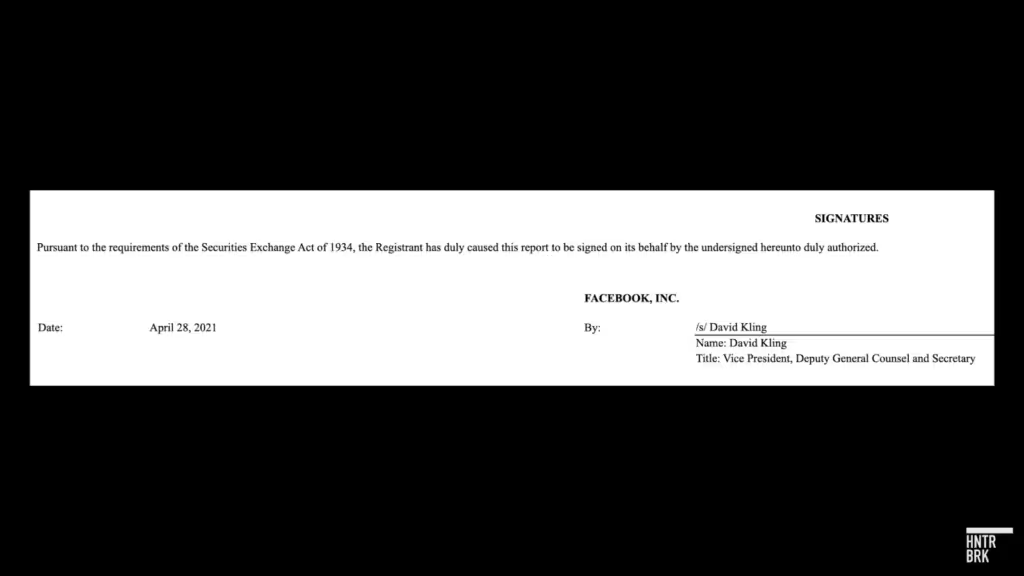
David Kling is listed as the manager for J5, which also does business under the name Shaytura LLC. According to Facebook’s SEC filing, Kling was a corporate lawyer at Facebook at the time.
Meta did not respond to a request for comment.
A Pattern Emerges
Kling is not the only person appearing on J5’s corporate documents. Pamela Gregorski is a signatory for the company on business registrations in both Ohio and Nevada.
Gregorski, senior manager at Corporation Service Company in Delaware, appears to be one of Meta’s go-to experts when it comes to incorporating front LLCs for data center projects.
Hunterbrook analyzed all 78 companies that list Gregorski as an officer on OpenCorporates, a legal-entity database. Six of those businesses are linked to data center projects, according to Hunterbrook’s review. Four of them have already been confirmed as Meta front companies: Orla LLC in Indiana, Laidley LLC and Pelican Leap LLC in Louisiana, and Wurldwide LLC in Texas.1
The other two data center companies under Gregorski’s name in OpenCorporates? J5, aka Shaytura — and Hatchbo LLC.
Little is known about Hatchbo.
Hatchbo is described as “an affiliate of an investment grade, global technology company and industry leader in the evolving artificial intelligence computing space” that in February entered a 10-year rental agreement with Solaris Energy Infrastructure for 500 MW of power equipment for data centers, according to an SEC filing.
Solaris is a somewhat new player in the data center business. For a long time, the company was an oilfield services company, but that business began to deteriorate in 2022. In 2024, Solaris changed its name and acquired Mobile Energy Rentals, a tiny power equipment leasing operation whose co-owner spent five years in federal prison for environmental crimes. Today, Solaris is worth over $4 billion and its 2025 SEC filing suggests that the vast majority of its power solutions revenue so far is coming from a single customer: xAI.
Solaris provides power equipment for Elon Musk’s data center projects near Memphis, Tennessee. Environmental advocates have criticized xAI for operating as many as 35 gas turbines at its Colossus 1 data center without air quality permits for several months. The company later obtained an air permit for 15 turbines.
Solaris also provided the gas turbines that power Colossus 2, Musk’s second data center in the area. Similarly, 20 such turbines were already running and generating power before xAI obtained a required air permit in March.
Hatchbo appears to be Solaris’s first major data center customer that isn’t xAI. Despite Gregorski’s involvement, there is no confirmation that Meta is involved in Hatchbo.
Hatchbo LLC registered as a foreign entity in the state of Arkansas in February. But so far, it does not appear to have filed any permit applications for a data center project, the Arkansas Energy & Environment Department told Hunterbrook in response to a public records request.
Solaris and Gregorski did not respond to a request for comment.
Incorporated on the Same Day
Several other clues link a second data center front company to Meta: DB Stu LLC, which is proposing a data center in Mount Orab, Ohio, was not only incorporated by Gregorski, it was also incorporated on the exact same day as Balloonist LLC, a confirmed Meta subsidiary behind a data center development in Wisconsin.
DB Stu’s corporate filings in Ohio also list Toreak Acquisition Corp., a Delaware-registered entity that appears as a sort of corporate middleman across documents filed by several Meta data center businesses, including Pelican Leap LLC and Laidley LLC.
DB Stu had local officials in Mount Orab sign an NDA, in which they agreed to keep discussions with the data center developer confidential, according to a local news report. When this controversial arrangement became public, Ohio Rep. Adam Bird, who counts Mount Orab residents among his constituents, introduced legislation that would ban the use of confidential agreements by elected leaders in village, township and county boards across Ohio.
A local TV station published DB Stu’s NDA. Perhaps unsurprisingly, the document appears to be almost identical to the nondisclosure agreement posted on Facebook that J5 LLC allegedly got a Piqua town official to sign.
Till Daldrup is an investigative journalist who joined Hunterbrook from The Wall Street Journal, where he focused on open-source investigations and content verification. In 2023, he was part of a team of reporters who won a Gerald Loeb Award for an investigation that revealed how Russia is stealing grain from occupied parts of Ukraine. He has an M.A. in Journalism from New York University and a B.S. in Social Sciences from University of Cologne. He’s also an alum of the Cologne School of Journalism (Kölner Journalistenschule).
Sam Koppelman is a New York Times best-selling author who has written books with former United States Attorney General Eric Holder and former United States Acting Solicitor General Neal Katyal. He helped build Fenway Strategies into one of the preeminent strategic communications firms in the country—with side quests speechwriting for Michael Bloomberg, running the surrogate remarks operation on the Biden-Harris campaign, and co-founding Mayday, which is now one of the leading information providers on how to access reproductive health care in states with bans. Sam has published in the New York Times, Washington Post, Boston Globe, Time Magazine, and other outlets — and occasionally volunteers on a fire speech for a good cause. He has a BA in Government from Harvard, where he was named a John Harvard Scholar and wrote op-eds like “Shut Down Harvard Football,” which he tells us were great for his social life.