Hunterbrook Media’s investment affiliate, Hunterbrook Capital, does not have any positions related to this article at the time of publication. Positions may change at any time. Full disclosures below.
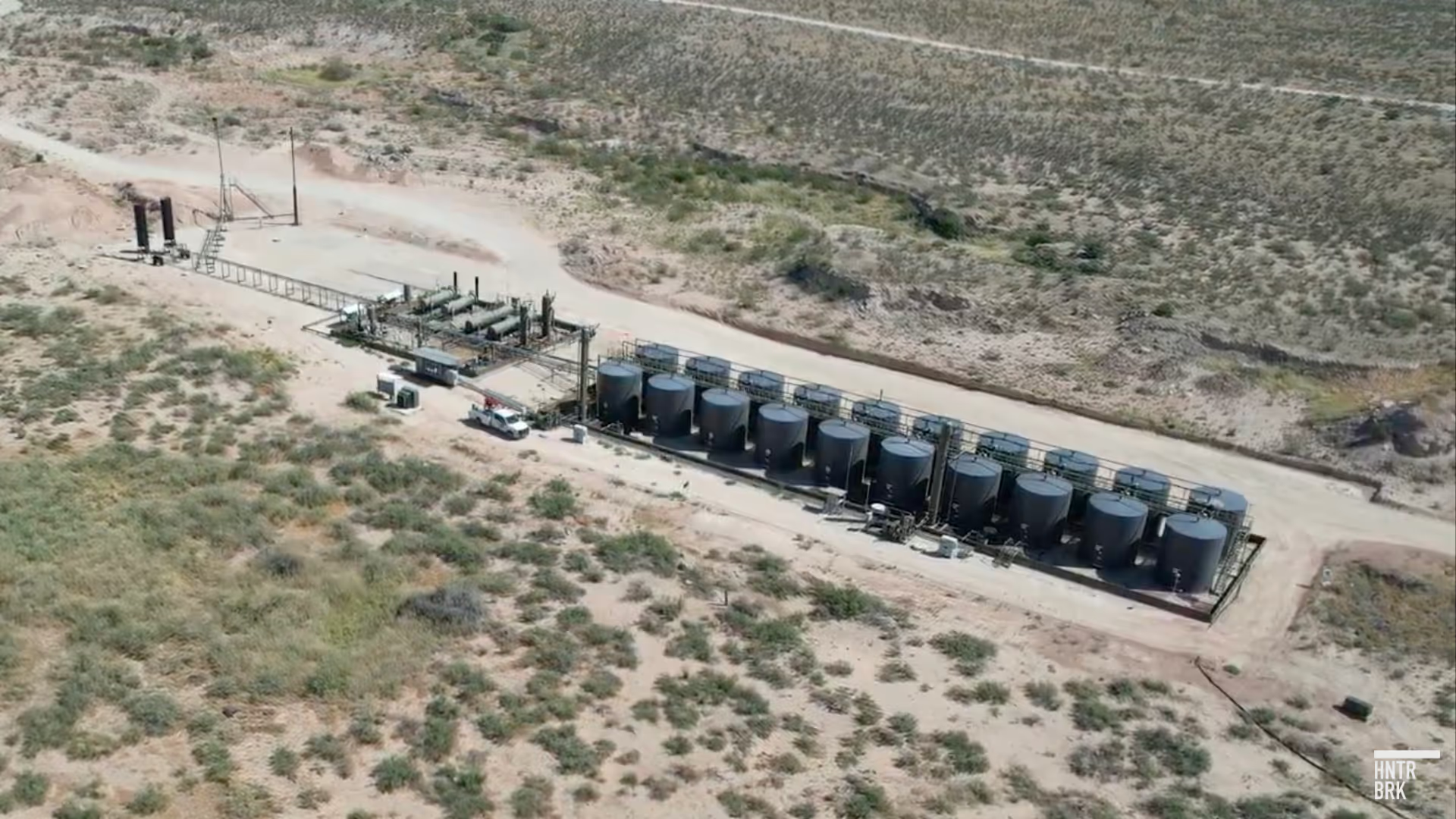
On September 29, the New Mexico Oil Conservation Division, or OCD, emailed Permian Resources regarding a possible methane leak at its tank battery on the arid flatlands near Carlsbad in southeastern New Mexico. The inquiry followed Hunterbrook reporting about a gas release containing cancer-causing chemicals at the site.
Hunterbrook has learned that the company admitted to regulators there had indeed been a gas release at its tank battery earlier this year — and that Permian submitted more than two dozen emissions reports, nine days after the OCD’s inquiry.
They show that the release went on for over a month: The leak at the tank battery started on January 20 and continued until February 25, except for four days without gas emissions during that time.
Along with the release reports, the company shared a statement with regulators that suggested the problem could have been fixed sooner, if not for an internal communications breakdown that delayed the repairs.
“Permian Resources field personnel identified a leaking valve on the vapor recovery piping at the [Central Tank Battery]. Field personnel put in a maintenance request for repair, but it was not elevated per Permian’s internal protocol, which delayed valve repair,” reads Permian’s statement, which Hunterbrook received from an OCD spokesperson.
Permian Resources did not respond to a request for comment.
Regulators continue to investigate the release at Permian’s tank battery. “OCD’s review of the incident is ongoing, and the Division is evaluating whether any additional compliance actions are warranted,” an OCD spokesperson told Hunterbrook.
Hunterbrook reported in September that a satellite spectrometer had picked up signs of a gaseous discharge near Permian’s tank battery in early February: a release of more than 1,400 kilograms of methane per hour, according to the nonprofit Carbon Mapper, which specializes in methane and carbon dioxide monitoring.
Researchers at the scientific institute PSE Healthy Energy took a closer look at this discharge. They said that based on gas samples in the same county, the release at Permian’s tanks did not just include methane — it was a toxic cocktail consisting of substances like benzene, ethylbenzene, hexane, toluene, and xylenes.
The PSE team modeled where the toxic plume moved, based on local weather conditions during the release. The resulting map showed that the contaminant cloud migrated in several directions and covered an area of almost 80 square miles, including large parts of Carlsbad and more than a dozen schools and childcare centers. It exposed more than 30,000 people to benzene, the researchers estimated.
The release reports Permian submitted in October did not include detailed information about all the hazardous pollutants that the released gas possibly contained. A compositional analysis submitted by the company does not list benzene, ethylbenzene, toluene, or xylenes. It does show that the gas contained hexanes, a group that includes n-hexane, though n-hexane is not specifically named. Inhaling n-hexane can cause nerve damage, according to the Agency for Toxic Substances and Disease Registry.
“We have high confidence that produced gas will contain benzene and other hazardous air pollutants, such as toluene, ethylbenzene, xylenes, and hexane, based on the fact that >99% of gas samples reported through the air permitting process across the US contained detectable levels of these compounds,” a PSE spokesperson told Hunterbrook.
Gas release data from Carbon Mapper also suggests that the amounts of gas released that Permian reported might be an undercount.
Carbon Mapper’s satellite spectrometer picked up the gas leak at Permian’s tank battery twice, on January 31 and February 7. Permian reported that it released 316,000 cubic feet of gas on January 31, or about 13,200 cubic feet per hour. According to its database, Carbon Mapper estimates that the emissions rate that day was actually about six times higher — about 83,300 cubic feet per hour.
For February 7, the nonprofit’s database shows that the emissions rate was more than 15 times higher than the numbers Permian reported.
The released gas amounts Permian reported for three days in January appear high enough to be considered “major” flaring. According to state guidelines, oil and gas operators are required to report such events to regulators within 24 hours. Even “minor” flares need to be reported within 15 days. Permian reported the release eight months after the fact.
Release Admission Comes Amid Expansion Plans
Permian Resources is expanding in New Mexico, with its first project within the Carlsbad city limits: 10 new oil wells and a central tank battery, dubbed the “Water Buffalo Unit.”
The permits for the project were approved by the Carlsbad City Council in June, despite several residents voicing concerns about oil drilling near their homes.
Hunterbrook drone imagery from September showed that the construction work at the new wells was progressing. The project is reportedly supposed to be completed by this fall.
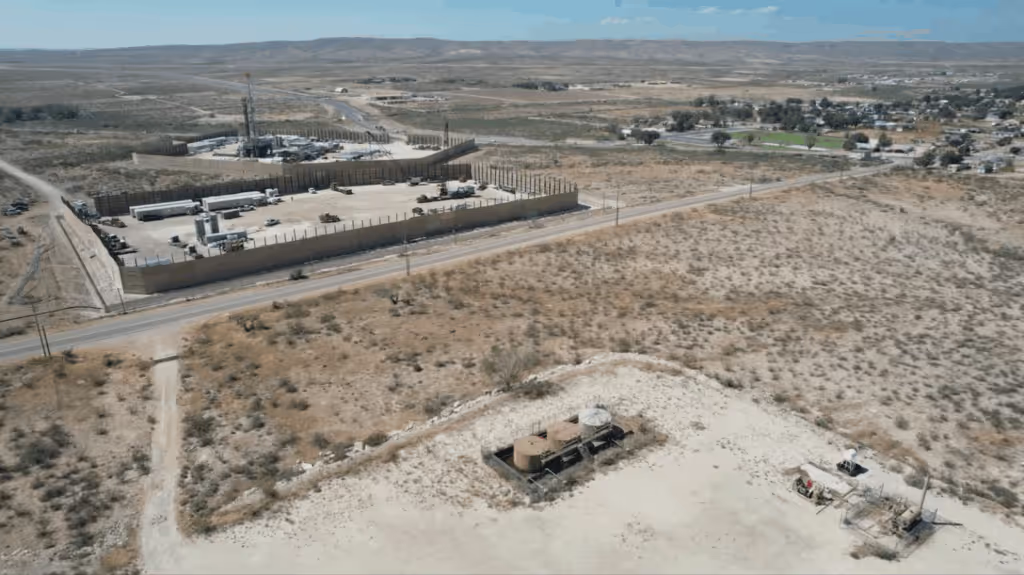
The delayed disclosure of the gas release at Permian’s tank battery east of Carlsbad raised concerns among residents about the company’s trustworthiness.
“From a Carlsbadian standpoint, knowing this now, the biggest issue is trust. Nobody around here expects perfection. But we do expect honesty,” Carlsbad resident Brittany Dye told Hunterbrook. She and her family moved to Carlsbad from Orlando last year.
“When these oil companies are not being honest about the harmful releases in our community we can’t make informed decisions regarding the health of ourselves, and more importantly, our children. That’s edging away from politics and into basic, personal safety,” Dye said.
Amid its expansion in Carlsbad, the company appears to be intent on staying on city officials’ good side: The company made a $200,000 “community partnership donation” to the City of Carlsbad, which will be used to buy a modular vehicle barrier, according to a press release.
City budget documents show that the donation was approved by Carlsbad’s budget committee on September 26, two days after Hunterbrook’s first article about the methane release at Permian’s tank battery was published. A city spokesperson did not respond to multiple requests for comment about the specific date Permian offered the donation to the city.
“Permian Resources’ commitment to the safety and well-being of our citizens is deeply appreciated,” Mayor Rick Lopez is quoted in the press release. “Their partnership reflects the strong bond between the energy industry and our community, ensuring Carlsbad remains both vibrant and secure.”
The Carlsbad mayor’s office did not respond to a request for comment for this article.
Till Daldrup is an investigative journalist who joined Hunterbrook from The Wall Street Journal, where he focused on open-source investigations and content verification. In 2023, he was part of a team of reporters who won a Gerald Loeb Award for an investigation that revealed how Russia is stealing grain from occupied parts of Ukraine. He has an M.A. in Journalism from New York University and a B.S. in Social Sciences from University of Cologne. He’s also an alum of the Cologne School of Journalism (Kölner Journalistenschule).
Michelle Cera trained as a sociologist specializing in digital ethnography and pedagogy. She completed her PhD in Sociology at New York University, building on her Bachelor of Arts degree with Highest Honors from the University of California, Berkeley. She has also served as a Workshop Coordinator at NYU’s Anthropology and Sociology Departments, fostering interdisciplinary collaboration and innovative research methodologies.
Sam Koppelman is a New York Times best-selling author who has written books with former United States Attorney General Eric Holder and former United States Acting Solicitor General Neal Katyal. He helped build Fenway Strategies into one of the preeminent strategic communications firms in the country—with side quests speechwriting for Michael Bloomberg, running the surrogate remarks operation on the Biden-Harris campaign, and co-founding Mayday, which is now one of the leading information providers on how to access reproductive health care in states with bans. Sam has published in the New York Times, Washington Post, Boston Globe, Time Magazine, and other outlets — and occasionally volunteers on a fire speech for a good cause. He has a BA in Government from Harvard, where he was named a John Harvard Scholar and wrote op-eds like “Shut Down Harvard Football,” which he tells us were great for his social life.