Hunterbrook Media’s investment affiliate, Hunterbrook Capital, does not have any positions related to this article at the time of publication. Positions may change at any time. Full disclosures below.
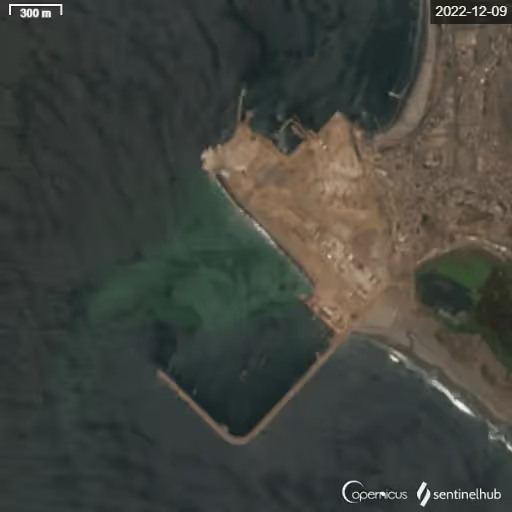
Peru has high hopes for Chancay, a new deep-water superport currently under construction some 50 miles north of the capital, Lima.
The port, costing approximately $3.6 billion, is part of China’s Belt and Road initiative, and is expected to become the principal gateway of trade between Asia and South America, lopping off as much as two weeks from freight times across the Pacific.
Expected to add 0.2% to the Andean nation’s GDP growth, Chancay, which can handle the latest generation of ultra-large ships, will funnel commodities such as metals, soy, corn and timber from as far afield as Colombia, Chile, Brazil, and Bolivia.
In doing so, it will transform international shipping routes, drawing traffic away from the saturated Panama Canal and other South American ports such as Guayaquil and Callao.
Initially, Chancay will handle around one million containers per year. That will eventually increase to five million annually. It’s set to be Peru’s first entirely private port — owned 60% by Chinese state-owned Cosco Shipping Corp. Ltd. (SSE: 601919) and 40% by Peruvian mining company Volcan (VCMBC1:CI), in which commodities giant Glencore (LSE: GLEN) has a large share.
Yet amid chronic political dysfunction, some fear the Peruvian government’s inattention, especially to the extensive infrastructure needed to service Chancay — above all road and rail networks — could represent a missed opportunity.
Risks could range from cargo backlogs to organized crime. The freight will be a sitting target, warns Alberto Ego-Aguirre, who chairs the Lima Chamber of Commerce’s commission for maritime, port, and customs affairs.
“At this point, there’s no escaping it,” he says. “There’s going to be a period of two or three years at least when the port is already operating but we’re still waiting for the supporting infrastructure.”
Specific projects that have finally been given the green light in Peru — but not in time to be ready for Chancay’s launch — include a $10 billion train along Peru’s Pacific coast, expected to begin running in 2031, and a ring road around Lima only due to begin construction in 2027.
Other roads due to reach deep into the Peruvian hinterland — and transport products from the Andes and Amazon — are behind schedule. Ego-Aguirre believes this, too, is a result of political chaos. “In comes a new minister, he fires everyone and puts in his own people and they don’t know what they’re doing,” says Ego-Aguirre.
Simeon Tegel is a British freelance journalist based in Lima, Peru, from where he also regularly roams across Latin America. He specializes in environmental stories, democracy and human rights and is a regular contributor to the Washington Post, among other media. A foodie and outdoorsman, he would not be anywhere other than Peru.
Sam Koppelman is a New York Times best-selling author who has written books with former United States Attorney General Eric Holder and former United States Acting Solicitor General Neal Katyal. He helped build Fenway Strategies into one of the preeminent strategic communications firms in the country—with side quests speechwriting for Michael Bloomberg, running the surrogate remarks operation on the Biden-Harris campaign, and co-founding Mayday, which is now one of the leading information providers on how to access reproductive health care in states with bans. Sam has published in the New York Times, Washington Post, Boston Globe, Time Magazine, and other outlets — and occasionally volunteers on a fire speech for a good cause. He has a BA in Government from Harvard, where he was named a John Harvard Scholar and wrote op-eds like “Shut Down Harvard Football,” which he tells us were great for his social life.