Hunterbrook Media’s investment affiliate, Hunterbrook Capital, does not have any positions related to this article at the time of publication. Positions may change at any time. Full disclosures below.
A California oil and gas regulator has decided not to enforce a new environmental protection law in its first big test: a merger between California Resources Corp (NYSE: $CRC) and Aera Energy LLC. It’s a decision the legislation’s author, Assemblymember Wendy Carrillo, warns “would set a terrible precedent.”
The July 1 merger is “exactly why” the new law — designed to require oil companies buying old or underperforming oil wells to set aside funds for cleanup — was passed, Carrillo (AD-52) said in an emailed statement to Hunterbrook Media. “Not enforcing the policy as intended sets up our state for a potential financial catastrophe.”
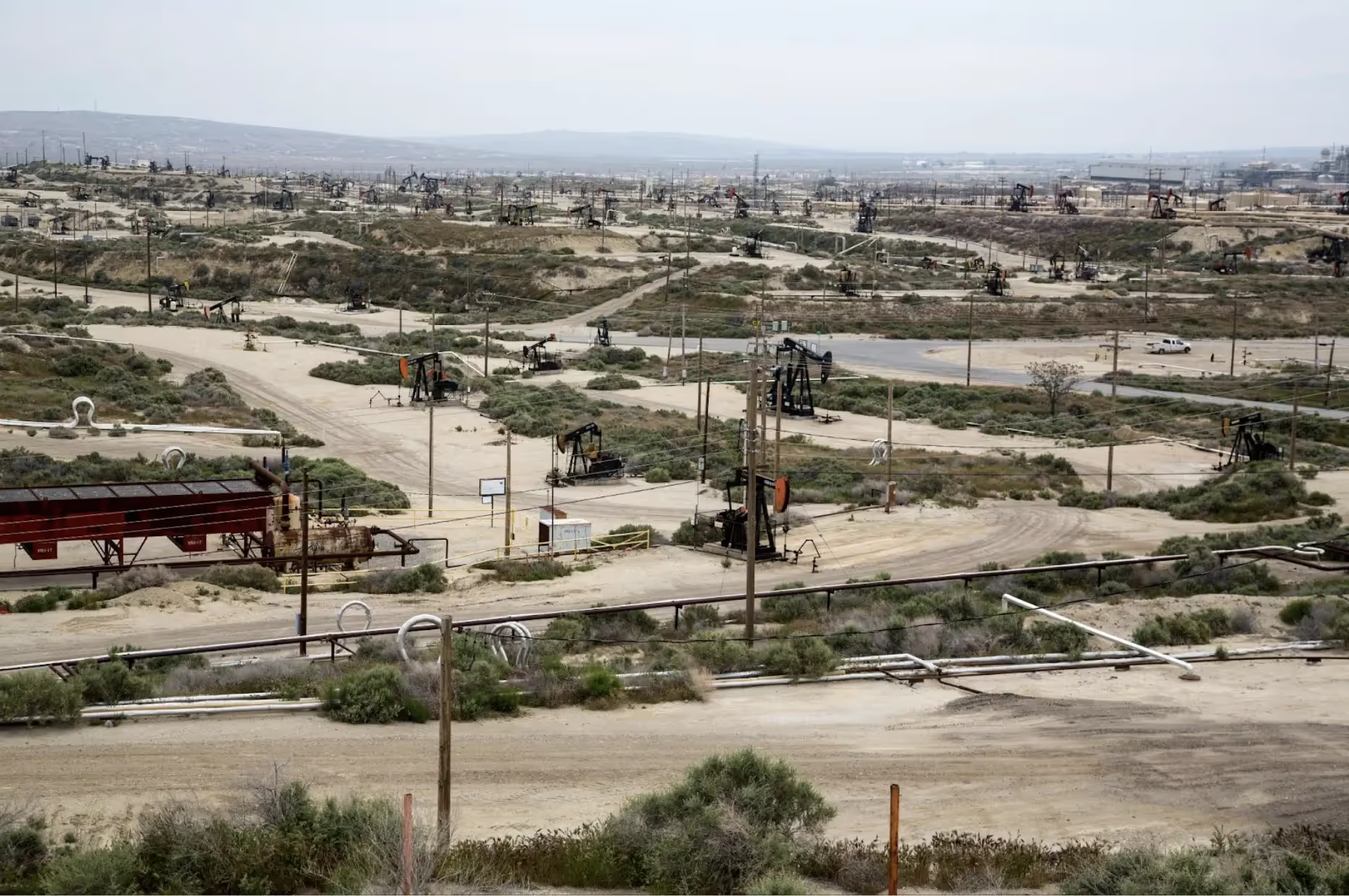
Oil and gas wells left unplugged can lead to potent greenhouse gas emissions and contaminant releases into the water and air. It is common in the oil and gas industry for companies to offload their declining assets to other operators instead of paying for cleanup costs. This practice, among others, has led to many of these wells remaining unretired years after they have stopped producing oil and gas, with their operators failing to take the steps required to properly fill and plug them.
The new California law was passed with the goal of ensuring that oil companies acquiring these declining wells, rather than the public, cover the costs of retiring them.
Oil majors’ exit leaves concentration in unretired well landscape
CRC is a 2014 spin-off of oil major Occidental Petroleum Corp. (NYSE: $OXY). In 2020, CRC declared bankruptcy, before restructuring months later.
Aera is a former joint venture of oil majors Shell plc (NYSE: $SHELL) and ExxonMobil Corp. (NYSE: $XOM), which the German private equity group Institut für Kapitalanlagen und Versicherungslösungen GmbH (known as IKAV) bought in 2022 for $4 billion. Just two years later, CRC acquired Aera from IKAV for $2.1 billion.
Aera owns more unretired and low-producing wells than any other operator in the state, according to state data analyzed by the environmental nonprofit FracTracker Alliance. Combined, the two entities will control more than 40,000 active and idle wells across California, almost 16,000 of which are idle and many of which are low-producing, according to data from the California Department of Conservation analyzed by Hunterbrook Media.
CRC, itself, had expressed a concern that depending on how AB 1167 was enforced, it could interfere with its merger or future deals. “Implementation of this law may lead to the delay or additional costs with respect to certain acquisitions or dispositions, which could impact our ability to grow or explore new strategic areas — or exit others — within the state of California,” the company wrote in SEC filings.
In response to the California Department of Conservation’s decision, a coalition of over 70 environmental, health, and community organizations sent a letter on Tuesday to the agency.
The letter urges the Department of Conservation’s Geologic Energy Management Division to reconsider its position and apply AB 1167’s bonding requirements to CRC’s acquisition of Aera. The groups argue that CalGEM’s stance is “inconsistent with the letter and spirit of the law.”
“If these provisions are not enforced,” they said, “frontline communities will bear the brunt of the fallout.”
California Resources did not return requests for comment.
CalGEM rejects plea from legislators to protect against “unprecedented consolidation” of California’s idle wells
On June 11, 2024 legislators sent a letter to CalGEM calling on the regulator to wield its authority under AB 1167 to require CRC to put aside a bond to cover what the coalition of lawmakers estimate to be a “price tag well over a billion dollars.”
Without AB 1167’s protections, the legislators warned, the merger would risk creating a “single entity that is too big to fail,” emphasizing that the deal would “result in unprecedented consolidation of California’s idle wells, placing control of roughly 40 percent of them in the hands of CRC.”
In a June 27, 2024 response, David Shabazian, Director of California’s Department of Conservation, stated that the regulator would not apply the new bonding requirements to the CRC-Aera merger.
Shabazian reasoned that Aera didn’t change ownership, due to the fact that CRC bought it from another holding company. Since “publicly traded corporations, including CRC change ownership every day as shareholders buy and sell their shares,” he wrote, “none of those new corporate owners have any power to control the corporation’s assets or to operate its wells and facilities.”
When asked whether it is setting a precedent that publicly traded companies will be exempt from the new bonding requirements, the California Department of Conservation declined to comment.
As reported by Politico, which first covered the agency’s decision to not apply the law, the Department said that it would monitor the situation and if “any wells, or the right to operate wells, are transferred to a new owner of record, then the provisions of AB 1167 would apply.”
California Resources did not indicate to Hunterbrook Media whether it intends to file any paperwork to indicate a change in an owner of record. But nonprofit publication Capital & Main reported that it had obtained a February email in which CRC wrote: “There will be no change in the organizational structure of Aera Energy LLC or its operating subsidiaries as a result of this transaction.”
Regulator reasoning receives criticism, could lead to billions in uncovered well retirement costs
According to the terms of the agreement between CRC and Aera, all of Aera’s assets, including the “oil and gas properties” and corresponding wells, are being merged into a “wholly owned direct subsidiary” of CRC. The contract ensures that each entity and their subsidiaries grant “all interests” in their oil and gas properties to the surviving parent, CRC.
This suggests that CRC, as the parent corporation, will have complete control over Aera and its subsidiaries’ assets.
Clark Williams-Derry, an energy finance analyst at the Institute for Energy Economics and Financial Analysis, criticized the Department of Conservation’s interpretation of the new law, in emails exchanged with Hunterbrook Media. “The fact that this is an all-stock transaction, and that shareholders don’t directly control CRC’s business decisions, is totally irrelevant. What matters isn’t whether shareholders control CRC’s wells, it’s whether CRC itself does.”
Environmental nonprofit Center for Biological Diversity’s Senior Counsel and Climate Law Institute Director Kassie Siegel told Hunterbrook Media in an interview the agency’s decision is a “dereliction of duty.”
“This agency is supposed to protect Californians, not the industry it is captured by,” she continued.
The regulator’s decision could have substantial financial implications. DeSmog, a publication focused on climate change, calculated the possible bond at $1.3 billion. But the law gives discretion to the agency.
The Sierra Club last year estimated that the cost to clean up just the portion of California Resources and Aera’s wells that are no longer in production would be $3.5 billion. If the active wells were included too, the cost would be billions more.
Daniel Sherwood contributed reporting. Sherwood joined Hunterbrook from The Capitol Forum, a premium subscription financial publication, where he was an Editor & Senior Correspondent, writing and managing market-moving investigative reports and building the Upstream database. Prior to The Capitol Forum, Daniel has experience conducting undercover investigations into fossil fuel companies and other research. He also served as an Honors Law Clerk in the Criminal Enforcement Division of the EPA. He has a JD from Michigan State University. Daniel is based in Michigan.
Sam Koppelman is a New York Times best-selling author who has written books with former United States Attorney General Eric Holder and former United States Acting Solicitor General Neal Katyal. He helped build Fenway Strategies into one of the preeminent strategic communications firms in the country—with side quests speechwriting for Michael Bloomberg, running the surrogate remarks operation on the Biden-Harris campaign, and co-founding Mayday, which is now one of the leading information providers on how to access reproductive health care in states with bans. Sam has published in the New York Times, Washington Post, Boston Globe, Time Magazine, and other outlets — and occasionally volunteers on a fire speech for a good cause. He has a BA in Government from Harvard, where he was named a John Harvard Scholar and wrote op-eds like “Shut Down Harvard Football,” which he tells us were great for his social life.