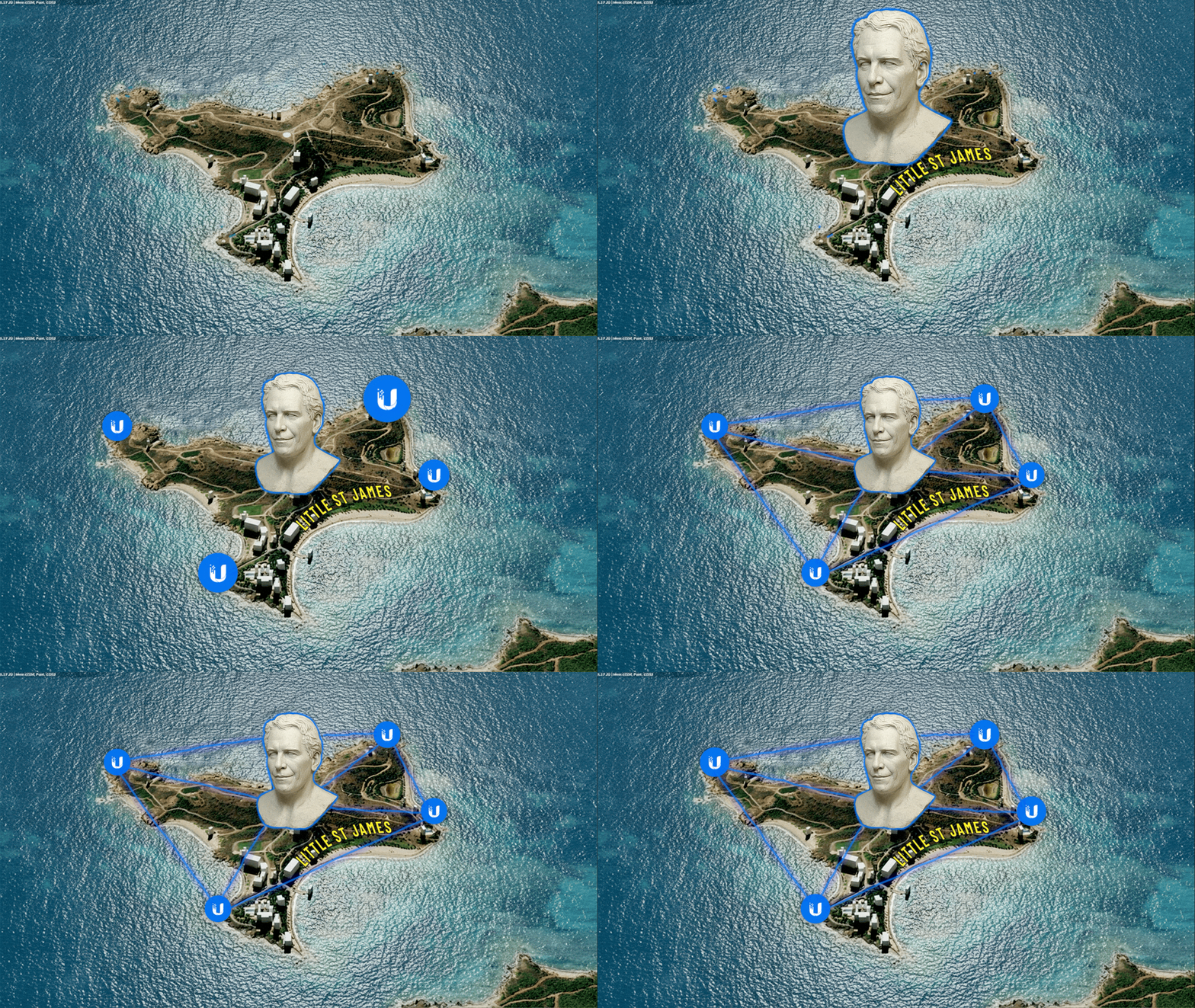
Based on Hunterbrook Media’s reporting, Hunterbrook Capital is short $UI and long a basket of comparable securities at the time of publication. Positions may change at any time. See full disclosures below. Our affiliate Hunterbrook Law is in conversations with litigation firms regarding potential private litigation.
The jury is out on whether Jeffrey Epstein was working with Russia. But they apparently shared a loyalty to the same wireless supplier: Ubiquiti.
Emails and photographs from the Epstein files reviewed by Hunterbrook Media reveal that Ubiquiti ($UI) equipment was integral to the communications and surveillance infrastructure on Epstein’s notorious private island, Little St. James, in the U.S. Virgin Islands.
Epstein appears to be part of a specific consumer class: bad actors who put a primacy on privacy and are drawn to Ubiquiti’s local control architecture. That seemingly includes the Russian military fighting in Ukraine, as Hunterbrook recently revealed in an investigation that has since reached millions.
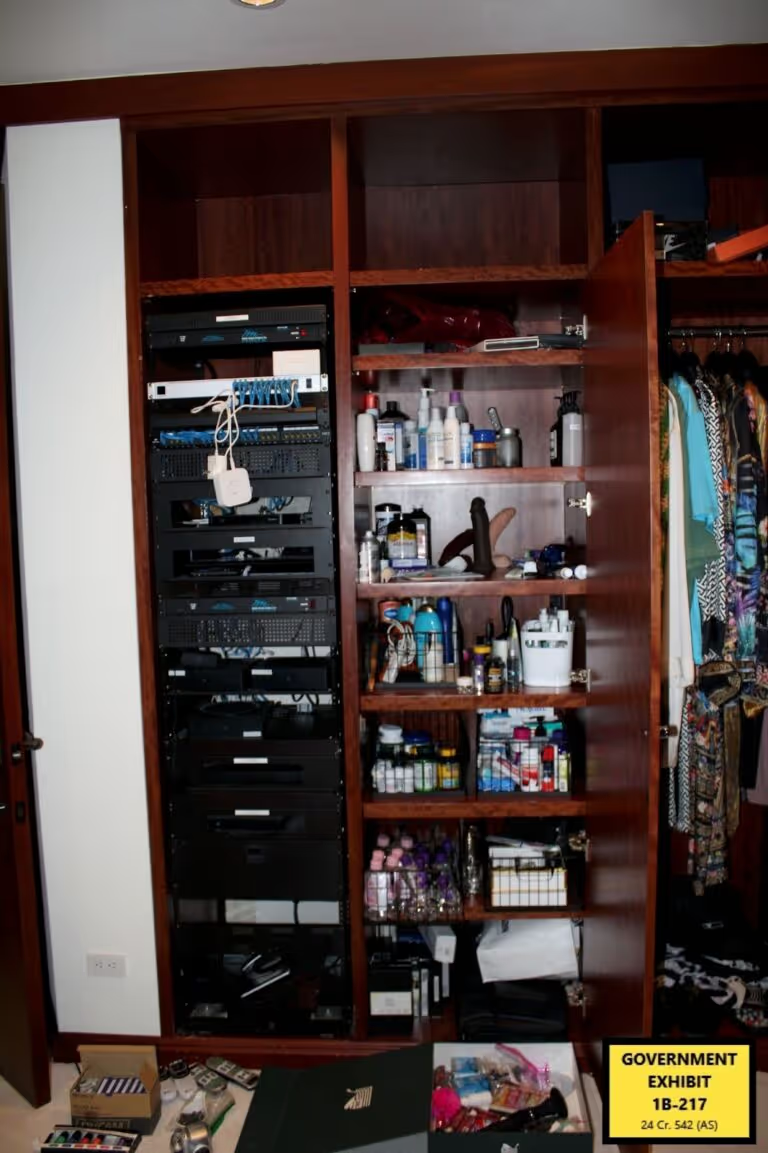
Also apparently a Ubiquiti fan: Sean Combs, known as P. Diddy. This assumption is based on a Department of Justice image from a separate investigation depicting what Hunterbrook has identified as a Ubiquiti device photographed inches away from some of the “Mo Money Mo Problems” artist’s notorious collection of baby oil and sex toys.
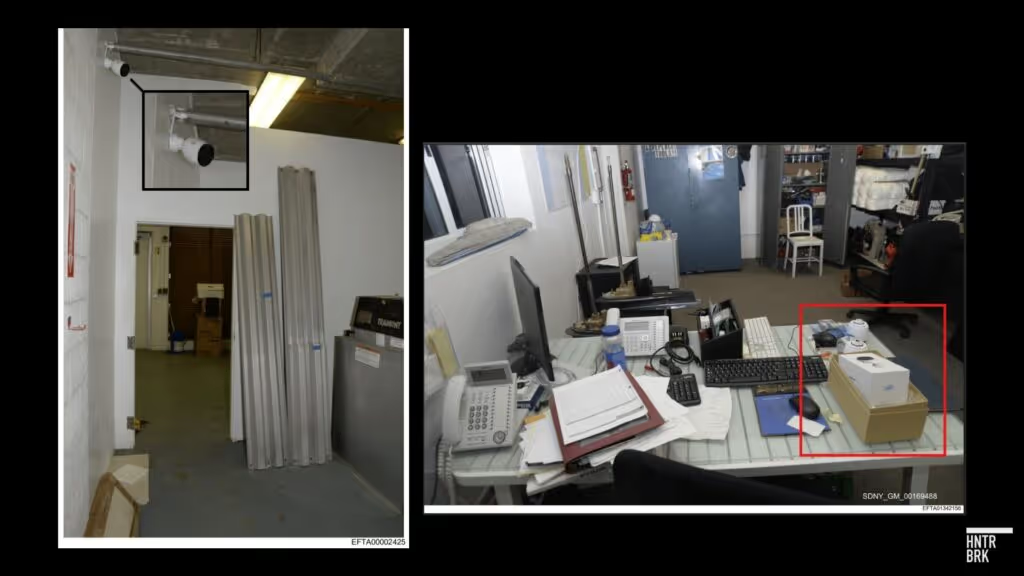
Evidence of Ubiquiti’s role on Epstein’s island is starker, with photos pointing also to a surveillance system supported by Ubiquiti.
One photograph taken from the island by the FBI shows a box of what appears to be a UniFi Video G3 — Ubiquiti’s surveillance camera. Another photo of a storage area shows what appears to be the same camera — with Ubiquiti’s “U” logo on it — mounted near the ceiling. The FBI also seized a UniFi Video Recorder from the server rack, according to an FBI log of items collected from Little St. James.

The hardware visible in these photos goes beyond what would be needed for a simple island internet hookup. This is an enterprise-grade communications operation, according to Steven Burgess, a court-recognized expert on digital forensics. He reviewed six images of Ubiquiti equipment from the Epstein files.
“It’s more than you would need to bring the internet to it, but it’s probably not more than what you would need to coordinate several hundred devices,” Burgess told Hunterbrook, estimating the setup could support 800 to 1,000 devices — what one might expect for large gatherings or dignitaries traveling with security details.
As for what data may have been stored on the servers: “Anything and everything. Pictures, communications, emails, documents, whatever,” Burgess said. He said that there likely was a log of devices that interacted with Epstein’s Wi-Fi network, such that if a visitor were carrying a smartphone, that connection to the Wi-Fi would be recorded.
The documents show that the tech staff at Epstein’s island specifically sought out Ubiquiti products for Wi-Fi coverage, network switching, and security camera systems beginning in late 2017 and continuing through at least 2019, the year Epstein was arrested on federal sex trafficking charges.
The paper trail apparently began in December 2017, when Jermaine Ruan, who seemingly worked for Epstein on the island property known as “LSJ,” said he reached out to Ubiquiti for a quote.
“I have approach Ubiquiti network solutions … to quote me their recommendation for equipment for the wifi,” Ruan wrote in a December 28, 2017, email to Epstein.
The email thread reveals an island struggling with significant infrastructure challenges: “Areas that don’t have internet due to fiber damage … will be set up with a wireless bridge to bring them back online.”
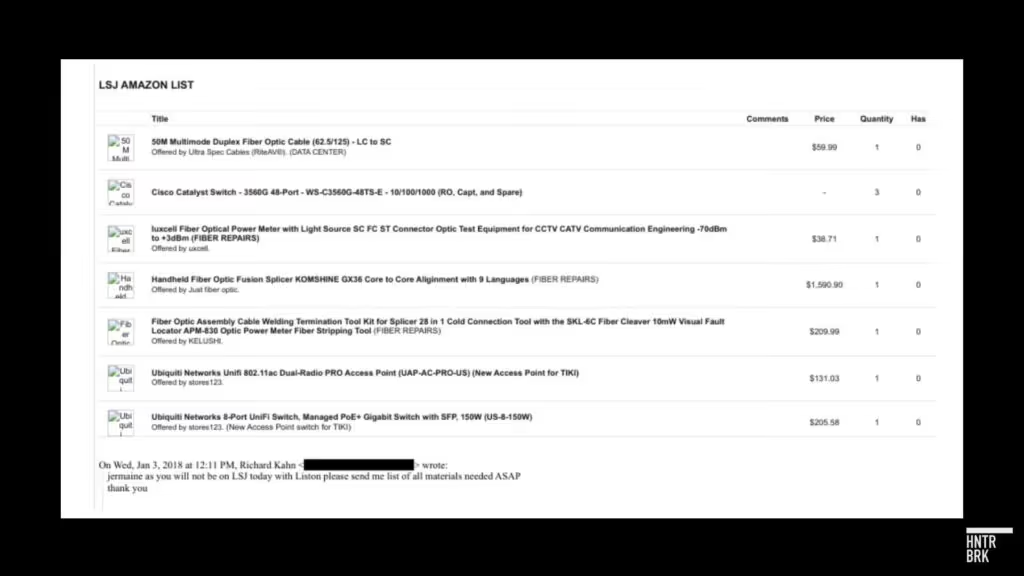
By January 2018, Ruan was compiling detailed procurement lists for network equipment. In response, Epstein wrote, “order today,” referring to an email list labeled “LSJ AMAZON LIST” that included multiple Ubiquiti products.
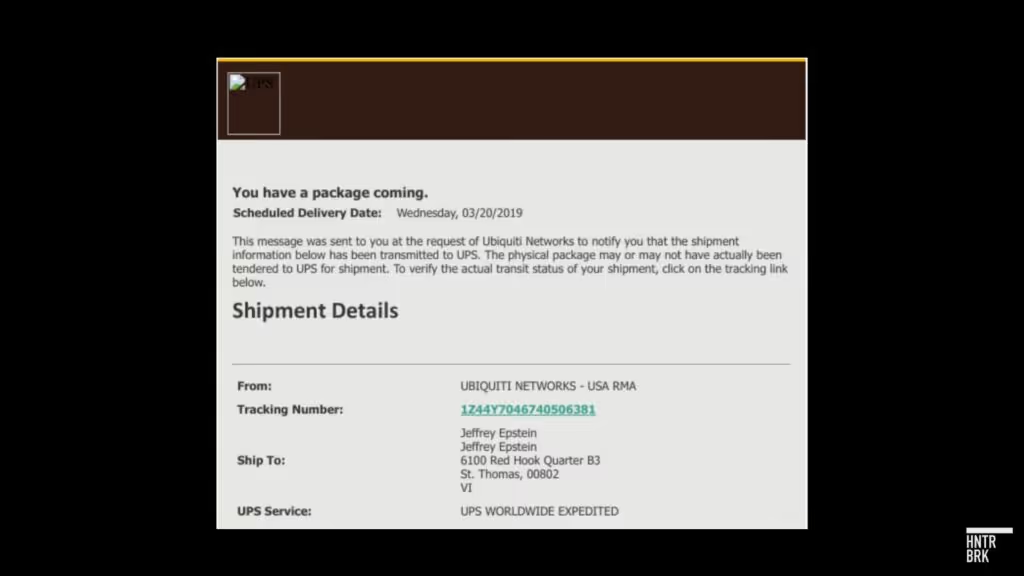
The installation appears to have continued through March 2019. “I will be scheduling myself to be on LSJ from Wednesday to Friday … to install, configure, and setup the new incoming equipment to the island,” Liston Thomas, a tech contractor, wrote in a March 15, 2019, email. Further back in the email chain is a UPS delivery confirmation on the same day from Ubiquiti to Jeffrey Epstein.
Privacy Primacy: Why Not Google?
Perhaps unsurprisingly, the preference for Ubiquiti may have been driven by a need for privacy and local control. When discussing home Wi-Fi options for a separate property in Connecticut in July 2018, a technology consultant named James Ce explicitly warned against Google’s mesh Wi-Fi products.
“Software wise, it’s even worse,” Ce wrote of Google Wi-Fi in a July 20, 2018, email. “Google manages the configuration of the routers and the traffic on their servers remotely. Besides the privacy nightmare scenario there — they literally can use every site you visit to build profiles of you — if their servers go down, so does your internet.”
Ce instead recommended Ubiquiti’s consumer mesh product: “The Ubiquiti Labs Amplifi HD wireless mesh system should be perfect for your home.”
Unanswered Questions
Hunterbrook found no evidence Ubiquiti knew about the end use of its equipment on Epstein’s island. The company’s products are widely used in commercial and residential deployments. Other than the UPS confirmation on a delivery from Ubiquiti, there is no indication the company had knowledge of its recording devices being used by a sex offender. (Which, you know, was probably kind of the point!)
The documents don’t reveal what specific footage was captured by the camera systems, but they indicate that the storage devices themselves have been seized by the DOJ as potential evidence.
Ubiquiti did not respond to multiple requests for comment.
Read Hunterbrook’s full, months-long investigation into Ubiquiti and Russia here.
Blake Spendley joined Hunterbrook from the Center for Naval Analyses (CNA), where he led investigations as a Research Specialist for the Marine Corps and US Navy. He built and owns the leading open-source intelligence (OSINT) account on X/Twitter, called @OSINTTechnical (over 1 million followers), which also distributes Hunterbrook Media reporting. His OSINT research has been published in Bloomberg, the Wall Street Journal, and The Economist, among other top business outlets. He has a B.A. in Political Science from USC.
Sam Koppelman is a New York Times best-selling author who has written books with former United States Attorney General Eric Holder and former United States Acting Solicitor General Neal Katyal. He helped build Fenway Strategies into one of the preeminent strategic communications firms in the country—with side quests speechwriting for Michael Bloomberg, running the surrogate remarks operation on the Biden-Harris campaign, and co-founding Mayday, which is now one of the leading information providers on how to access reproductive health care in states with bans. Sam has published in the New York Times, Washington Post, Boston Globe, Time Magazine, and other outlets — and occasionally volunteers on a fire speech for a good cause. He has a BA in Government from Harvard, where he was named a John Harvard Scholar and wrote op-eds like “Shut Down Harvard Football,” which he tells us were great for his social life.
Jenny Ahn joined Hunterbrook after serving many years as a senior analyst in the US government. She is a seasoned geopolitical expert with a particular focus on the Asia-Pacific and has diverse overseas experience. She has an M.A. in International Affairs from Yale and a B.S. in International Relations from Stanford. Jenny is based in Virginia.
Andrew Ford is an investigative journalist who exposed systemic flaws and prompted reforms in healthcare, business, policing, and state government. His reporting was published by ProPublica, USA Today, The Arizona Republic, Asbury Park Press, and Florida Today. He holds a journalism bachelor’s from the University of Florida and received a data analytics master’s from Georgia Institute of Technology. He is based in Phoenix, AZ.
Jim Impoco is the award-winning former editor-in-chief of Newsweek who returned the publication to print in 2014. Before that, he was executive editor at Thomson Reuters Digital, Sunday Business Editor at The New York Times, and Assistant Managing Editor at Fortune. Jim, who started his journalism career as a Tokyo-based reporter for The Associated Press and U.S. News & World Report, has a Master’s in Chinese and Japanese History from the University of California at Berkeley.
Dan DeLorenzo is a creative director with 25 years reporting news through visuals. Since first joining a newsroom graphics department in 2001, he has built teams at Bloomberg News, Bridgewater Associates, and the United Nations, and published groundbreaking visual journalism at The Wall Street Journal, Associated Press, The New York Times, and Business Insider. A passion for the craft has landed him at the helm of newsroom teams, on the ground in humanitarian emergencies, and at the epicenter of the world’s largest hedge fund. He runs DGFX Studio, a creative agency serving top organizations in media, finance, and civil society with data visualization, cartography, and strategic visual intelligence. He moonlights as a professional sailor working toward a USCG captain’s license and is a certified Pilates instructor.