Hunterbrook Media’s investment affiliate, Hunterbrook Capital, does not have any positions related to this article at the time of publication. Positions may change at any time. Full disclosures below.
U.N. human rights experts have formally demanded answers from the Namibian government about decades of alleged environmental contamination and worker safety violations at the Tsumeb copper smelter, following investigative reporting by Hunterbrook Media that exposed widespread health impacts on local communities.
In a strongly worded letter dated June 11, 2025, and obtained by Hunterbrook today, four U.N. Special Rapporteurs expressed “most serious concern” about arsenic and sulfur dioxide contamination affecting workers and residents in Tsumeb, where Canadian miner Dundee Precious Metals (TSX: DPM) operated the facility until selling it to Chinese firm Sinomine Resource Group (SHE: 002738) last September for $20 million — less than half the initially announced price.
The U.N. intervention marks a significant escalation in international scrutiny of the smelter, which Hunterbrook Media first reported in May 2024 had caused “systemic overexposure” to arsenic among community members and hospitalized as many as 48 workers in a single year.
Sinomine did not respond to Hunterbrook Media’s request for comment.
“Grandfather Clause” Under Fire
The U.N. experts specifically questioned a controversial “grandfather clause” that has allowed successive owners — including Weatherly International, based in the U.K.; Dundee Precious Metals; and now Sinomine — to avoid liability for environmental damage dating back to the 1960s.
“The sale included a so-called ‘grandfather clause,’ which works as a non-assumption of liabilities clause,” the U.N. letter states, noting that such provisions “foster de facto impunity” and allow continued pollution without accountability.
The letter reveals new details about the extent of contamination: Soil samples near the smelter showed arsenic levels of 229 mg/kg — potentially hazardous compared to natural U.S. levels of 0.1mg/kg-40 mg/kg. Workers report suffering from arsenic-induced skin conditions, respiratory problems, and in some cases, infertility or miscarriages linked to toxic exposure.
Workers Denied Medical Records
According to the U.N. letter, employees who request their health records face “formal warnings or termination,” while under Sinomine’s new ownership, workers must sign liability waivers before receiving test results.
The letter describes a system where on-site doctors inform workers if their arsenic levels are high but refuse to provide specific diagnoses or medical records needed for proper treatment — a practice the U.N. notes violates Namibia’s ethical guidelines for health professionals.
In a statement to Hunterbrook, Dundee said: “During our ownership, the on-site clinic provided primary healthcare, health monitoring and employee wellness services. Medical assessments were conducted by independent third-party providers, using their own equipment. There was a a formal process was in place for employees to access their medial records to ensure doctor-patient confidentiality and the security of their sensitive, personal medical information.”
Dundee added that it had “welcomed various independent studies of the health of employees and residents, including one with the World Health Organization. These results were made public, presented to the community and show our operations remained within international and Namibian guidelines.”
“As part of our commitment to continue monitoring community health, we conducted an additional health study in 2023, which reaffirmed earlier findings.
“Notably the studies confirmed that the average biological exposure index for Tsumeb residents showed no significant difference when compared to the control population in Oshakati, a city located almost 300 kilometres away from Tsumeb,” said Dundee.
Water Crisis Deepens
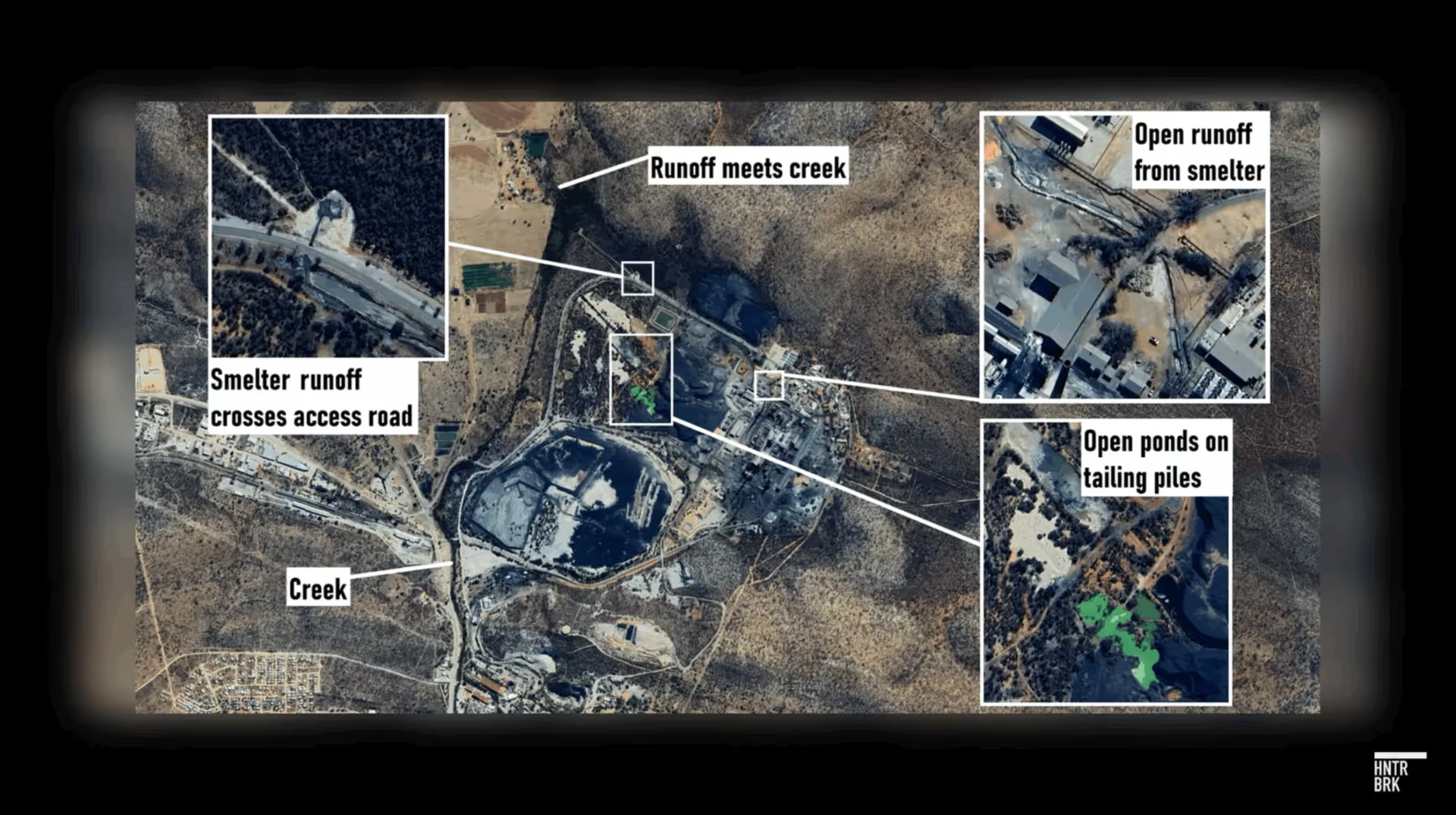
The contamination extends beyond the smelter’s gates. The U.N. letter confirms what Hunterbrook first reported using satellite imagery: Visible runoff from the facility appears to flow into local water systems. Tsumeb’s boreholes reportedly show elevated arsenic and sulfate levels, with one measuring 0.11 mg/L of arsenic — 11 times the World Health Organization guideline for drinking water, according to the U.N.
Community members described brown-tinted tap water with white particles, the U.N. reported, and many have stopped drinking from municipal sources entirely. The crisis is compounded by a cryptosporidium parasite outbreak that has led to boil-water advisories — a measure that actually concentrates arsenic rather than removing it.
International Pressure Mounts
The U.N. communication, signed by Special Rapporteurs on hazardous substances, business and human rights, environment, and water and sanitation, gives Namibia 60 days to respond before the findings are made public through official U.N. channels. Similar letters have been sent to Canada, China, and the U.K. — home countries of the smelter’s current and former owners.
Former Tsumeb Mayor Engelbrecht A. Nawatiseb, who spoke to Hunterbrook Media for its original investigation, had warned: “The rehabilitated tailings dam is not rehabilitated, and in the long run, the people of Tsumeb will suffer.”
The U.N. experts are demanding Namibia explain how it will ensure independent health assessments, provide access to medical information, and secure accountability from companies that have profited from the smelter while leaving behind a toxic legacy affecting generations of Namibians.
Sam Koppelman is a New York Times best-selling author who has written books with former United States Attorney General Eric Holder and former United States Acting Solicitor General Neal Katyal. He helped build Fenway Strategies into one of the preeminent strategic communications firms in the country—with side quests speechwriting for Michael Bloomberg, running the surrogate remarks operation on the Biden-Harris campaign, and co-founding Mayday, which is now one of the leading information providers on how to access reproductive health care in states with bans. Sam has published in the New York Times, Washington Post, Boston Globe, Time Magazine, and other outlets — and occasionally volunteers on a fire speech for a good cause. He has a BA in Government from Harvard, where he was named a John Harvard Scholar and wrote op-eds like “Shut Down Harvard Football,” which he tells us were great for his social life.
Nyasha Nyaungwa is an African media industry veteran with over 20 years of experience. Nyasha has gained first-hand knowledge of local, regional and international finance through his work as a Reuters correspondent, sub-editor of the Namibia Economist and news editor of the Windhoek Observer, among other publications. His interests span mining, energy, financial markets, politics and the environment with a strong focus on the Southern African region.
Wendy Nardi joined Hunterbrook after working as a developmental and copy editor for academic publishers, government agencies, Fortune 500 companies, and international scholars. She has been a researcher and writer for documentary series and a regular contributor to The Boston Globe. Her other publications range from magazine features to fiction in literary journals. She has an M.A. in Philosophy from Columbia University and a B.A. in English from the University of Virginia.