Hunterbrook Media’s investment affiliate, Hunterbrook Capital, does not have any positions related to this article at the time of publication. Positions may change at any time. Full disclosures below.
Vietnam has been conspicuously overlooked by American tech giants in their recent wave of AI investments across Southeast Asia.
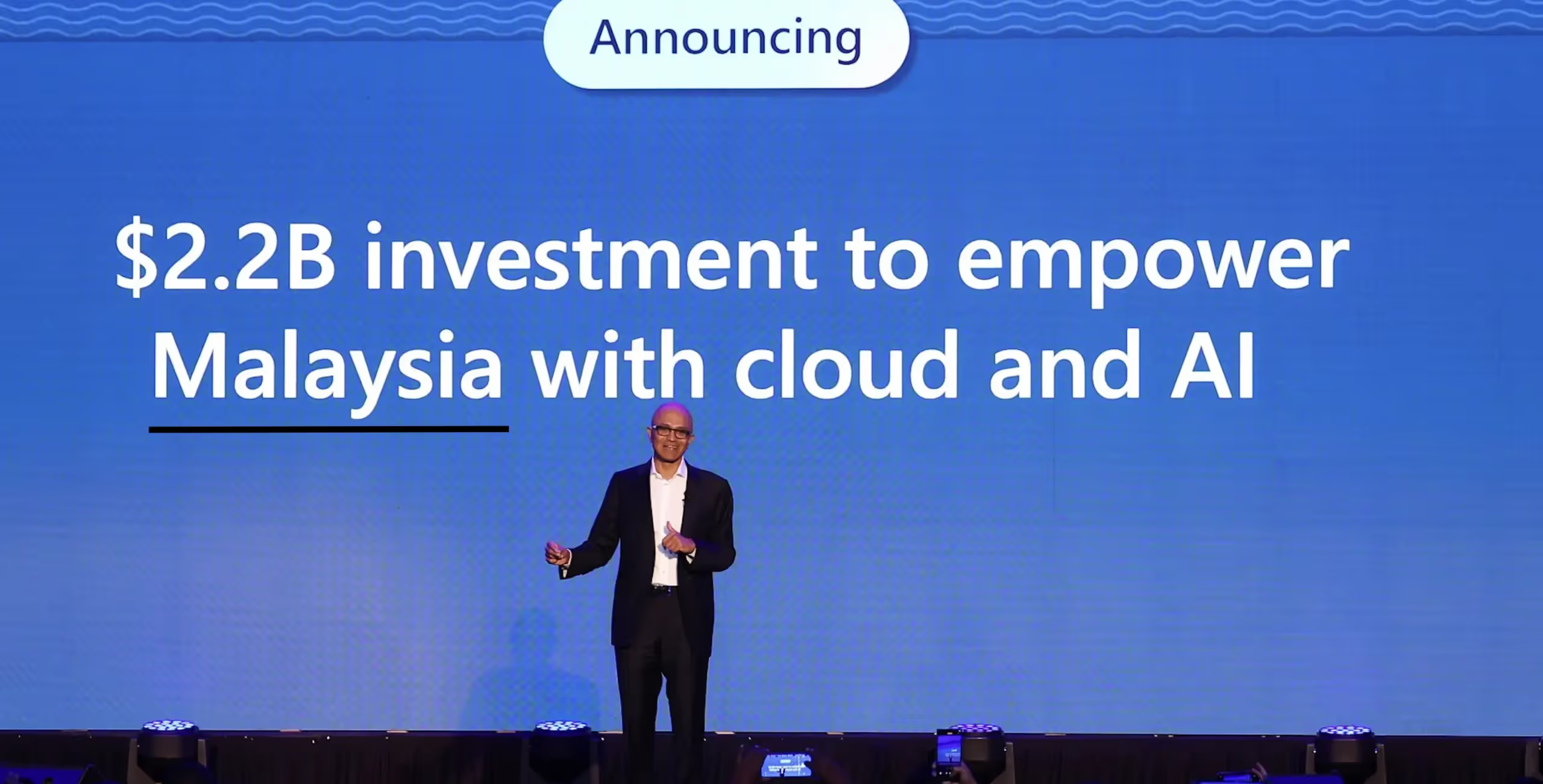
During Satya Nadella’s tour of the region earlier this year, the Microsoft (NASDAQ: $MSFT) Chief Executive Officer skipped Vietnam, opting instead to announce multibillion-dollar investments in Indonesia and Malaysia to expand cloud and IT services. The company also promised that by 2025, it would provide AI upskilling opportunities for 2.5 million people in the Association of Southeast Asian Nations region, which includes Vietnam.
Google (NASDAQ: $GOOG) and Nvidia (NASDAQ: $NVDA) have also chosen to invest heavily in Malaysia, with a $2 billion data center and a $4.3 billion AI partnership, respectively.
The most prominent AI investment in Vietnam this year was significantly smaller: a $200 million partnership between Vietnamese tech group FPT Corp. and Nvidia. And last November, Reuters reported that Intel (NASDAQ: $INTC) had canceled plans to expand its existing semiconductor packaging and testing plant in Ho Chi Minh City due to concerns about red tape and electricity supply. Vietnamese officials reportedly denied the news.
Apple (NASDAQ: $AAPL) CEO Tim Cook did visit Hanoi in mid-April and said he wanted to invest further in suppliers in Vietnam, but the company has yet to announce concrete investments.
Vietnam has been touted as a potential beneficiary of the “China+1” strategy, which refers to the incentive for companies to diversify their supply chains and investments away from China. The shift was driven by concerns over geopolitical risks, rising costs, and the impact of U.S. tariffs on Chinese exports.
Investment data, however, suggests that while Western companies have diversified their operations across Southeast Asia, it is Chinese companies themselves that are leading the way in diversifying their operations to Vietnam.
Through the first five months of 2024, Chinese companies reportedly accounted for 28.3% of new investments in Vietnam, more than any other country, according to a website run by the state-controlled Vietnam News Agency. The top five sources of foreign direct investment were Singapore, Hong Kong, Japan, China, and South Korea, with the United States notably absent.
This trend suggests that Chinese companies may be hedging against geopolitical risks and U.S. tariffs by expanding into Vietnam, effectively co-opting the China+1 strategy. While this may benefit Vietnam’s economy, it also means that the country remains heavily reliant on Chinese investment and supply chains.
The potential risks associated with doing business in Vietnam have also become increasingly clear. Last summer, Vietnam faced widespread brownouts. And Reuters reported that Foxconn (TPE: 2354), a major Apple supplier, was recently asked by the Vietnamese government to reduce power consumption at their facilities by 30% amid concerns that electricity demand will outstrip supply in key industrial areas.
Vietnam Electricity, the state-owned energy utility that has a monopoly on electricity distribution, allegedly rejected the Reuters reporting.
Semiconductor supplier Amkor’s (NASDAQ: AMKR) new $1.6 billion plant in Bac Ninh is just around 13 miles from Foxconn’s facilities, raising questions about whether it, too, will be impacted by the electricity shortage. Bac Ninh Electricity Company has conducted scheduled electricity outages in areas of the province throughout this year.
This comes as the Vietnamese government fails to meet its goals for public spending — a challenge that has persisted for years despite substantial financing needs for critical infrastructure like new power plants and transmission lines.
According to VnEconomy, a website run by the Vietnam Economic Association, through the end of April, just 16.4% of the annual public expenditure goal was spent. Though an improvement from the same period in 2023, at that rate, the country would be on pace to reach just 65.6% of its target by year-end.
Ho Chi Minh City, Vietnam’s commercial capital, is in even worse shape. The city is expected to see slower growth in the second quarter, in part due to lagging public budget spending. Through the end of May, the city government had only disbursed 14% of its total target for 2024.
Municipal leaders had set a goal of spending nearly $160 million per week in April and May but only managed to spend about $8 million each week.
“Vietnam shouldn’t be complacent that they’re the only ‘party in town,’” Jack Nguyen, CEO of InCorp Vietnam, which describes itself as a market-entry advisory company, told Hunterbrook Media. Vietnam “is still [an] attractive investment destination,” he added, “but they need to up their game.”
Michael Tatarski is a Southeast Asia-based journalist focused on economic and business issues, the environment, and infrastructure development. He has contributed to publications including The Washington Post, The Guardian, and the South China Morning Post.
Sam Koppelman is a New York Times best-selling author who has written books with former United States Attorney General Eric Holder and former United States Acting Solicitor General Neal Katyal. He helped build Fenway Strategies into one of the preeminent strategic communications firms in the country—with side quests speechwriting for Michael Bloomberg, running the surrogate remarks operation on the Biden-Harris campaign, and co-founding Mayday, which is now one of the leading information providers on how to access reproductive health care in states with bans. Sam has published in the New York Times, Washington Post, Boston Globe, Time Magazine, and other outlets — and occasionally volunteers on a fire speech for a good cause. He has a BA in Government from Harvard, where he was named a John Harvard Scholar and wrote op-eds like “Shut Down Harvard Football,” which he tells us were great for his social life.