Hunterbrook Media’s investment affiliate, Hunterbrook Capital did not take any positions related to this article. Hunterbrook Media is in talks with litigation firms exploring a potential class action lawsuit based on our reporting. If you are a victim, we invite you to share your story by emailing ideas@hntrbrk.com — where we source information for ongoing reporting.
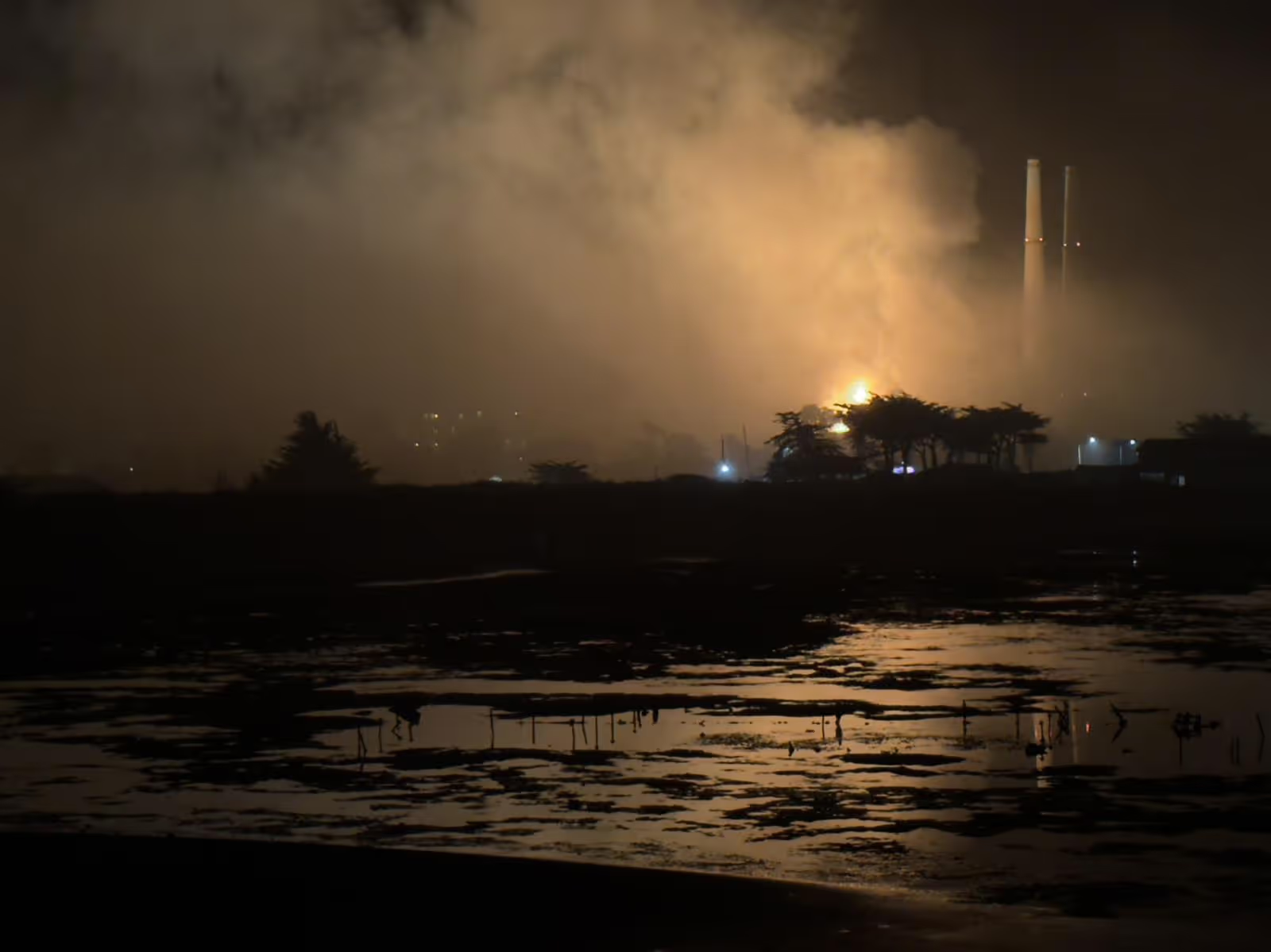
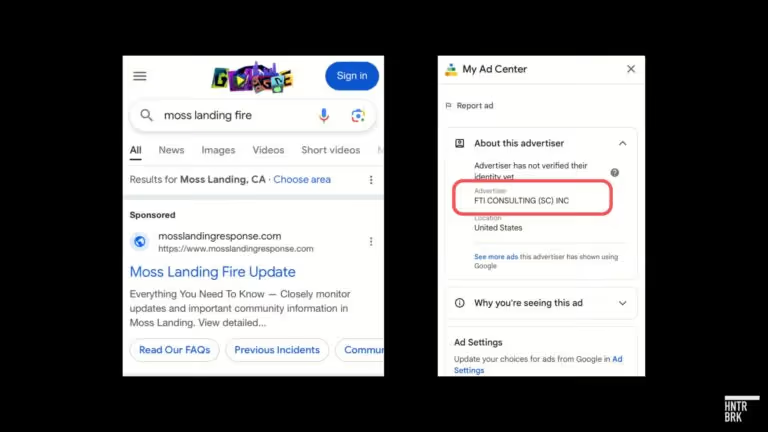
When a Hunterbrook Media reporter googled “Moss Landing fire” in the wake of an inferno at one of the largest battery facilities in the world, the first result he saw wasn’t news about evacuation orders or health warnings. It wasn’t the county’s emergency response page with safety information for the 1,200 people forced to flee their homes. Instead, it was a sponsored link to mosslandingresponse.com — a Vistra corporate website.
Google’s transparency data reveals the ad was purchased by “FTI CONSULTING (SC) INC,” a global crisis management firm with a documented history of running bizarre, sophisticated influence campaigns for fossil fuel companies.
The ad directs concerned citizens to a company-controlled narrative about the January 16 fire at Vistra’s Moss Landing battery storage facility — a fire that burned for two days, sent toxic smoke inland, and has left residents reporting serious health problems that mirror those experienced in other environmental disasters like the train derailment in East Palestine, Ohio.
The Vistra (NYSE: VST) response website prominently features corporate bromides about “lighting up lives” and “powering a better way forward.” It also selectively addresses community concerns, emphasizing EPA air quality findings that “no hazardous substances were found in the air during the event” and highlighting a Marina Coast Water District statement that “Our Water Supply Remains Safe.”
Yet the site only glancingly mentions the soil contamination that scientists have now documented — claiming not to have “received details about their findings or data” — despite researchers allegedly having found “unusually high concentrations of heavy-metal nanoparticles” in nearby marsh soils, which may partly explain the wave of illness that has followed the fire.
More than 3,000 members have joined a Facebook group where Moss Landing residents are documenting symptoms ranging from burning eyes and sore throats to headaches and nosebleeds. And locals from Marina to Prunedale who spoke to Hunterbrook have reported their sickness disappears when they leave the area — only to return when they come home.
“$750 will not bring back our health!”
How do you quantify the damage the fire did to Teresa Villaruz, a cancer survivor who told Hunterbrook she worries about “the lasting effect of the toxins in our air and our water and in our farmlands as well?” Or to Marcy Castro, who told Hunterbrook that she had to keep her nine-year-old daughter with asthma home from school? Or to the farms across the “Salad Bowl Region,” which produce billions worth of lettuce, broccoli, and other vegetables sold across the country — food some residents claim they are now afraid to consume?
At this point, just weeks after the fire, with tests still pending, it’s hard to know.
But for now, Vistra is hoping the answer is $750, depending on where you live.
Earlier this week, Vistra announced it has established a $450,000 fund offering gift cards to evacuated households — each worth $750 — the kind of idea you could imagine a firm like FTI proposing.
But Moss Landing residents appear unsatisfied.
“$750 will not bring back our health!” wrote one resident in the Facebook group. Another pointed out the battery fire had occurred “right next to a marine sanctuary, an important estuary for bird migration, an important fishing and tourist whale/otter watching port, and the most important agricultural fields in the nation,” asking how, exactly, the gift cards would cover the potential damage to these environmental landmarks.
“What a slap in the face,” another resident commented. Additional remarks criticized restrictive eligibility criteria for the gift cards, such as one user noting that, “There are a lot of sick people just outside the evacuation zone and farther away.”
“Seriously, a gift card for being poisoned,” lamented another.
Vistra’s approach has particularly angered residents outside the official evacuation zone who report similar health issues but do not qualify for the $750 payoff. “Look how carefully they zoomed in to eliminate the farm fields, birds, otter rafts and houses here. You’d think that this catastrophe happened in one of those ‘Bowman Texas’ type industrial areas,” wrote one resident.
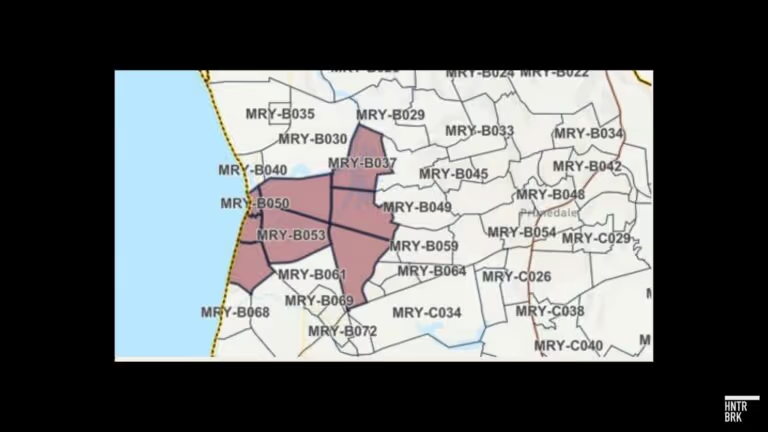
“What about families that evacuated and incurred costs because they knew the Monterey Bay Air Resource District did not have the resources to provide adequate air sensors for a disaster like this?” asked another.
“This is an insulting joke.”
Fake Facebook Profiles, Astroturf Websites, and an Alleged History of Corporate Crisis Management for Fossil Fuel Companies
FTI Consulting Inc.’s (NYSE: $FCN) involvement in Vistra’s response fits a pattern documented in a 2020 New York Times investigation that revealed how the consulting giant has shaped public perception of environmental disasters and controversies. According to the Times investigation, FTI’s playbook includes creating and staffing seemingly independent websites, monitoring environmental activists, and developing strategies to influence public discourse.
The firm’s tactics, as revealed by the Times, have included creating fake social media personas to track protesters, running numerous “local” and “grass-roots” organizations that were actually industry-funded, and staffing “news and information sites” that published pro-industry content with direction from major energy companies. In one instance, FTI allegedly created a fake Facebook profile to monitor environmental activists who were protesting a drilling project — complete with preferences for ice cream and a “local farmers’ market.”
Asked whether it has infiltrated the Moss Landing Facebook group, FTI declined to comment, citing a policy not to comment on “client engagements.”
The Times also found that the firm helped run at least 15 distinct “influence campaigns promoting fossil-fuel interests” while making them appear to be independent local movements. The firm staffed supposedly independent news sites like “Energy In Depth” and “Western Wire,” which published pro-industry articles on contentious issues while receiving direction from energy companies.
In a statement to the Times in response to their investigation, a spokesperson said: “We summarily reject as false, misleading and defamatory the general narrative and specific claims,” adding that FTI holds itself “to the highest professional and ethical standards of conduct.” The spokesperson also claimed that “when and where shortfalls are identified in this regard, they are addressed appropriately.”
On the surface, Vistra may seem out of step with FTI’s past clients — as a company branding itself as part of the clean energy future. And California’s Democratic Governor Gavin Newsom’s administration has made battery storage facilities like Moss Landing a centerpiece of its climate strategy.
But Vistra’s portfolio extends well beyond battery storage. In a paragraph at the bottom of the sponsored webpage, Vistra notes its “diverse portfolio” of energy generation, which includes “natural gas” and “coal.”
Sam Koppelman is a New York Times best-selling author who has written books with former United States Attorney General Eric Holder and former United States Acting Solicitor General Neal Katyal. He helped build Fenway Strategies into one of the preeminent strategic communications firms in the country—with side quests speechwriting for Michael Bloomberg, running the surrogate remarks operation on the Biden-Harris campaign, and co-founding Mayday, which is now one of the leading information providers on how to access reproductive health care in states with bans. Sam has published in the New York Times, Washington Post, Boston Globe, Time Magazine, and other outlets — and occasionally volunteers on a fire speech for a good cause. He has a BA in Government from Harvard, where he was named a John Harvard Scholar and wrote op-eds like “Shut Down Harvard Football,” which he tells us were great for his social life.
Michelle Cera trained as a sociologist specializing in digital ethnography and pedagogy. She completed her PhD in Sociology at New York University, building on her Bachelor of Arts degree with Highest Honors from the University of California, Berkeley. She has also served as a Workshop Coordinator at NYU’s Anthropology and Sociology Departments, fostering interdisciplinary collaboration and innovative research methodologies.
Till Daldrup is an investigative journalist who joined Hunterbrook from The Wall Street Journal, where he focused on open-source investigations and content verification. In 2023, he was part of a team of reporters who won a Gerald Loeb Award for an investigation that revealed how Russia is stealing grain from occupied parts of Ukraine. He has an M.A. in Journalism from New York University and a B.S. in Social Sciences from University of Cologne. He’s also an alum of the Cologne School of Journalism (Kölner Journalistenschule).
Wendy Nardi joined Hunterbrook after working as a developmental and copy editor for academic publishers, government agencies, Fortune 500 companies, and international scholars. She has been a researcher and writer for documentary series and a regular contributor to The Boston Globe. Her other publications range from magazine features to fiction in literary journals. She has an M.A. in Philosophy from Columbia University and a B.A. in English from the University of Virginia.