Hunterbrook Media’s investment affiliate, Hunterbrook Capital, did not take any positions related to this article. Hunterbrook Media has partnered with litigation firms exploring a potential class action lawsuit based on our reporting. If you have experienced frame failure, we invite you to share your story by emailing ideas@hntrbrk.com. See full disclosures below.
The United States National Highway Traffic Safety Administration has launched an investigation into potential safety defects in RVs made by Winnebago Industries Inc. (NYSE: $WGO) following widespread reports of serious frame failures in its popular Grand Design models.
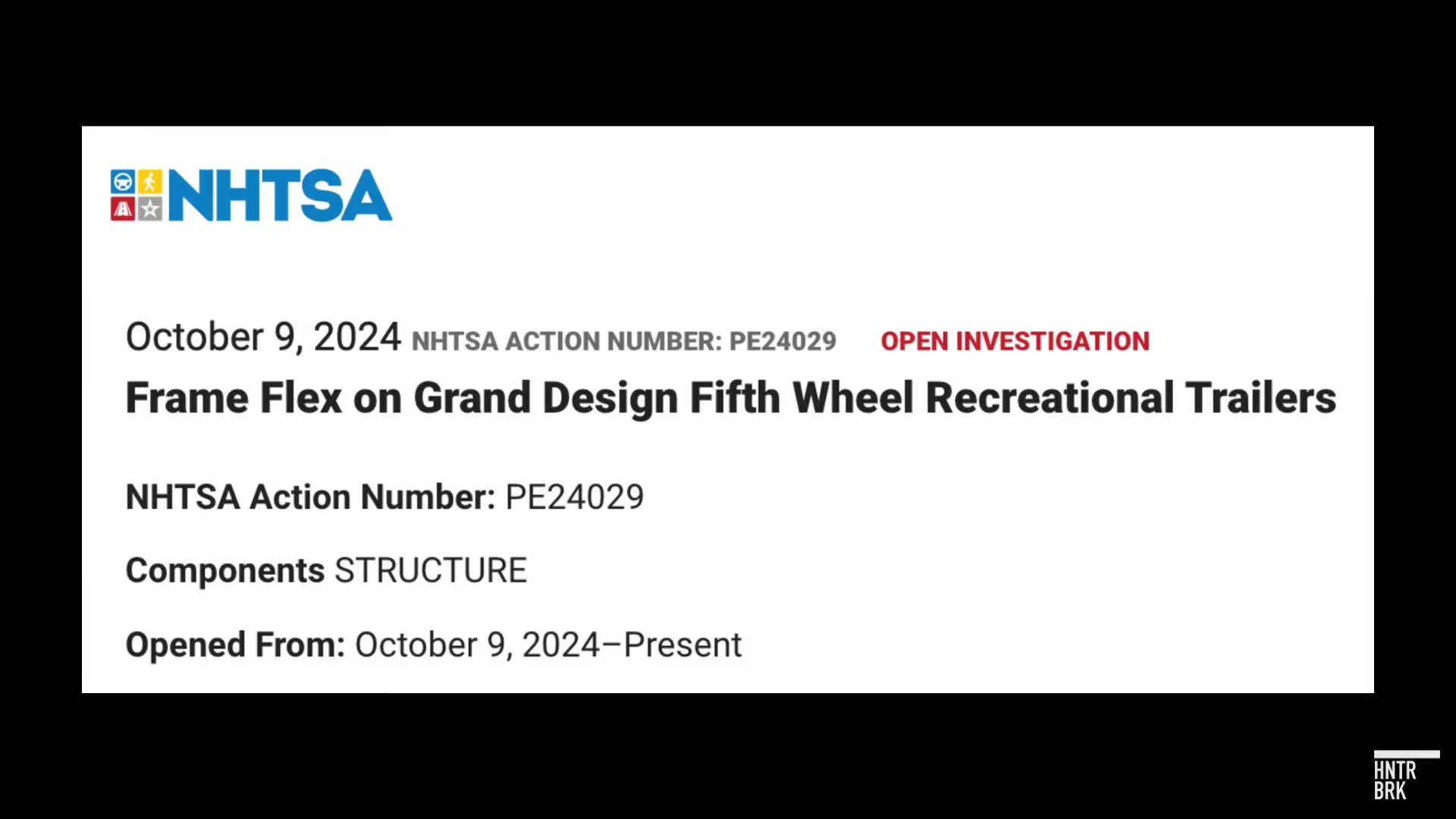
The investigation — opened on October 9, 2024 — covers a total of 55,887 Momentum and Solitude fifth wheel recreational trailers manufactured between 2017 and 2023, the NHTSA stated.1
According to the NHTSA documents, the agency has received 23 complaints about frame flex issues on the two models, with 22 cases reporting cargo or entry doors opening during transit — sometimes launching objects onto roadways. The NHTSA so far has recorded one incident involving an injury, according to the documents. The investigation aims to evaluate whether these problems pose “an unreasonable risk to motor vehicle safety.”
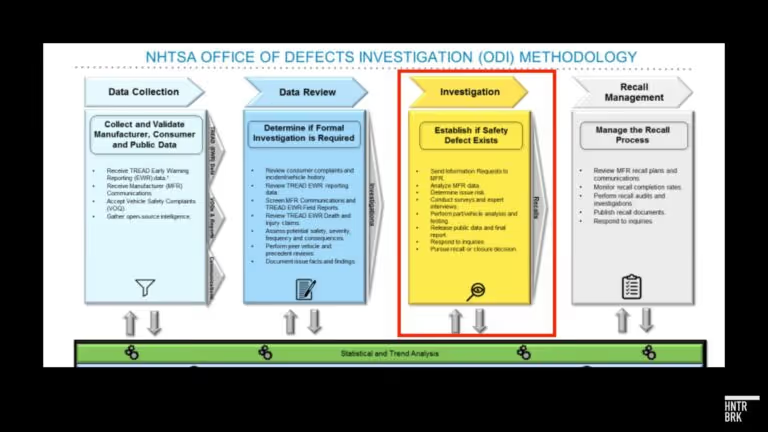
The NHTSA investigation marks a significant escalation in scrutiny of what RV owners and industry experts have long claimed was a serious safety issue. According to the NHTSA’s publicly available documents, an “investigation” is the last step — after data collection and review have already been completed to determine there is “sufficient evidence of potential safety-related defect” — before the agency decides whether or not a recall is necessary.
The Momentum and Solitude RVs are Winnebago’s premium towable models, popular among full-time RVers, who often invest their life savings in what Grand Design marketed as units specifically designed for extended stay use.
This federal investigation follows Hunterbrook Media’s September 23 report detailing the frame flex issue, including that Winnebago had allegedly used nondisclosure agreements and buybacks to silence customers reporting frame failures in their Grand Design RVs.
Hunterbrook’s investigation found that the company’s best-selling Grand Design division, which accounts for approximately 35% of Winnebago’s total revenue, was experiencing what appeared to be widespread structural defects in the RVs that rendered many of the vehicles unsafe to tow.
Earlier this year, Winnebago CEO Michael Happe dismissed concerns about excessive frame flex as “misinformation” during an earnings call, claiming it affected “less than 1% of all RVs” produced by Grand Design.
But independent RV specialists interviewed by Hunterbrook suggested the problem was far more prevalent than Winnebago acknowledged. One repair shop owner reported that 70% of Grand Design RVs inspected at his facility showed frame issues, while a certified welder and retired structural stress analysis engineer found frame failures in all 10 Grand Design RVs he examined at various campsites.
Warranty claims paid by Winnebago have also soared — increasing by 290% between 2017 and 2024, according to the company’s 10-K filings with the SEC.
In the company’s most recent earnings call a month after Hunterbrook’s article was published, a Winnebago executive cited “higher warranty expense” due to “elevated quality issues” as a reason for missing guidance — though he blamed the company’s Winnebago-branded Towable business, rather than Grand Design, for the inflated costs.
The same quarter as those disappointing earnings, Punch Card Management LP, a major Winnebago investor, reduced its position in the company by more than 50%, according to a November 13-F filing with the SEC.
The NHTSA notice also touched on another question at the core of Hunterbrook’s investigation: whether Grand Design or Lippert Components Inc., the manufacturer of the frames, is responsible for the defect. “While Lippert provides frames for multiple trailer manufacturers, the majority of complaints are for these Grand Design products,” wrote the NHTSA.
The agency also cited a disagreement between Grand Design and Lippert. According to the NHTSA, Grand Design claims frame flex is “only occurring in the upper deck area” and “resulting in cosmetic defects.” Lippert, by contrast, “believes that the effects of frame failure may also extend back to the front axle of the trailer,” which, if true, would represent a more serious structural problem.
Greg Carson, a former Grand Design owner who had reportedly signed an NDA with the company, has been digging into which company is to blame on his YouTube channel, Cruzin With The Carsons.
In a video posted earlier this month, Carson said he had spoken with multiple sources from the industry, all of whom told him with “100% accuracy” that Winnebago supplied Lippert with designs for its frames. “Lippert then turns around and builds the frame to that manufacturer’s specifications,” Carson said.
He went on to post a recording of an alleged conversation with an “industry insider” who is still currently employed directly with “Indiana,” where Grand Design is based. He called it a “bombshell.” And, if true, it is.
According to the source, Lippert had told Winnebago that the designs for its frames would not support “the weight the unit needs” and weren’t “to Lippert’s standards.”
“They went ahead and just built the frame the way they wanted to even though Lippert informed them they shouldn’t do that?” Carson asked.
“Yes,” said the industry source.
If the investigation leads to a recall, it could potentially affect thousands of units sold for billions of dollars, according to Hunterbrook’s analysis.
A Winnebago spokesperson declined to comment on the NHTSA investigation. Lippert did not respond as of the time of this publication.
Sam Koppelman is a New York Times best-selling author who has written books with former United States Attorney General Eric Holder and former United States Acting Solicitor General Neal Katyal. He helped build Fenway Strategies into one of the preeminent strategic communications firms in the country—with side quests speechwriting for Michael Bloomberg, running the surrogate remarks operation on the Biden-Harris campaign, and co-founding Mayday, which is now one of the leading information providers on how to access reproductive health care in states with bans. Sam has published in the New York Times, Washington Post, Boston Globe, Time Magazine, and other outlets — and occasionally volunteers on a fire speech for a good cause. He has a BA in Government from Harvard, where he was named a John Harvard Scholar and wrote op-eds like “Shut Down Harvard Football,” which he tells us were great for his social life.
Jenny Ahn joined Hunterbrook after serving many years as a senior analyst in the US government. She is a seasoned geopolitical expert with a particular focus on the Asia-Pacific and has diverse overseas experience. She has an M.A. in International Affairs from Yale and a B.S. in International Relations from Stanford. Jenny is based in Virginia.