Hunterbrook Media’s investment affiliate, Hunterbrook Capital, does not have any positions related to this article at the time of publication. Positions may change at any time. Full disclosures below.
“This water for Tsumeb is dirty,” Nikasuis Shifeleni, a former employee of a Namibian copper smelter owned by Canadian miner Dundee Precious Metals (TSX: $DPM), told Hunterbrook Media. “The poor people with no money are drinking this water. It’s a big problem.”
Engelbrecht A. Nawatiseb, a former mayor of Tsumeb and cabinet official of Namibia, shared a similar perspective. “There are elements of arsenic contamination in the water,” he said in an interview. “It has been scientifically proven.”
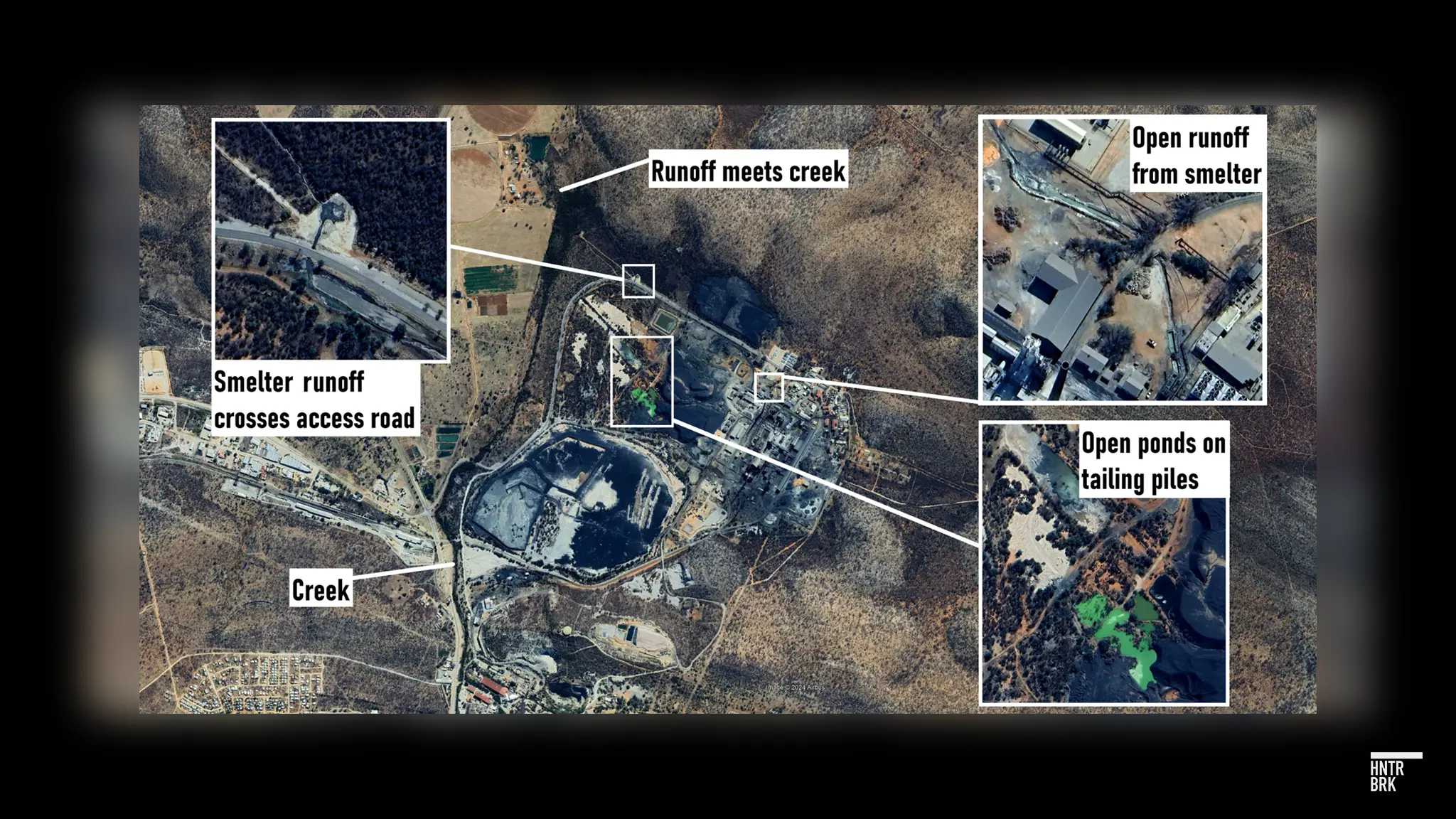
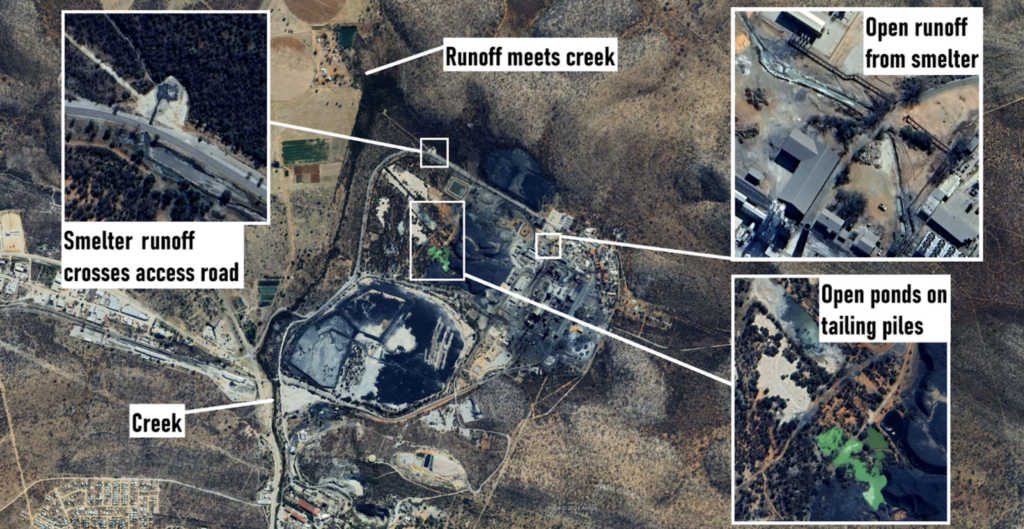
Satellite imagery of the smelter obtained by Hunterbrook Media appears to show uncontained runoff from Dundee’s facility flowing into the local water system.
Multiple conversations with Dundee employees, present and former, revealed what they described to Hunterbrook Media to be dangerous working conditions. Last year, as many as 48 employees were hospitalized, according to local news outlets. The smelter employs just under 800 people.
Earlier this year, Dundee announced a deal to sell the facility, which it purchased in 2010, to the Chinese mining company Sinomine Resource Group (SHE: 002738) for $49 million. But before the sale is finalized, Tsumeb residents are calling on Dundee to assess — and potentially answer for — the environmental and health damage they say the company has brought to their community.
A 2017 government audit of the facility — which reportedly involved the Namibian government and the United Nations — has never been published or shared with the municipality, Tsumeb Municipality Strategic Liaison Officer Stella Imalwa told Hunterbrook Media. The Ministry of Environment has not provided a comment in response to Hunterbrook Media’s questions about the report and why it has not been made public.1
The most recent comprehensive assessment of the facility’s impact on Tsumeb was released in 2019.
That report, commissioned by Dundee to justify an expansion at the smelter, found that there had been “continuous improvement” due to the company’s efforts to modernize the smelter. But it also stated that Tsumeb community members faced “systemic overexposure” to arsenic and “significantly more prevalent” exposure to another pollutant, sulfur dioxide, than residents of a similar town without a smelter.
In a presentation to the community, Dundee said that its planned production increases could lead to “exceedance of annual criteria” for sulfur dioxide levels, adding that “ambient arsenic levels could potentially increase.”
Since 2022, Tsumeb has issued boil notices due to concerns regarding bacteria in the town’s water. While the bacteria risk appears to be separate from Dundee’s operations, boiling water would increase the concentration of any arsenic present.
Ahead of the deal with Sinomine closing, Tsumeb residents interviewed by Hunterbrook Media are calling for a new, independent audit, paid for by Dundee, with the goal of measuring the impact the miner’s operations have had on Tsumeb.
“Before Dundee exits, we want all the Tsumeb residents to be subjected… to a medical examination so that we can know about our status before they leave,” Nawatiseb, the former Tsumeb mayor, said.
Asked whether it would conduct a new audit, Dundee told Hunterbrook Media: “A community health survey was conducted in the fourth quarter of 2023 by an independent health consultant, the results of which are currently being finalized.”
Dundee did not specify whether the results would be shared before the sale to Sinomine is finalized.
Sinomine, for its part, said in a statement that it would adhere to Namibian and international law in its operations of the facility.
Dundee’s tailings leak appears to persist, as do complaints about water quality
Tsumeb is a small mining town, bordered by farmland. The smelter, which purifies copper and produces sulphuric acid, has been plagued by allegations of questionable hazardous waste disposal practices, air quality issues, and water safety concerns.
When Dundee purchased the smelter in 2010, the mining town had high hopes. Dundee, which describes itself as “an environmentally and socially responsible gold mining company” on its website, operates the Chelopech and Ada Tepe mines in Bulgaria. It acquired the Tsumeb smelter after a Bulgarian court stymied the company’s plans to build a similar plant there, citing environmental and health concerns.
The copper concentrate Dundee produces in Tsumeb is sold into Asian and European markets where it is further refined. Copper has a number of broad applications in the global economy, from construction to manufacturing to transportation. Dundee’s sulphuric acid is sold to uranium and copper miners.
The industrial processes at the smelter also generate byproducts, including arsenic and sulfur dioxide, which have been linked to a variety of health conditions, from skin lesions to keratosis (skin hardening), and lung, kidney, and bladder cancer to aggravating conditions like asthma or bronchitis.
Dundee told Hunterbrook Media it is “very proud” of the “many environmental improvements achieved” by the company during its tenure owning the smelter. But Dundee has repeatedly faced complaints from the community, particularly regarding the alleged contamination of the water supply.
In line with findings from CEE Bankwatch Network, an anti-corruption nongovernmental organization, Andreas Pandereepo, a former union leader, alleged that hazardous material from Dundee’s smelter, including “arsenic bags” weighing more than 1,100 pounds, had been seeping into Tsumeb’s water system “underneath the surface.”
Dundee did not respond to Hunterbrook Media’s question about progress it has made toward its plan to improve its groundwater management but has disputed Bankwatch’s findings.
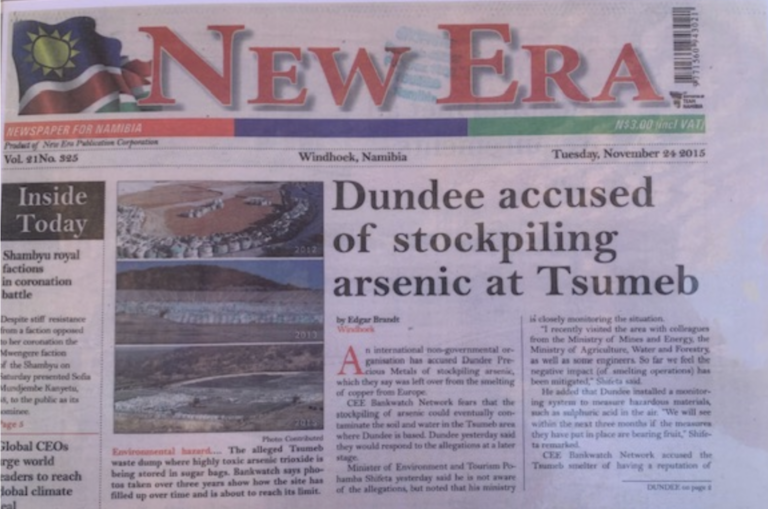
Company documents indicate the integrity of Dundee’s tailings dam — designed to contain waste produced as a byproduct of the smelter’s operations — has been compromised since 1997, with the company appearing to have failed to fully repair a leak.
The company provided no further clarity as to why their response plan had yet to adequately fix the tailings dam.
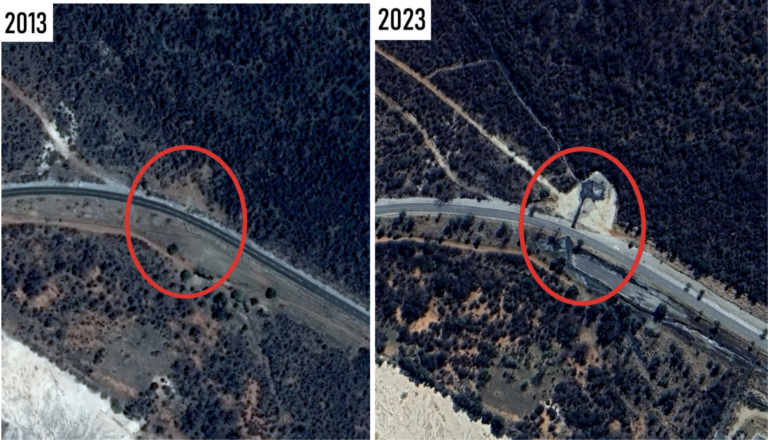
Satellite imagery of the smelter from the last 10 years appears to show runoff, particularly on the northern side of the smelter, from the facility itself and from waste containment ponds intended to prevent this type of release.
The imagery reflects signs of erosion from the runoff, indicating sustained flow, that seems to eventually make its way to a local creek, which would introduce any contaminants the wastewater contains into Tsumeb’s groundwater.
“Since acquiring the smelter in 2010, we have made significant investments to bring the tailings facility up to Namibian and international tailings standards,” Dundee told Hunterbrook Media, adding that third-party experts conducted “regular independent reviews and audits of the tailings facility.”
The 2019 report, however, found “a significant trend with small increases of arsenic in water levels the closer the residential area was to the smelter,” though levels remained below the World Health Organization’s limit.
Smelter has damaged the livelihoods of Dundee workers
The smelter, which was constructed in 1963, has been associated with hazardous working conditions — and pressure allegedly began to increase in 2022 after Dundee implemented a voluntary layoff that cut the workforce.
The remaining employees were often scheduled for 12-hour shifts, seven days a week, according to a company source who asked to stay anonymous out of fear of retribution. “Fatigue is obviously an issue, and whenever there is fatigue, there is always the risk of accidents,” he said. The facility operates 24/7.
The source said fatigue-related accidents often go unreported, “unless there is a major incident, there’s no choice, like a leg or arm amputation, and then they can’t hide that kind of thing.” He added that injured workers frequently do not report incidents due to fear of being blamed and accused of misconduct by the company.
In addition to accidents, sources familiar with the facility say workers also suffer from exposure to toxic chemicals. “The main exposure that is there at Dundee is … arsenic,” said one source with knowledge of the conditions at the smelter. “Arsenic irritates the skin; that is its main effect. If you get exposed to arsenic, particularly if you are sweating, you will get irritation.”
Employees onsite have also been exposed to bacteria, according to a company statement in the national paper, Windhoek Observer. A company spokesperson confirmed that some of its employees were being treated for “nausea and vomiting” at hospitals in August 2023, conceding: “In the handling of our onsite dispenser water, we provide to our employees, our controls were inadequate leading to our onsite water quality being out of specification for microbiology.”
But in a statement to Hunterbrook Media, Dundee cited a recent health report it claimed “does not support an allegation that ‘numerous’ employees were hospitalized.”
Dundee did not send the report.
In the long run, the people of Tsumeb will suffer. — Nico Kaiyamo, former member of parliament
Nico Kaiyamo, a former member of parliament, told Hunterbrook Media that the Namibian government should hold Dundee accountable for the toll its operations have taken on the local community and the environment before the sale is allowed.
“The rehabilitated tailings dam is not rehabilitated, and in the long run, the people of Tsumeb will suffer,” he said. “You are supposed to force Dundee to conduct an audit now before they exit. But is it going to be done?”
Nyasha Nyaungwa is an African media industry veteran with over 20 years of experience. Nyasha has gained first-hand knowledge of local, regional and international finance through his work as a Reuters correspondent, sub-editor of the Namibia Economist and news editor of the Windhoek Observer, among other publications. His interests span mining, energy, financial markets, politics and the environment with a strong focus on the Southern African region.
Daniel Sherwood contributed reporting. Sherwood joined Hunterbrook from The Capitol Forum, a premium subscription financial publication, where he was an Editor & Senior Correspondent, writing and managing market-moving investigative reports and building the Upstream database. Prior to The Capitol Forum, Daniel has experience conducting undercover investigations into fossil fuel companies and other research. He also served as an Honors Law Clerk in the Criminal Enforcement Division of the EPA. He has a JD from Michigan State University. Daniel is based in Michigan.
Sam Koppelman is a New York Times best-selling author who has written books with former United States Attorney General Eric Holder and former United States Acting Solicitor General Neal Katyal. He helped build Fenway Strategies into one of the preeminent strategic communications firms in the country—with side quests speechwriting for Michael Bloomberg, running the surrogate remarks operation on the Biden-Harris campaign, and co-founding Mayday, which is now one of the leading information providers on how to access reproductive health care in states with bans. Sam has published in the New York Times, Washington Post, Boston Globe, Time Magazine, and other outlets — and occasionally volunteers on a fire speech for a good cause. He has a BA in Government from Harvard, where he was named a John Harvard Scholar and wrote op-eds like “Shut Down Harvard Football,” which he tells us were great for his social life.