Based on Hunterbrook Media’s reporting, Hunterbrook Capital is long $GSM and $NOM at the time of publication. Positions may change at any time. See full disclosures below.
“The modern economy rests on a single road in Spruce Pine, North Carolina,” wrote Ethan Mollick, a professor of management at the University of Pennsylvania Wharton School and codirector of its Generative AI Labs, on March 9, 2024.
At the end of this inconspicuous road sit two mines that produce the vast majority of high-purity quartz (HPQ) that is indispensable to the global semiconductor industry.
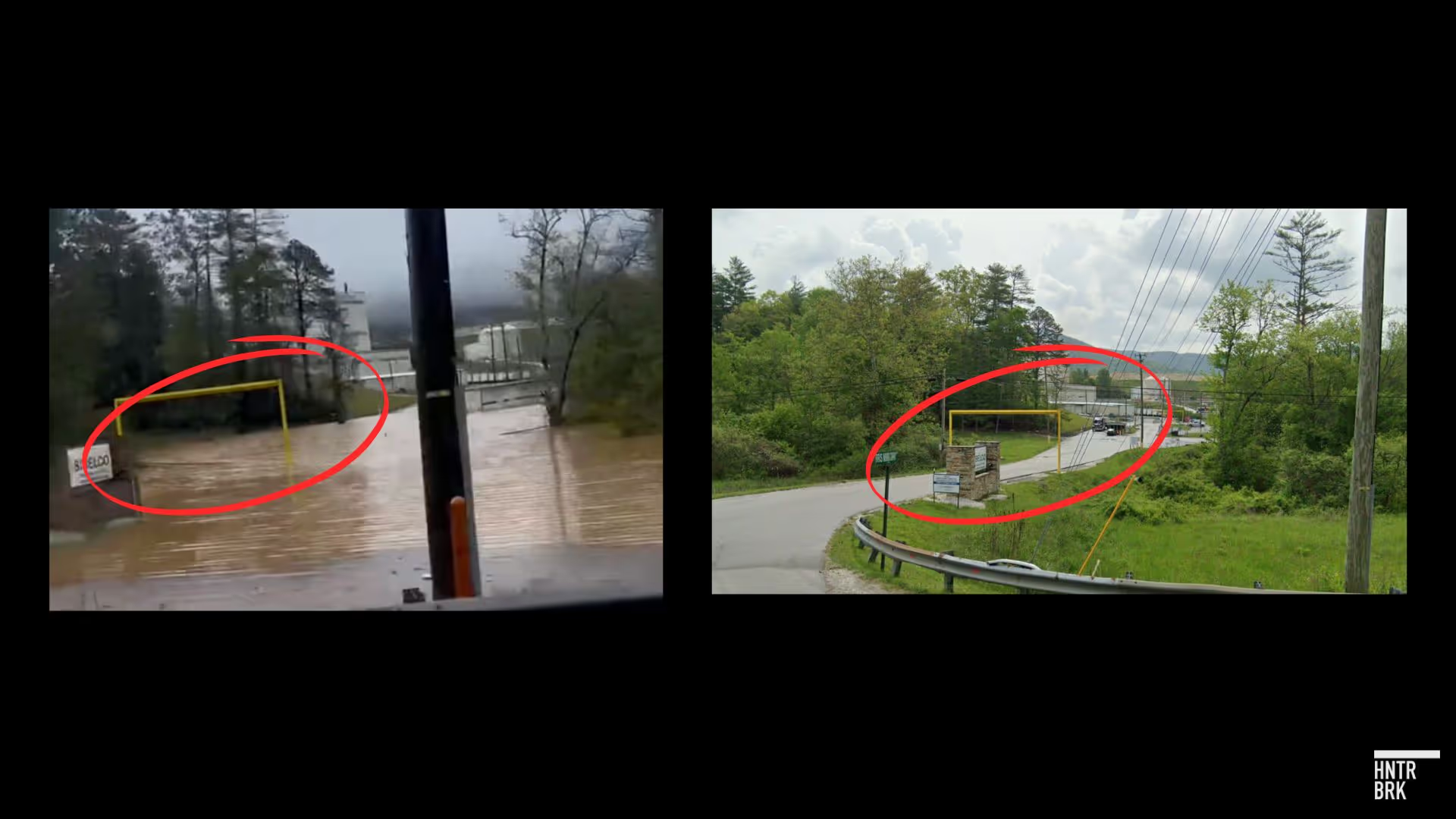
In the aftermath of Hurricane Helene, the horrific damage to the community appears to have extended to the roads and freight rail line connecting the mining operations to the outside world — according to images reviewed and geolocated by Hunterbrook Media.
One video posted to TikTok appeared to show the entrance to one of the structures of the mine — owned by SCR Sibelco NV (BSE: BE0944264663) — underwater, with a text overlay praying for the community.
In the video, a truck appears to be submerged.

In the Appalachian Mountains, the facilities in Spruce Pine supply between an estimated 70% and 90% of the mined and processed HPQ used in the electronics industry.
Although it is one of Earth’s most common minerals, quartz in its purest form — such as the white quartz in North Carolina — is much rarer. And pure quartz is a critical component for the production of the silicon wafers necessary for everything from your phone and computer to large language models and solar panels.
If the operations of the two major quartz miners in the region — Sibelco and The Quartz Corp. — are interrupted, experts have said, the consequences could be catastrophic.
“If you flew over the two mines in Spruce Pine with a crop duster loaded with a very particular powder, you could end the world’s production of semiconductors and solar panels within six months,” said an industry expert in the acclaimed book Material World by economist Ed Conway.
Conway claims this is because, “no high-purity quartz means no Czochralski crucibles, which means no monocrystalline silicon wafers, which means, well, the end of computer chip manufacture as we know it.”
A Hunterbrook reporter in North Carolina was unable to reach the government in Spruce Pine for comment because the cell signal is still down.
On September 27, the Town of Spruce Pine posted on its Facebook page, “Town Hall will not open today. Please pray for our police and public works personnel as they handle emergencies today.”
After publication, in a statement to Hunterbrook, Sibelco wrote that it has “temporarily halted operations at the Spruce Pine facilities in response to these challenges” since September 26th. The company said it had “confirmed the safety of most employees and are working diligently to contact those still unreachable due to ongoing power outages and communication challenges,” adding that its ” top priority remains the health, safety, and well-being of our employees, as well as ensuring the security of the Spruce Pine facility.”
Serious damage to roads, freight rail near quartz facilities
Quartz companies in the region “have used a mix of freight rail and trucking for shipments,” according to a 2017 economic analysis prepared for the North Carolina government.
Hunterbrook’s review of imagery indicates the mine is now cut off by rail from both the north and south, with multiple washouts and catastrophic damage to CSX’s Blue Ridge line north of Spruce Pine.

Images captured closer to the mine confirm that damage along the river was severe, with long segments of railway — more than a thousand feet long — washed out.
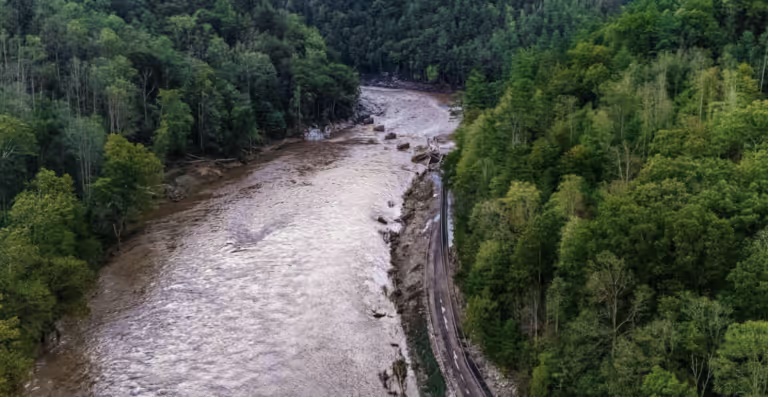
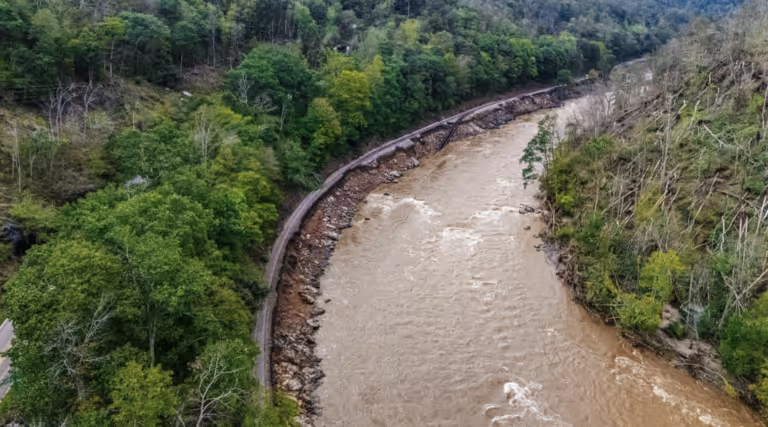
CSX, the company that operates the rail system, issued a customer advisory on September 29 — stating that Spruce Pine was “experiencing significant flooding and bridge damage, leading to a major outage.”
A local trainspotter reports that “over 30 miles of CSX’s Blue Ridge [rail line] has been washed away,” adding that “it’s almost unrecognizable.”
The roads are largely blocked, too, according to a Facebook post from local Matthew Pate. “The amount of damage is beyond words,” he said, adding that he had stopped along the highway to “help locals clear some of the debris.”
“I asked when they expected power to be restored. They told us it normally takes a month,” he wrote.
More than 100 power lines in Spruce Pine are down with many residents and businesses still without electricity, according to the regional electricity provider Duke Energy’s website and posts on the ground. Duke has said certain areas were so badly hit, “we’re going to have to completely rebuild parts of our system.”
Due to recent supply chain pressures, lead times for replacement grid components have skyrocketed. On average, transformer lead times currently sit at 120 weeks.
Operations shrouded in secrecy
Exactly how much HPQ is produced — and shipped out — by these mines is not publicly known. Seaver Wang, codirector of climate and energy for The Breakthrough Institute, called it a “guarded secret” earlier this year.
Vikram Sekar, a senior staff engineer at semiconductor giant Qualcomm, has shared a similar perspective about the secrecy of Sibelco and its former subsidiary Unimin, writing that little is known about “Semiconductor’s Wonka” factory.
“They do not publicize how much high purity quartz is produced from the facility each year. They have contractors sign confidentiality agreements to enter the facility and ensure that the work is spread out between different contractors, so that no one entity knows too much. They even filed a lawsuit against” a former employee who joined a competitor five years after he had left Uninim, noted Sekar.
In an interview with Hunterbrook, Sekar said that it’s hard to know what kind of damage this hurricane will have — because of the lack of public information about the company. But, he says, he assumes that “if there’s only going to be transportation delays, I think we’d recover pretty quickly.” He said his understanding is that companies in the industry have stockpiles of HPQ.
Asked whether the storm had impacted operations, Sibelco did not immediately respond to Hunterbrook’s request for comment. In a statement to The Verge, which reported on this story earlier today, The Quartz Corp, another company in the region, said: “We are in a phase of assessing the situation and it is far too early to comment on the impact to high purity quartz production.”
Yinan Wang, a geologist at Rensselaer Polytechnic Institute, told Hunterbrook that even if other high-quality quartz mines were found elsewhere in the near future, it would take several months to build the kind of facility necessary to refine the material.
“There’s an entire procedure or process you need to do,” Wang said. “All of this is closely guarded secrets by Sibelco, who owns the mine.”
Wang said he feared a “future global economic disaster” if the facility in Spruce Pine is severely damaged. “All semiconductor production may grind to a halt in six months,” he posted on X. “The entire world’s economy depends on Spruce Pine.”
Although Spruce Pine is responsible for the vast majority of high performance quartz, several other companies have begun or plan to begin mining the material.
Jiangsu Pacific Quartz Co., Ltd. (SHA: 603688) produces HPQ in China. Earlier this year, state legislators evaluated North Carolina House Bill 385, which could ban ownership of local quartz mines by foreign entities from countries designated as adversarial to the U.S., such as China.
Other projects at various stages of exploration and development span the globe, including in Norway, Brazil, Canada, Sri Lanka, and Australia.
In South Carolina, the silicon supplier Ferroglobe Plc (NASDAQ: GSM) last year announced that it would begin production of HPQ “in the second half” of 2024, claiming capacity to produce more than 300,000 tons of HPQ per year. Ferroglobe acquired the HPQ mine in October 2023.
As of the publication of this article, Ferroglobe had not announced the production or sale of any HPQ from the South Carolina mine.
Ben Rappaport is a reporter based in North Carolina. He has previous experience at outlets across the state including the Chatham News + Record and the Border Belt Independent. A proud graduate of the Hussman School of Journalism & Media at the University of North Carolina at Chapel Hill, Ben’s previous coverage has focused on education, politics and rural communities.
Blake Spendley joined Hunterbrook from the Center for Naval Analyses (CNA), where he led investigations as a Research Specialist for the Marine Corps and US Navy. He built and owns the leading open-source intelligence (OSINT) account on X/Twitter, called @OSINTTechnical (over 1 million followers), which also distributes Hunterbrook Media reporting. His OSINT research has been published in Bloomberg, the Wall Street Journal, and The Economist, among other top business outlets. He has a B.A. in Political Science from USC.
Daniel Sherwood contributed reporting. Sherwood joined Hunterbrook from The Capitol Forum, a premium subscription financial publication, where he was an Editor & Senior Correspondent, writing and managing market-moving investigative reports and building the Upstream database. Prior to The Capitol Forum, Daniel has experience conducting undercover investigations into fossil fuel companies and other research. He also served as an Honors Law Clerk in the Criminal Enforcement Division of the EPA. He has a JD from Michigan State University. Daniel is based in Michigan.
Sam Koppelman is a New York Times best-selling author who has written books with former United States Attorney General Eric Holder and former United States Acting Solicitor General Neal Katyal. He helped build Fenway Strategies into one of the preeminent strategic communications firms in the country—with side quests speechwriting for Michael Bloomberg, running the surrogate remarks operation on the Biden-Harris campaign, and co-founding Mayday, which is now one of the leading information providers on how to access reproductive health care in states with bans. Sam has published in the New York Times, Washington Post, Boston Globe, Time Magazine, and other outlets — and occasionally volunteers on a fire speech for a good cause. He has a BA in Government from Harvard, where he was named a John Harvard Scholar and wrote op-eds like “Shut Down Harvard Football,” which he tells us were great for his social life.
Jim Impoco is the award-winning former editor-in-chief of Newsweek who returned the publication to print in 2014. Before that, he was executive editor at Thomson Reuters Digital, Sunday Business Editor at The New York Times, and Assistant Managing Editor at Fortune. Jim, who started his journalism career as a Tokyo-based reporter for The Associated Press and U.S. News & World Report, has a Master’s in Chinese and Japanese History from the University of California at Berkeley.
Jim Impoco is the award-winning former editor-in-chief of Newsweek who returned the publication to print in 2014. Before that, he was executive editor at Thomson Reuters Digital, Sunday Business Editor at The New York Times, and Assistant Managing Editor at Fortune. Jim, who started his journalism career as a Tokyo-based reporter for The Associated Press and U.S. News & World Report, has a Master’s in Chinese and Japanese History from the University of California at Berkeley.