Hunterbrook Media’s investment affiliate, Hunterbrook Capital, does not have any positions related to this article at the time of publication. Positions may change at any time. Full disclosures below.
NUEVA OCEANIA, Peru — The Forest Stewardship Council touts itself as setting the “gold standard” of sustainability for the global timber and paper industries. If you’ve shopped at Ikea or Home Depot, you may have seen the FSC logo on your purchase. It’s a sign that the wood has been harvested responsibly, even if often sourced from emerging markets with weak governance.
Yet the FSC has given its imprimatur to logging in the remote, dense jungles of eastern Peru. The concession is in an area that is home to the Mashco Piro, a tribe of nomadic hunter-gatherers, whose extreme vulnerability is recognized and protected by international law.
Numbering some 750, the Mashco Piro are the largest group of indigenous peoples still living in voluntary isolation anywhere in the world, says Teresa Mayo, of Survival International, a UK-headquartered indigenous rights group.
The Mashco Piro have a right to be left uncontacted. But it is precisely their history of contact with outsiders — including the threat of the rampant slavery during the rubber boom of the late 19th century — that made them choose to retreat deeper into the vast rainforest.
“They’re so vulnerable. We’re the only ones protecting them,” said Julio Añez, a fisherman and boat builder from Nueva Oceania, a tiny indigenous village that is the only nearby settlement and receives occasional visits from the Mashco Piro — who, skittishly, from a distance, ask for food.
“If it wasn’t for us, no one would know what’s going on here,” added Añez, whose ancestors spoke a similar dialect of Yine, a language from the Arawak family, that the Mashco Piro speak today. “The logging company, damn, it’s lamentable that the state doesn’t sort this out.”
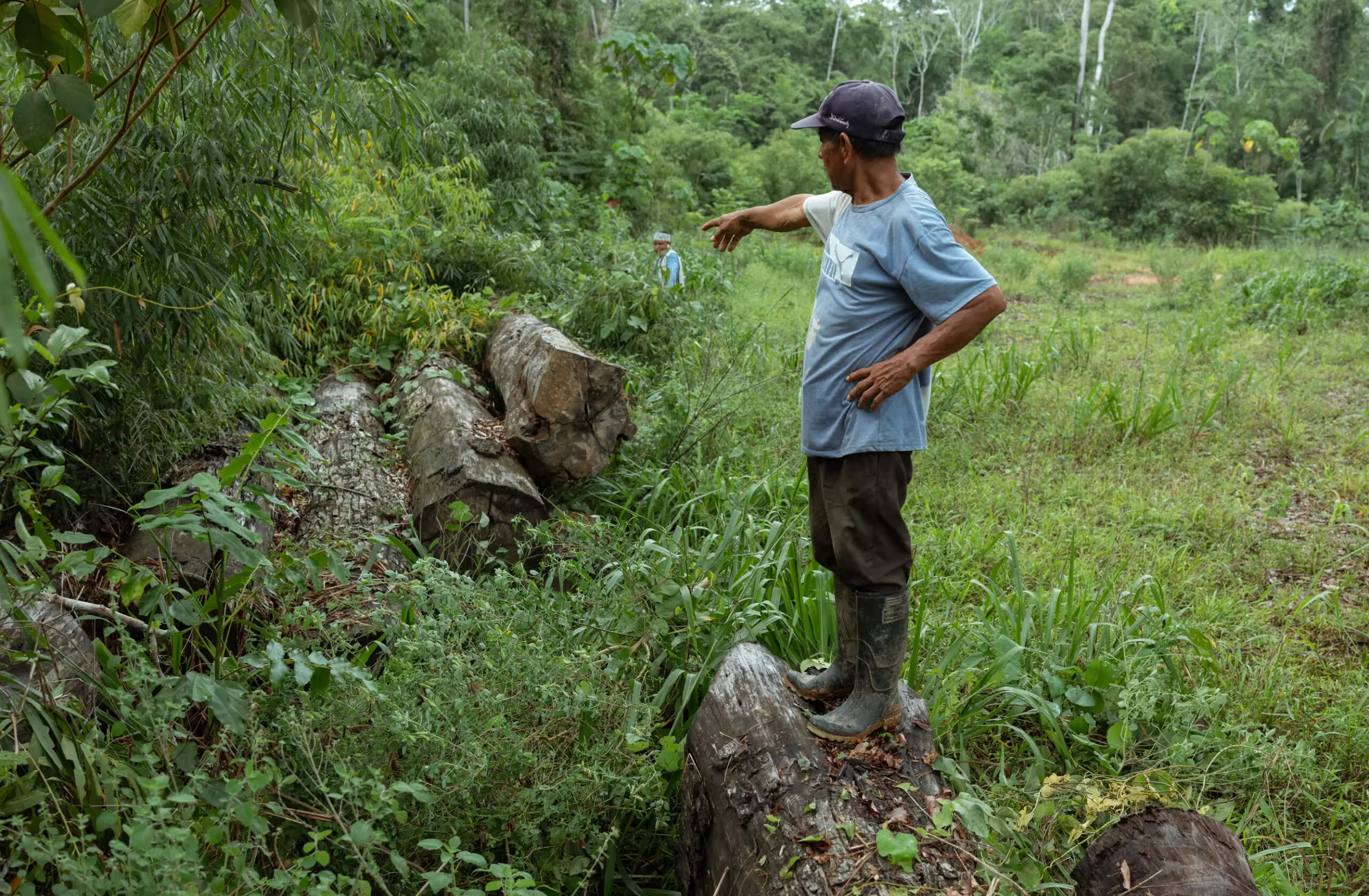
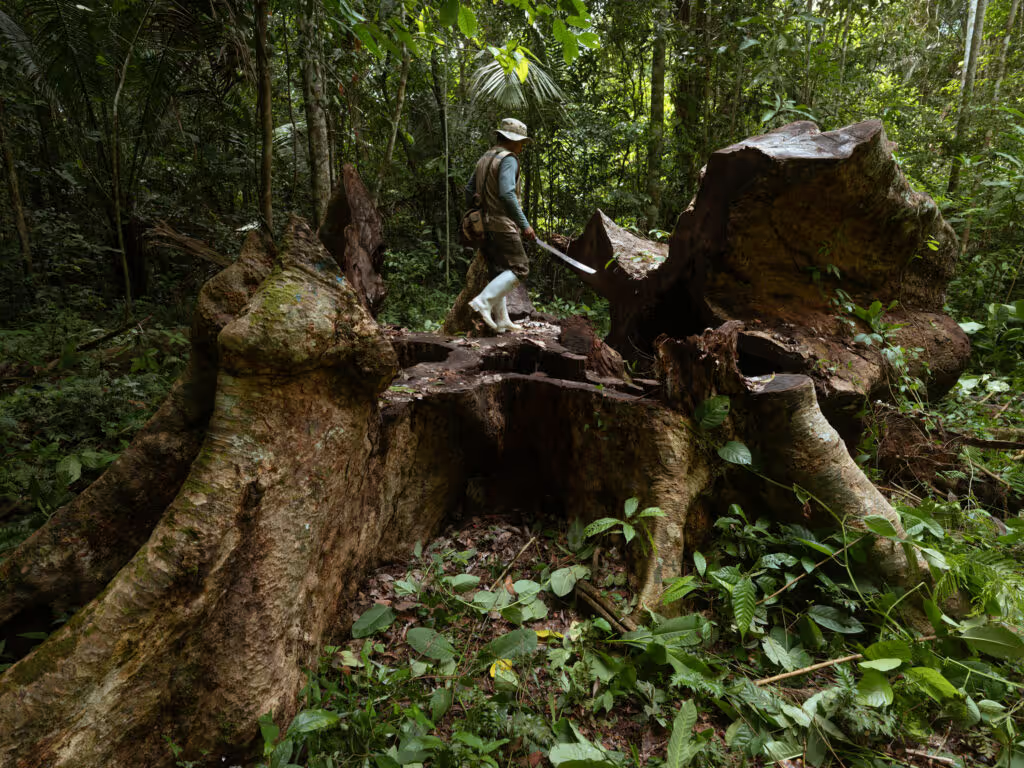
The company he is referring to is Maderera Canales Tahuamanu, or Catahua. As I reported in the Washington Post, it owns a legal timber concession covering about 50,000 hectares, including Nueva Oceania, across this verdant wilderness pushed up against the border with Brazil.
For more than a decade, Catahua’s trucks and heavy machinery have rumbled across the forest as its workers harvest the largest, oldest trees. In 2022, members of the tribe shot two Catahua workers with bows and arrows as they fished on the Tahuamanu River, killing one.
Catahua’s concession has also drawn the attention of six United Nations Special Rapporteurs, who wrote to Catahua in June 2023 asking it to suspend operations to avoid “possible forced contact.”
“They are going to defend themselves, as they have been doing for decades, centuries,” said Mayo in an interview with Hunterbrook Media, “like any of us would if someone came to destroy our home or take away our food, medicine, land, and way of life.”
How those workers came to be on that river is a complicated story. It begins with Catahua being granted its concession in 2002, as reported in The Washington Post, but the tale also involves the FSC — as journalist David Hill has written about — which in 2011 began certifying Catahua’s operations.
The FSC was founded in 1993 following the landmark Earth Summit of world leaders in Rio de Janeiro. Based in Bonn, Germany, the FSC brought together the private sector and environmentalists to “create a revolutionary market-based approach to improve forestry practices worldwide.”
The FSC now offers a series of voluntary certification schemes for loggers around the world. The FSC claims its label — which Catahua’s timber bears — means: “Local communities living in and around forest areas are consulted, and their legal and cultural rights to land and forest resources are respected.”
However, according to Survival International and other human rights experts, Catahua’s FSC-approved concession appears to be a flagrant violation of the Mashco Piros’ right to be left uncontacted unless they themselves initiate that contact. This right is enshrined in international legal guidelines that recognize self-imposed isolation as a denial of consent.
These unique rights, which only apply to indigenous peoples in voluntary isolation, are defined by the United Nations. The rights require states to establish protective reserves in areas frequented by such tribes, including buffer zones, to prevent even accidental contact, says Juanita Goebertus, Americas Director of Human Rights Watch.
When asked for an interview, the FSC said that none of its representatives were available. The organization did provide two written statements to Hunterbrook Media.
In the first, the FSC insisted it complied with international law regarding indigenous rights and “takes all allegations about the violation of [these rights] seriously.”
It also said that the FSC follows United Nations and Inter-American Commission on Human Rights standards “presuming non-consent for activities that interfere with the territory of Indigenous Peoples living in voluntary isolation.”
The statement added that it “did not find evidence that the Mashco Piro tribe is legally entitled to the concession … or are present there.”
In the second statement, responding to Hunterbrook Media’s follow up questions, the FSC said that it “has acknowledged the gaps in the National Forest Stewardship Standard for Peru and is actively revising it to … specifically address Indigenous Peoples’ rights to isolation and the necessity of respecting these right[s].”
In an interview, Yony Picchotito, a lawyer representing Catahua, said company workers had never sighted members of the Mashco Piro on its land. She also accused the villagers of Nueva Oceania — who Catahua claims are illegally occupying its concession — of presenting the real risk to the Mashco Piro.
“Who enters into contact with the Mashco Piro? A concessionaire who enters … to work three or four months or a group of people who live there? Who generates the most risk for the uncontacted?”
Survival International’s Mayo, meanwhile, called the FSC’s certification of Catahua’s operation a “scandal.”
“The Mashco Piro depend on their territory for survival. They understand themselves as part of the forest and they are going to protect it with their lives. If the logging continues razing their jungle, it is pushing them towards certain death.”
Simeon Tegel is a British freelance journalist based in Lima, Peru, from where he also regularly roams across Latin America. He specializes in environmental stories, democracy and human rights and is a regular contributor to the Washington Post, among other media. A foodie and outdoorsman, he would not be anywhere other than Peru.
Sam Koppelman is a New York Times best-selling author who has written books with former United States Attorney General Eric Holder and former United States Acting Solicitor General Neal Katyal. He helped build Fenway Strategies into one of the preeminent strategic communications firms in the country—with side quests speechwriting for Michael Bloomberg, running the surrogate remarks operation on the Biden-Harris campaign, and co-founding Mayday, which is now one of the leading information providers on how to access reproductive health care in states with bans. Sam has published in the New York Times, Washington Post, Boston Globe, Time Magazine, and other outlets — and occasionally volunteers on a fire speech for a good cause. He has a BA in Government from Harvard, where he was named a John Harvard Scholar and wrote op-eds like “Shut Down Harvard Football,” which he tells us were great for his social life.